A condo buyer in Phuket spends weeks comparing floor areas, views and instalment plans, yet rarely asks the question “does the building have the right to host tourists?” And that question determines whether your rental income will be lawful, stable and understandable to a future buyer. A hotel licence is not a piece of paper for the developer; it is the condition on which the entire condo-hotel model rests. Below we look at what it means, how it differs from ownership of a unit, how to verify it before the deal, what happens to projects without it and how it relates to yield and resale.
This material is informational and is not legal advice: rules and the practice of applying them change, and a specific project must be checked by a Thai lawyer.
Contents
- What a hotel licence is
- Licence and ownership: two different things
- Who needs a licence and who does not
- How a licensed condo-hotel works
- How to verify a licence before buying
- What happens to projects without a licence
- Licence, yield and resale
- Traps
- Mini case: two identical units
- Checklist and next step
1. What a hotel licence is
The basis of regulation is the Hotel Act B.E. 2547 (2004). The law defines a hotel as a place of temporary accommodation for a fee and requires such activity to be carried out under a licence. The key word here is activity: the law looks not at what the building is called, but at what happens inside it. If guests are in fact given overnight stays for money, that is a hotel business, even when there is no “hotel” sign.
The practical benchmark used by lawyers and officials is a stay of fewer than 30 days. Such a rental is treated as temporary accommodation. Stays of 30 days or more are usually treated as an ordinary residential lease. We covered the 30-day threshold and the risks of nightly letting in detail in the article Airbnb in Phuket: what is legal; here we concentrate on the licence itself and what it means for an investor.
What is worth keeping in mind from the very start:
- The licence is a permit for an activity, not for ownership. It does not pass automatically together with the apartment and does not belong to the unit owner.
- The licence is tied to a place and to a term: it is issued for a specific property and must be kept in force. “It once existed” is not an argument.
- A violation is not an administrative trifle: the Hotel Act provides liability for running a hotel without a licence, and in practice it also means guest bookings being stopped. Publications quote the specific fine amounts differently, so clarify them with a lawyer rather than from retellings.
Looking at the topic more broadly, the licence is one of three layers of a project’s legality, alongside the land documents and the construction permit. We covered the land layer in the materials on title verification and due diligence; the licence is the operational layer, and it is the one people remember last.
2. Licence and ownership: two different things
The most common confusion for a newcomer: “I bought an apartment, so I can do whatever I want with it.” Ownership and the right to operate are different regimes, and below they are separated point by point.
| Question | Ownership (chanote, contract) | Hotel licence |
|---|---|---|
| What it gives | The right to own and dispose of the unit | The right to host guests for a fee |
| Who holds it | You | The licensed operator |
| Where it is recorded | Department of Lands, sale and purchase agreement | Decision of local authorities under the Hotel Act |
| Can it be “bought with the apartment” | Yes, it passes on the deal | No, it stays with the operator |
| What happens if lost | Ownership does not disappear | Hosting guests has to stop |
| What to check | Title, encumbrances, quota | The licence, its term and its holder |
An unpleasant conclusion follows from the table: you can be the full owner of an apartment and still have no right to rent it out nightly. The Department of Lands (dol.go.th) registers property rights but does not issue permits for hotel activity; that is a separate branch of regulation. So “I have a chanote and a condo ownership certificate” does not answer the question “can I lawfully host tourists?”
A second conclusion follows: when you are told “everyone here rents through Airbnb,” that describes practice, not law. Practice changes; for example, in 2025–2026 the authorities repeated that nightly letting without a licence is illegal, as reported by Nation Thailand and Bangkok Post. By contrast, the legal status of a project with a licence does not depend on the practice of inspections.
3. Who needs a licence and who does not
The answer depends on who hosts guests and for what term.
| Scenario | Licence needed | Comment |
|---|---|---|
| Apartment for yourself, no letting | No | No licence is needed, but the building bylaws still apply |
| Annual lease | No | Standard contract, income reporting |
| Rental of 30 days or more (long-stay) | Usually no | The contract must be genuine, not a “slicing” of nights |
| Nightly letting by the owner in a residential building | Yes | This is exactly the situation the authorities treat as a violation |
| Condo-hotel with a management company | Yes, held by the operator | The licence and documents are on the project side |
| Your own small hotel | Yes | For a private investor this is already a business, not passive income |
Note the third row: the phrase “from 30 days” does not work as a loophole. If in fact guests stay three to five nights while the contract is drawn up for a month with early departure, this looks like circumvention of the rule. A comparison of the long-term and nightly models with occupancy figures is in the article short-term vs long-term rental in Phuket.
A separate note on the foreign owner. For such an owner the risk is not limited to the Hotel Act: illegal activity can complicate relations with the building juristic person, and immigration services take part in joint inspections. The calmest format is one where a licensed operator handles the guests and the owner receives a share of profit under a contract.
4. How a licensed condo-hotel works
A condo-hotel (condotel) is a format in which the units belong to different owners while guests are hosted by a single operator. We described the mechanics in detail in the article condotel: how it works; here what matters is the role of the licence in the chain.
- The developer builds the building with hotel operation in mind; this must be built into the design and permits.
- The management company obtains the right to run the hotel activity and hosts guests under its licence.
- Unit owners place their apartments in the rental pool and receive a share of net profit.
- Guests book through a single channel: platforms, direct sales, partners.
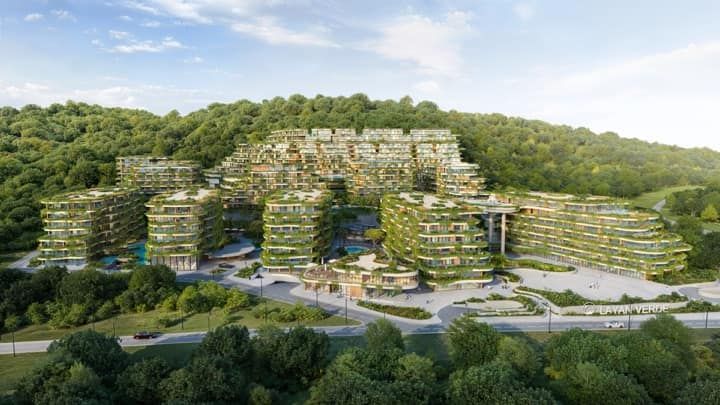
In Layan Verde and Layan Green Park this is a rental pool: the owner receives 60% of the pool net profit and the management company 40%. The yield benchmark is about 8–10% net per year; this is the programme target, not a guarantee. How costs and distribution are arranged is covered in the breakdown of the rental management programme, and the promises of “guaranteed yield” are covered in the article why yield guarantees are a red flag.
Now about the format itself. A condo-hotel exists not for the sake of a nice name: a licensed operator removes from the owner the part of the legal risk that would otherwise have to be carried personally. But this works only if the licence really exists and relates to your building. The word “hotel” in a project name has no legal force.
There is also a flip side. A condo-hotel is not a “pure apartment for yourself”: the unit works in a hotel model, and your own stay is limited by the programme terms. For Layan Green Park, the owner stay conditions (30 days a year in the May to October period) should be confirmed in the pool agreement, and the owner general costs, the CAM fee and the sinking fund, were covered in the article CAM fee and sinking fund.
5. How to verify a licence before buying
The check takes one or two working days and costs incomparably less than any mistake. The order of actions:
- Request a copy of the licence. Not a presentation and not a manager phrase, but the document: to whom it was issued, for which property, from what date and until what term it is valid.
- Match the licence holder name. It must match the operator that will rent out your unit and pay you your share. If the licence is issued to one company and the pool is run by another, you need to understand the link between them and see the agreement.
- Check the tie to the building and phase. Multi-phase projects bring blocks into operation in turn; a licence for the first phase does not automatically mean the right for the second. For a phase still under construction, ask how and when the operator plans to obtain the licence, and record this in writing.
- Verify the documents with the local administration. A lawyer can request confirmation from the body that keeps the register; this is the most reliable method.
- Read the pool agreement. It should state who is responsible for licences and permits, what happens if they are lost and how the owner money is returned.
- Request the house rules and the building bylaws. The operator licence does not cancel the rules of the building juristic person.
| Document | What it confirms | Red flag |
|---|---|---|
| Copy of the hotel licence | The operator right to host guests | No document, only “in progress” without deadlines |
| Management / pool agreement | Income distribution, responsibility | No clause on licences and permits |
| Construction permit and building use | That the building allows hotel operation | The building is registered as purely residential |
| Bylaws and house rules | Rules of the building juristic person | A ban on short stays despite “hotel” advertising |
| Pool reporting for past periods | Actual occupancy and payouts | Only forecasts without facts |
The last row matters for a phase that is already operating: at Layan Green Park phase 1 has been hosting guests since 2024, so pool reporting can be requested for real periods instead of reading a forecast. For Layan Verde, which is under construction (completion in December 2028), there is by definition no reporting yet; here the question of the licence and the operator should be fixed in the contract in advance. The general signs of an unreliable developer are collected in the article developer red flags.
6. What happens to projects without a licence
The topic has stopped being a formality. According to a chronicle confirmed by the press:
- 2025. The government repeated that nightly letting of condos without a licence is illegal, amid complaints from residents (Nation Thailand).
- Summer 2026. According to Bangkok Post, by 12 August the Ministry of Interior had approved 275 of 392 hotel licence applications that had accumulated since 2018. This shows that even for existing properties the path to lawful status is long.
- 29–30 July 2026. Phuket authorities inspected a condominium in the Wichit area after residents complained about nightly letting; the operator faces a case under Section 15 of the Hotel Act (The Thaiger).
- 26 September 2026. The deputy governor announced the suspension of five hotels without a licence after the 30-day period for correction expired; about 40 properties remain under review until October (Bangkok Post). A market review for that week is in the week 40 digest.
What follows for a buyer. First, the trend is one-directional: control is tightening. Second, sanctions are so far selective, but they hit not an abstract “market” but specific buildings and operators, and unit owners pay for them, losing their income. Third, we have no public statistics on the number of inspections and fines and do not quote “exact” risk percentages: any such figures in advertising should be treated as marketing.
What an owner actually loses if a project is stopped:
- Income. Until the operator puts the documents in order, guests cannot be hosted and the pool earns nothing.
- Liquidity. A resale buyer will price in the risk and demand a discount, or will not come at all.
- Nerves and costs. The CAM fee and mandatory payments keep coming even when there is no revenue.
7. Licence, yield and resale
The licence does not add percentage points to yield by itself, but it determines whether that yield can be relied on. The logic is simple: the expected ~8–10% net is a result on the condition that the operator hosts guests lawfully and continuously. Any downtime eats the income.
A comparison of three approaches to “nightly” income looks like this:
| Approach | Lawfulness of income | Stability | What the resale buyer sees |
|---|---|---|---|
| Licensed condo-hotel with a pool | Confirmed by documents | Higher: the operator is responsible for permits | Pool reporting, a clear contract |
| Nightly letting by the owner in a residential building | Formally a violation | Low: depends on complaints and inspections | A risk to be “subtracted” from the price |
| Long-stay from 30 days | Needs no licence | Medium: you must find tenants yourself | Real contracts and payments |
For resale this matters no less. Whoever buys your unit in two or three years will ask the same questions you ask today: is there a licence, to whom is it issued, what does the reporting show. A unit whose answers are in a folder sells faster. How to build an exit we described in the breakdown of exit strategies and in the article how to resell property in Phuket.
Now about entry prices, so the scale is clear. At the current price list, Layan Green Park phase 2 studios (completion in 2026) start from 7,424,784 THB ($224,043), and resale of studios in the ready phase 1 starts from 4,800,000 THB ($142,602); all phase 1 lots are resales. Layan Verde starts from 7,833,125 THB ($235,995). For those who want to see what this looks like in the area, see Layan and Bang Tao, and for the return calculation see the ROI block on the home page. At sums of this order the “paper” risk must definitely be checked.
8. Traps
- “Hotel” in the name. A sign is not a licence. Ask for the document.
- “Licence in progress.” Without a deadline and a responsible person this is not a status but a promise. If the phase has not yet been commissioned, record in the contract what happens if there is no licence on the launch date.
- A licence for someone else. The document may be issued to a structure that does not take your unit. Match the licence holder name with the pool operator.
- Another phase. A licence for the first phase does not extend to the one under construction.
- Building bylaws. Even with an operator licence, the rules of the building juristic person may impose restrictions on private letting.
- The seller “expert.” The phrase “everyone does it” describes practice, not law. It cannot be relied on either legally or financially.
- Circumvention via “monthly” contracts. Slicing nights under the guise of long-stay may be treated as circumvention of the law.
- Only a yield forecast. If instead of reporting you are shown only a forecast, ask for the facts: an operating phase should have them.
- Commission as an argument. The market commission of an agency has nothing to do with the legal status of a project: terms are discussed at a meeting, and the legal check is done by your lawyer, not by the seller.
9. Mini case: two identical units
A hypothetical example for illustration; this is a scenario, not real figures of specific people.
Two investors buy studios of identical floor area in neighbouring buildings in Phuket. The first chooses a condo-hotel: he asks for a copy of the licence, the pool agreement and reporting for past periods, shows the package to a lawyer and receives comments on two points of the contract. After the edits he signs the deal, and the unit joins the pool: the owner receives a share of profit and the operator does the rest.
The second buys a studio in a residential building advertised as “rents out well on Airbnb.” The first seasons go smoothly. Then neighbours complain to the building juristic person, it reminds everyone of the bylaws, and an inspection arrives at the building. Income drops to zero for the duration of the proceedings, maintenance payments continue, and on resale buyers ask for a discount precisely for the legal risk.
The difference between them is not in floor area or district, but in the fact that the first checked the document before the deal, while the second trusted practice. This is an observation about market logic, not a forecast for a specific building: any specific situation requires verification.
10. Checklist and next step
Before buying a unit in any project with a rental programme, go through the list:
- A copy of the valid hotel licence: licence holder, property, term.
- The licence holder matches the pool operator, and the contractual link between the companies is clear.
- For phases under construction, a written procedure and deadlines for obtaining the licence and the consequences of delay.
- The pool agreement: profit distribution, responsibility for permits, terms if the licence is lost.
- The building bylaws and house rules.
- Pool reporting for actual periods (for an operating phase).
- A check of the package by an independent Thai lawyer.
- A full calculation of owner costs: CAM fee, sinking fund, tax on rental income.
If you are looking at Layan Verde or Layan Green Park, we, as the Layan Real Estate agency, an authorised sales partner for VillaCarte Group projects, will show which documents to request from the operator and the developer, and put you in touch with a lawyer for an independent check. The agency commission is at market level, and the terms will be discussed at a meeting.
Want to go through the licence and the pool agreement for a specific unit? Leave a request and we will select a project for your goal and send the current price list and a list of documents for the lawyer.