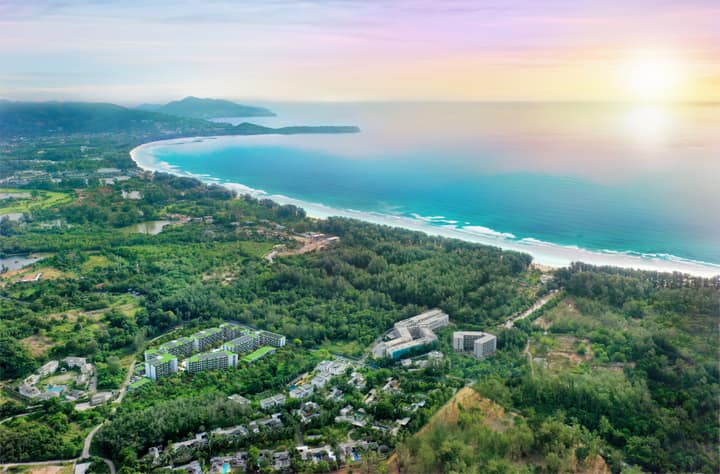
The week opened with a picture nobody expected in the middle of preparations for China’s biggest holiday: in the last days of September, Bangkok went under water. Around 300 mm of rain in three days, all 50 districts of the capital affected, more than 52,000 households, six-hour baggage queues at Suvarnabhumi — and all of it right before Golden Week, when Thailand expects about 250,000 Chinese visitors. For an investor in Phuket property the question is not “is this frightening” but which part of it actually touches the island and which part is noise. We answer with numbers: what arrivals showed through 26 September, what TAT and the Thai Hotels Association estimate for the flood effect, what the Bank of Thailand decided and where the baht moved.
The format is the usual one: the week’s numbers, their analysis, interpretation traps, a mini-case and a takeaway for the buyer. The previous issue is the week 40 digest, where we covered the holiday bounce in arrivals and the first sanctions against unlicensed hotels. All external data sits in the “Sources” block under the article.
Contents
- Bangkok floods: what happened and what was hit
- Golden Week in question: TAT estimates and redirected demand
- Arrivals to 26 September: 22.67M and −3.65%
- Who drove the week: China, India, Taiwan — and the Malaysia and Japan slump
- Bank of Thailand: 1.00% and the 28 October meeting
- The baht: around 33.55 per dollar
- Phuket hotel licences: status at the start of October
- Traps of the week
- Mini-case: a viewing trip through Bangkok the day after the floods
- What it means for Layan and the rental pool, and the next step
1. Bangkok floods: what happened and what was hit
According to Nation Thailand and Skift, Bangkok received about 300 mm of rain over a weekend at the end of September — more than 300 mm in 72 hours per Nation — affecting all 50 districts of the city and more than 52,000 households. The flooding hit mainly eastern districts — Srinakarin, On Nut, Bang Kapi, Ramkhamhaeng — and parts of Samut Prakan province. These are areas with relatively few hotels, so the direct blow to the hotel stock was limited: the Thai Hotels Association (THA) notes that most hotels along main roads were not affected, and both airports — Suvarnabhumi and Don Mueang — kept operating.
The operational consequences were nevertheless noticeable. Flooded roads kept part of Thai Airways’ ground staff from reaching work, arriving passengers waited up to six hours for baggage, and some departures were delayed by up to eight hours. THA president Thienprasit Chaiyapatranun put the flooded share of Bangkok at roughly 30–40% and stressed that this is considerably less than the 2011 crisis; he estimated a return to normal within seven days, provided the rain stops.
| Indicator | Value | Source |
|---|---|---|
| Rainfall | ~300 mm in 72 hours | Nation Thailand, Skift |
| Districts affected | all 50 districts of Bangkok | Nation Thailand |
| Households | more than 52,000 | Nation Thailand |
| Share of Bangkok under water | ~30–40% (THA estimate) | Nation Thailand |
| Baggage delay at Suvarnabhumi | up to 6 hours | Skift |
| Airports | Suvarnabhumi and Don Mueang operating | Nation Thailand |
What matters for Phuket? The island is in a different climatic and infrastructural situation: TAT explicitly names Phuket, Krabi and Chiang Mai as unaffected destinations. But Bangkok itself is the country’s main transit hub, and disruption there is felt by those flying to the island with a connection. That is a logistics question, not a question about the property market.
🔗 Live snapshot of the index, type medians and every weekly digest on one permanent page: Phuket property market hub →
2. Golden Week in question: TAT estimates and redirected demand
The main risk the industry talks about is not physical damage but perception. TAT had expected about 250,000 Chinese tourists over the extended Golden Week holiday (starting 1 October) and about THB11.5 billion in tourism revenue. After the floods the agency warned that Chinese arrivals could come in 5–10% below the original forecast, and called the situation a “perception crisis” rather than a real collapse in demand. Skift cites a tougher scenario: if rain continues during the holiday, the decline from western Chinese provinces could reach 15–20% of the expected 250,000.
TAT ran a confidence-building campaign on 28–30 September on Chinese social media (WeChat, Weibo, Douyin) with influencers to show that airports are open and tourism outside Bangkok runs as normal. THA, for its part, expects Bangkok hotel occupancy in September–October to fall by less than 10% year on year, and sees the main vulnerability in online booking platforms: a trip can now be cancelled or changed just two or three days before departure.
| Scenario | Effect on Golden Week Chinese flow | Where the estimate comes from |
|---|---|---|
| Baseline forecast before the floods | ~250,000 visits, ~THB11.5 billion | TAT |
| TAT estimate after the floods | 5–10% below forecast | TAT (Nation Thailand) |
| Prolonged rain, western China | 15–20% below expected | Skift, citing officials |
| Bangkok hotels, Sept–Oct | occupancy below last year by less than 10% | THA |
Skift makes an interesting observation: demand is shifting inside Thailand rather than leaving it — Chinese travellers are switching to Krabi, Samui and Hua Hin, keeping spending in the country but pulling it out of Bangkok. The same piece contains a figure that is easy to misread: Minor Hotels reported Chinese room nights across its Thailand portfolio 78% ahead of last year. That is a chain-wide national portfolio figure, not Phuket data, and it cannot be carried over to the island. We mention it only as an illustration that pre-holiday bookings at a large operator are strong.
What follows for a Layan investor? China is the largest market by visit count, but rentals of premium resort units in Layan draw a mix of guests from many countries, and occupancy is held up by seasonality rather than one holiday. How the annual cycle works is covered in the piece on seasonality and occupancy in Phuket.
3. Arrivals to 26 September: 22.67M and −3.65%
According to the Ministry of Tourism and Sports (published by Nation Thailand), Thailand received 22,666,429 foreign tourists between 1 January and 26 September 2026. That is 3.65% fewer than in the same period of 2025; the annual shortfall narrowed by 0.02 percentage points from 3.67% in the week 40 digest. Tourism revenue for the period is about THB1.105 trillion, against ~THB1.083 trillion a week earlier.
In the week of 20–26 September the country received 482,751 foreign visitors — 4% more than the week before, an average of 68,964 a day. The difference from last week’s cumulative figure (22,183,678) equals the weekly increment exactly, so the data reconcile.
| Indicator | 19 Sept (wk 40) | 26 Sept (wk 41) |
|---|---|---|
| Cumulative arrivals since 1 Jan | 22,183,678 | 22,666,429 |
| Change vs 2025 | −3.67% | −3.65% |
| Visits in the week | 464,200 | 482,751 |
| Week-on-week change | +5.72% | +4% |
| Revenue year to date | ~THB1.083 trillion | ~THB1.105 trillion |
An important detail: growth for a second week running, but growth above the seasonal norm should not be expected — this is a transition period between the summer holidays and the high season that starts in November. How Phuket’s statistics relate to the national ones is covered in the piece on the August dip in arrivals.
4. Who drove the week: China, India, Taiwan — and the Malaysia and Japan slump
The year-to-date ranking of markets is unchanged. Cumulative at 26 September:
| Market | Visits, Jan–26 Sept 2026 | Rank |
|---|---|---|
| China | 3,822,928 | 1 |
| Malaysia | 2,891,908 | 2 |
| India | 1,680,725 | 3 |
| Russia | 1,249,801 | 4 |
| South Korea | 831,716 | 5 |
| Total for Thailand | 22,666,429 (−3.65% y/y) | — |
The weekly picture is more contrasting. China delivered 94,343 visits in the week (+42.62%) and returned to first place in the weekly ranking; India 40,284 (+17%); Taiwan 24,135 (+33.25%). Malaysia, by contrast, delivered 60,254 visits (−13%) and Japan 24,853 (−18.5%). This mirrors last week, when Malaysia (+29.12%) and Japan (+55.36%) were pushed up by national holidays: the effect faded and the numbers fell back. Nation Thailand names Taiwan’s Mid-Autumn Festival, preparations for China’s Golden Week and South Korea’s Chuseok as the week’s drivers.
The practical conclusion is the same as before: weekly statistics on short-haul markets are a calendar of neighbouring countries’ holidays. Last week’s 5.72% rise was not a reversal, and this week’s +4% should not be read as a trend either; what actually matters is the cumulative picture (−3.65%) and how the high season goes from November. Russia — the fourth-largest market with 1.25 million visits — remains a significant source of buyers and tenants for Phuket; more on the market in the review of the Phuket real estate market in 2026.
5. Bank of Thailand: 1.00% and the 28 October meeting
According to Reuters on 17 September 2026, the Bank of Thailand held its policy rate at 1.00% for the third time in a row. Assistant Governor for monetary policy Don Nakornthab called the stance “very, very accommodative”, adding that the rate is among the lowest in the world but needed given weak domestic demand; “all options remain open”, though he sees no crisis that would justify an immediate cut. The GDP growth outlook was unchanged: 2.3% in 2026 and 1.8% in 2027, with about 2% expected in the fourth quarter. The next committee meeting is on 28 October 2026. Official committee decisions are published on the Bank of Thailand website (bot.or.th).
| Indicator | Value | Date / source |
|---|---|---|
| Policy rate | 1.00% (third hold in a row) | Reuters, 17.09.2026 |
| GDP growth forecast 2026 | 2.3% | Bank of Thailand via Reuters |
| GDP growth forecast 2027 | 1.8% | Bank of Thailand via Reuters |
| Baht weakening year to date | ~5.7% | Reuters, 17.09.2026 |
| Next meeting | 28 October 2026 | Bank of Thailand |
What does this mean for a property buyer? For a foreigner buying a condo with their own money or on a developer instalment plan, the Bank of Thailand rate does not directly affect the terms of the deal: mortgages for non-residents are limited in the country (see mortgages for foreigners). The influence is indirect — through the baht rate and overall demand in the economy. A low rate supports domestic demand and reduces the appeal of baht deposits, and so weakens the baht — a plus for those converting dollars, a minus for those earning in baht and counting in dollars. Any forecast for the 28 October outcome is exactly that — a forecast: per the official, different results are possible.
6. The baht: around 33.55 per dollar
According to Trading Economics, USD/THB on 2 October 2026 was about 33.55 baht per dollar, with the baht easing roughly 0.32% in the session. A week earlier, on 28 September, it was about 33.51 (week 40 digest). Over the month the baht eased roughly 1.89%, over the year roughly 3.78%. Analyst forecasts diverge: Trading Economics expects a return to around 33.35 by the end of the quarter, while other aggregators quote ranges considerably higher. We do not rely on forecasts: their spread alone shows there is no precise answer.
| Date | USD/THB | Comment |
|---|---|---|
| 21.09.2026 | ~33.27 | week 39 digest |
| 28.09.2026 | ~33.51 | week 40 digest |
| 02.10.2026 | ~33.55 | Trading Economics |
| Over a month | ≈ −1.89% for the baht | weakening |
| Over a year | ≈ −3.78% for the baht | weakening |
The Bank of Thailand, per Reuters, is not opposed to a weaker baht as long as the move stays orderly. For a buyer from the dollar or euro zone two conclusions follow. First: paying in baht has become slightly cheaper, and catalogue prices in dollars are converted into baht at the actual rate on the payment day. Second: the rate should be fixed on the transfer day, not from week-old news. How currency operations work when buying is covered in the piece on the FET document and currency transfer. For reference: a studio in Layan Verde currently costs 7,833,125 THB ($235,995), and a phase-2 studio in Layan Green Park 7,424,784 THB ($224,043) at catalogue prices.
7. Phuket hotel licences: status at the start of October
There is no news that changes last week’s picture, but it is worth keeping in mind. According to Bangkok Post, Phuket authorities suspended five hotels that lacked licences and had not met improvement requirements — sanctions imposed after an extra period for corrections expired; about 40 more hotels remain under consideration and must submit missing documents (notably environmental impact assessment reports and structural safety certificates) in October. This story continues the campaign to legalise the hotel stock that we covered in the week 40 digest.
| Indicator | Value |
|---|---|
| Hotels suspended (end of September) | 5 |
| Hotels on a separate review track | ~40 |
| Deadline for missing documents | October 2026 |
| Documents missing at some of the 40 | environmental assessment, structural safety certificates |
For a condo-hotel owner the takeaway is unchanged: check that the project and the management company hold a valid licence and that the rental programme is formally documented. A checklist is in the articles on due diligence when buying and Phuket rental programmes. The October document deadline means new decisions on these ~40 hotels are possible in the coming weeks; we will follow this in the next issues.
8. Traps of the week
- “Floods in Bangkok = problems in Phuket”. No. TAT names Phuket an unaffected destination, and there is no direct data on damage to the island. The effect comes through connection logistics and perception among some Chinese tourists.
- The “+78%” figure from booking headlines. That is Chinese room nights across Minor Hotels’ entire Thailand portfolio, not Phuket. It cannot be carried over to the island.
- TAT’s projections are estimates, not facts. The 5–10% and 15–20% ranges are scenarios; final Golden Week data will only come after the holiday.
- A +4% week is not a reversal. It follows last week’s +5.72% and is explained by the holiday calendar of short-haul markets; the cumulative −3.65% shortfall matters more.
- A low rate ≠ a cheap mortgage for a foreigner. A 1.00% rate does not make a mortgage available to a non-resident; lending terms for foreigners are set by banks and law, not only by the policy rate.
- A weak baht ≠ a reason to wait for an even weaker one. Exchange-rate forecasts diverge; fix the rate on the transfer day and do not build a decision on a single forecast.
- Arrivals statistics ≠ the yield of your unit. Yield through the rental pool is determined by occupancy over an annual cycle and contract terms, not by one week of news.
9. Mini-case: a viewing trip through Bangkok the day after the floods
A hypothetical, composite example; figures are illustrative except for price-list numbers. An investor from Kazakhstan planned a trip to Phuket for 28–30 September with a connection in Bangkok, to look at a phase-2 studio at Layan Green Park and the buildings of Layan Verde. Learning of the floods, they wrote to the agent asking whether to cancel the trip and whether the news meant the market had “slumped”.
The analysis rested on three points. First: the island is not flooded and Phuket airport is operating; the risk concerned the connection in Bangkok, where baggage was delayed up to six hours. The solution — take a direct flight, or leave at least four to five hours for the connection and travel with hand luggage. Second: arrivals and the policy rate are background, not a reason to change the budget. They checked prices in the catalogue and saw a phase-2 studio at 7,424,784 THB ($224,043) and a Layan Verde studio at 7,833,125 THB ($235,995); Layan Verde completes in December 2028, with 35% and 50% instalment schemes. Third: the exchange rate. On the calculation day the baht was about 33.5 per dollar, and they decided to fix the transfer amount on the last day before payment rather than in advance. To keep expectations realistic, the agent recalled the project benchmark: about 8–10% net per year through the rental pool (60% of net profit to the owner, 40% to the management company) and a payback of roughly 12 years. In the end the investor moved the flight back by a week, until the Bangkok situation stabilised, and postponed the purchase decision until after the viewing.
The lesson of the case: the week’s events change trip logistics and the reason to re-check the exchange rate, not the fundamental assessment of a project. A purchase decision is made on contract terms, deadlines and liquidity, not on headlines. More on buyer mistakes is in the piece on common investor mistakes.
10. What it means for Layan and the rental pool, and the next step
Let us fold the week into one picture. The Bangkok floods are an event of perception and transport logistics, not a blow to the island; TAT’s estimates point to a 5–10% reduction in the Chinese flow versus forecast, and the Golden Week results will be known after the holiday. Cumulative arrivals remain 3.65% below last year, with the high season starting in November. The Bank of Thailand holds the rate at 1.00% and keeps all options open ahead of the 28 October meeting. The baht eased to ~33.55 per dollar, which is background for anyone planning payments in baht.
For Layan this means the following. The district does not depend on a single guest market, and the projects’ rental model is built on an annual cycle and a management company. For Layan Verde (700 m to Layan beach, completion in December 2028) and phase 2 of Layan Green Park (completion in 2026) the benchmark remains unchanged — about 8–10% net per year and a payback of roughly 12 years; it is important to remember that the entire phase-1 price list of Layan Green Park consists of resales from owners. What to follow over the next few weeks: the Golden Week results, the Bank of Thailand decision on 28 October, and how Phuket authorities close the October deadline on hotel documents. If you are choosing an entry moment, see the best time to buy in Phuket and the area comparison — Layan and Bang Tao.
We will send the current price list, fresh rental pool occupancy figures and a yield calculation for your budget — leave a request or see the terms on the Layan Real Estate page. The commission is at market rate; terms are discussed at a meeting.
This material is for information only and is not legal, tax or investment advice. Figures are given per the sources on the publication date; forecasts remain forecasts. Check current rules and figures at the time of the transaction.