The first week in Phuket almost always ends the same way: the home is chosen, but you still need to get to the shop, the beach and the airport. And then it turns out that “just renting a bike” is a matter of paperwork, insurance and, if things go wrong, serious money. The island stretches along the coast, there is no public transport in the usual sense, and most permanent residents drive themselves. So a licence is not a bureaucratic detail but part of the infrastructure of your life, like a bank account or internet.
The rules also change. In 2025 Thailand’s Department of Land Transport (DLT) tightened how licences are issued to foreigners: an international permit no longer replaces an exam, and new drivers sit a written test. In 2026 the agency is preparing digital services, including online renewal. Below is the whole path: what you can drive on in the first weeks, how to get a Thai licence, whether to choose a bike or a car, how to count costs, and where people most often lose money.
Contents
- Who needs what: visitor, resident, property owner
- Home licence and IDP: what covers the first weeks
- Thai licence: what changed in 2025
- How the application works: steps and documents
- Motorbikes in Phuket: categories, helmets and real risks
- Renting or buying a car
- Insurance: what it covers and when it refuses
- Transport and location: how the area reduces the need for a car
- Pitfalls
- Mini-case and checklist
1. Who needs what: visitor, resident, property owner
The rules depend not on how much money you have or what property you own, but on your status and time horizon. Broadly, a foreigner in Phuket has three scenarios, and each calls for its own strategy.
A visitor for up to a few weeks. You drive on your national licence together with an international permit of the right category, or you use taxis and transfers. A Thai licence makes no sense: the process is longer than the trip. If you came to look at property, the most sensible thing is not to get behind the wheel at all in the first days — routes between areas and projects are covered by taxis and apps, and viewings can be arranged with a driver.
A resident for a season or longer. The picture is different: you will drive daily, rent a bike or car for months and buy insurance. Using an IDP for years is inconvenient and risky — the permit has an expiry date, and its category often does not match the vehicle you actually use. For this scenario the right target is a Thai licence.
A property owner who visits 2–4 times a year. An intermediate case. If you come for a few weeks and live in a hotel-style format, a transfer from the management company, taxis and one-off rentals are enough on site. But if the property is your second base and you spend months on the island, a Thai licence quickly pays off in convenience. On building a life between two countries, see our piece on a second home in Thailand.
The general principle is simple: plan transport together with choosing an area. The closer your home is to everyday infrastructure, the fewer trips you make and the lower the load on your licence, insurance and budget. For more on the ways of getting around the island, see the breakdown of transport in Phuket.
2. Home licence and IDP: what covers the first weeks
A foreigner’s national licence is not a universal pass on its own. For driving in the country you usually need an International Driving Permit (IDP) issued in your country of residence, together with the national licence. An IDP is not a separate licence but a translation and confirmation of your national one, so without it the IDP is invalid.
Three practical points where problems most often arise:
- Category. An IDP is issued by category, and the “passenger car” category does not entitle you to ride a motorcycle. Many people arrive with a car permit and rent a bike — from the point of view of the rules and the insurer, that is riding without a licence of the required category.
- Validity. An IDP is valid for a limited time, while a stay in Thailand on a visa can be longer. An expired permit is the same as none.
- The full set. Both the IDP and the national licence are checked. A plastic licence forgotten at home is not replaced even by a valid IDP.
A separate question is what to do if you have moved for a long time. The practical rule: an IDP is a solution for a holiday and the first weeks, not for life on the island. Living as a resident on a temporary document means constantly taking a risk at every check and every accident. On arranging your stay so that your visa status matches your lifestyle, see our material on visas for property owners and the LTR visa.
3. Thai licence: what changed in 2025
The key change is described by The Nation Thailand in a piece dated 20 June 2025: the DLT changed the conditions for issuing licences to foreigners. Three takeaways matter in practice.
- An IDP is no longer grounds for a temporary licence. An applicant cannot present an international permit as evidence for obtaining a temporary Thai licence.
- A written test is mandatory. Foreigners with valid foreign licences, who were previously exempt from the written part, now sit a written exam.
- The term of the personal licence has grown. Personal licences are now issued for five years instead of two, while temporary ones, as before, last two years.
For an investor and resident the conclusion is this: the “bring your licence — swap it for a Thai one” route used to be quick, and now it is longer and you need to allow time for it. Here are the conditions in a table.
| Parameter | Temporary licence | 5-year licence |
|---|---|---|
| Validity | 2 years | 5 years |
| Basis | Not an IDP; written test for foreigners | Issued after the temporary one on renewal |
| Who it suits | New drivers in the country | Those who already held a temporary licence |
| What to check | Requirements of the specific DLT office | Renewal and medical-check conditions |
A note on facts: we do not give exact document lists, fees or test sets as numbers — they differ between offices and get updated. Rely on the official DLT page and confirm conditions with your chosen office before booking. Do not rely on social-media retellings: many people confuse the 2025 rules with the old ones.
4. How the application works: steps and documents
Formally the procedure looks the same for everyone: prepare documents, get a medical certificate, book at a DLT office, take the tests, receive the licence. Below is the order most applicants follow. It is based on office practice, so check details in advance.
Step 1. Make sure you have a basis of stay. DLT offices generally work with people living in the country on a long-term basis and ask for confirmation of residence. If you came on a tourist entry, getting a licence usually will not work — the question of status is solved first. Which visas suit property owners is covered in the visa guide, and long-term options in the Thailand Elite overview.
Step 2. Medical certificate. It is usually done at a clinic or hospital in a single visit: a basic examination, eyesight, colour perception and reaction check. The certificate has a limited validity, so it is done right before submitting documents. Finding clinics and quality benchmarks are in the piece on healthcare in Phuket.
Step 3. Documents. The usual set: passport with visa, proof of address, health certificate, photographs, the national licence (as proof of experience), sometimes an IDP as a supporting document. The full, current list is published by the DLT, and in practice it differs slightly from office to office.
Step 4. Booking and tests. Some offices work by appointment, some on a first-come basis. Tests include a written part and a reaction and eyesight check; beginners may also have a practical part. Prepare for the written test using the official DLT materials: the questions cover signs, right of way, speed limits and liability for violations.
Step 5. Issue. As a result you receive a temporary licence for two years. After two years you renew — this time for five. According to the Bangkok Post, the DLT together with the Ministry of Public Health is preparing online renewal for drivers under 55 whose licence has not been expired for more than a year: an electronic certificate replaces the in-person check, but the eyesight test remains. Launch was planned for June 2026; check the actual status of the service on the DLT website before your trip.
A practical note on time. Allow not “one day” but several weeks: preparing certificates, booking, a possible retake and issue. If you are coming for a limited period, it is better to start with the office and ask what documents they will require even before you pay for the medical check.
5. Motorbikes in Phuket: categories, helmets and real risks
A bike is the most accessible transport on the island and at the same time the most dangerous part of this topic. Monthly rental costs roughly $60–100 including fuel, according to our article on the cost of living in Phuket. But the rental price is not the main risk item.
What is important to know:
- Licence category. Your licence or IDP must carry a motorcycle endorsement. The “car” category does not cover a bike — in the eyes of both the police and the insurer.
- Helmet. A helmet is mandatory, and it is not a formality. A good helmet costs less than any treatment.
- The lessor’s insurance. It often covers only damage to the bike itself and not your treatment or liability to third parties. Check the contract terms and make sure your medical policy does not exclude injuries on two wheels.
- Rainy season. In rain the braking distance grows and road markings become slippery. In the Phuket rainy season it is better to swap a bike for a taxi or a car.
- Experience. The island is not a place for first driving lessons. Steep climbs, oncoming traffic and left-hand driving are hard even for experienced riders.
For a family with children a bike is auxiliary transport: a trip for water or to the beach, but not taking a child to school or riding with them in the rain. How safe life on the island is overall and which risks really exist is covered in the overview of safety in Phuket.
6. Renting or buying a car
For permanent life in Phuket a car is more convenient than a bike: air conditioning, safety, a boot, and rain is no obstacle. The question is whether to rent or buy.
| Criterion | Renting | Buying |
|---|---|---|
| Flexibility | High: you can change car and area | Low: you are tied to the asset |
| Upfront costs | Deposit and first payment | Price of the car, re-registration, insurance |
| Documents | Licence of the right category, passport | Licence, residence or proof of address, registration |
| Who it is for | First months, seasonal residents | Permanent residents, families |
| Main risk | Hidden contract terms | Loss in value on resale |
The practical logic is this: the first 3–6 months, rent. In that time you will understand how much you actually drive, whether you need a second car and whether the area suits you. Buying makes sense when you have acquired a home and your routes have settled. For a foreigner, registering a car comes down to residence documents and a licence, so before buying check which papers a specific office requires.
Separately, count the full cost of ownership: fuel, insurance, annual tax and inspection, parking, repairs. When comparing with taxis and transfers, honestly record how many trips you make a month. If you drive less than a few times a week, renting and taxis are almost always cheaper than owning a car. Benchmarks for the overall budget are in the breakdown of the cost of living in Thailand.
If you are considering buying property rather than just renting, include transport in the overall calculation: a project with a shuttle and parking reduces the need for your own car. You can calculate yield and ownership costs in the calculator.
7. Insurance: what it covers and when it refuses
Insurance in Thailand is the most underrated part of the transport topic. Formally a car has mandatory liability insurance, but its limits are modest, and voluntary comprehensive insurance covers damage to your own car. Separately there is medical insurance, which may not cover motorcycle accidents.
What to check before renting or buying:
- Who is insured. The policy must cover a driver with your licence. If the driver has no valid licence of the right category, the insurer can as a rule refuse to pay — and all the damage falls on you.
- What exactly is covered. Damage to the car, damage to third parties, treatment, legal help — these are different lines.
- Excess. When renting, the lessor’s excess may be noticeable; find out before signing.
- Exclusions. Intoxication, riding without a helmet and without a licence are usually excluded from cover.
- Medical insurance. Check that your policy does not exclude motorcycle injuries and that the limit covers a private clinic on the island.
Simple financial logic: the cost of proper insurance is a small fraction of the price of any serious accident. Saving precisely here is the worst idea available. How treatment on the island works and what it can cost is in the piece on healthcare in Phuket.
8. Transport and location: how the area reduces the need for a car
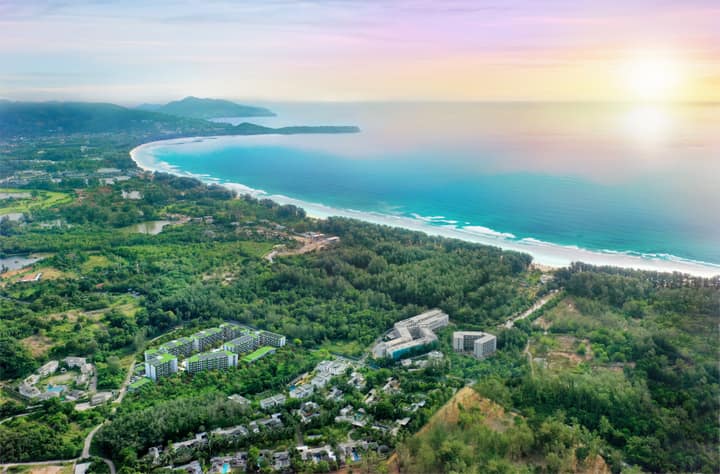
This is where the driving-licence topic meets investment. The need for a car is defined not only by your lifestyle but also by the area. The south of the island — Rawai and Nai Harn — is a set of scattered villages where everyday tasks are hard to handle without a bike or car. The north-west — Layan and Bang Tao — is more compact: beaches, supermarkets, restaurants, Boat Avenue and international schools are nearby. The distance to the airport from the Layan area is about 20 minutes; details are in the guide to Phuket airport.
For an investor this is a practical argument: the less a resident needs their own transport, the easier the property is to manage. For example, Layan Green Park is about two minutes from Layan beach, guests are carried by a free shuttle to the beach and Boat Avenue, and for those who arrive by car there is parking for 108 spaces. Near the Layan area daily life is arranged so that some everyday tasks are handled on foot or by shuttle. Unit prices in the project today: phase 1 — resales only, studios from $142,602; phase 2 — studios from $224,043 (in baht — 7,424,784 THB). The Layan Verde project starts from $235,995.
The Bang Tao area is arranged similarly and suits those who want to live near the beach and infrastructure without a mandatory car trip. A comparison of areas is in Layan vs Bang Tao.
The bottom line: do not buy property in an area remote from infrastructure hoping you will “take a bike”. Transport dependence means ongoing costs, risk and time. And for rental properties it is also an attractiveness factor: a guest who does not want to rent a car chooses a location where a shuttle and walkability solve the question.
9. Pitfalls
- A bike on a car licence. An IDP and national licence without a motorcycle category do not entitle you to ride a bike. It is the most common newcomer mistake, and it is expensive at the first check or accident.
- Counting on a “swap without an exam”. After the 2025 changes an international permit does not replace the test. Plan for a written exam and preparation for it.
- A paid medical check before learning the requirements. The certificate has a limited validity. First confirm the document list and visa conditions with the DLT office, then get the certificate.
- Saving on insurance. A policy covering only damage to the rented bike will not pay for your treatment. Without a valid licence the insurer may refuse payment altogether.
- Buying a car in the first month. You do not know the area, routes or real need. Renting for 3–6 months lets you make a mistake without losses.
- Relying on retellings instead of official sources. The 2025–2026 rules change, and forums often describe an outdated procedure. Check the DLT website and recent news publications.
- Property “off to the side” without a transport plan. A cheap location without infrastructure turns into daily trips, transport costs and road risk.
10. Mini-case and checklist
An example scenario, not a report on a real client: an investor buys an apartment in a project by Layan beach and plans to spend about four months on the island each season.
Month 0. Arrival. Licence from the country of residence and an IDP with car and motorcycle categories are in hand. They use an airport transfer, taxis and the project shuttle, and do not take a bike until they have clarified the position. In parallel they ask the DLT office for the document list and whether their visa type qualifies.
Month 1. Decision. They realise they only make long trips to the airport and hospital. They do not need their own car: taxis and a few-day rental when needed are enough. They will not apply for a Thai licence for four months a year — but if they lived on the island year-round they would start the procedure in the very first month.
Months 2–4. They use the shuttle to the beach and Boat Avenue, and taxis for longer trips. The saving compared with owning a car is on insurance, parking, maintenance and risk. Before leaving they check the apartment management terms and the schedule for extending their stay.
A checklist for your situation:
- Define the horizon: a week, a season or permanent life.
- Check the category and validity of your IDP.
- Confirm the requirements of the specific DLT office: visa, documents, tests.
- If you plan a bike — only with a motorcycle licence and a helmet.
- Get insurance that covers a driver with your licence and treatment.
- For the first 3–6 months rent rather than buy.
- Choose the area and project with transport accessibility in mind.
If you are choosing property in Phuket and want to understand how transport and area combine with yield, we will suggest options at a market commission — terms are discussed at a meeting. Leave a request via the form or get to know the Layan Real Estate agency.
This material is for informational purposes only and does not constitute legal advice. Rules for issuing driving licences, permit categories, fines and the way DLT offices operate change — confirm current requirements on the official website of Thailand’s Department of Land Transport and with your chosen office before submitting documents.