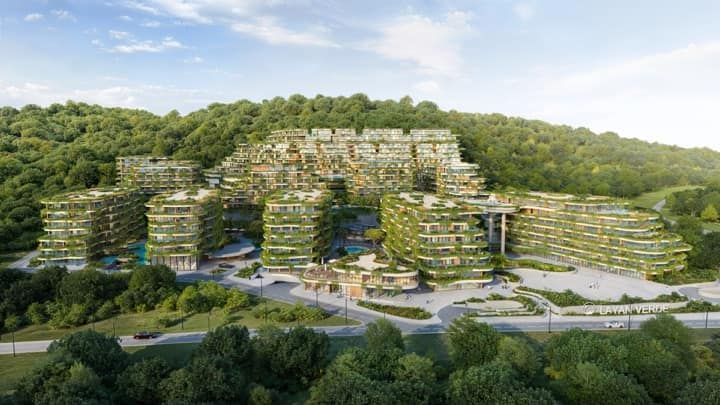

When people talk about yield in Phuket, they almost always mean income via a rental management program. The management company (MC) handles guests and operations, and the owner gets their share. In 2026 this is the main way to earn “passively” on a resort apartment. Let’s cover the models, the income split and — most importantly — how a pool’s gross revenue turns into the owner’s net yield.
Contents
- What it is and why
- Three income models
- Short-term or long-term rental
- What’s included and the income split
- Gross vs net: the calculation
- Seasonality and occupancy
- Taxes and costs
- Villas in a rental program
- Pitfalls
- Case: the real net yield
- Joining the program: step by step
- What to check in the contract
1. What it is and why
In resort projects, most owners don’t live in the unit — they rent it to tourists. Running short-term rental yourself from abroad is hard: booking channels, check-in, cleaning, 24/7 guest support. So an MC is brought in — it covers all operations and pays the owner a share of income. In Layan Verde and Layan Green Park, such a program is built into the project.
The format this most often takes is the condo-hotel: a residential complex with hotel infrastructure (reception, housekeeping, restaurants, spa), where the units belong to private owners while the operator runs the building as a single hotel. The owner remains a full owner throughout: the unit is registered to them — as freehold within the foreign quota or as leasehold — with a separate management contract signed with the MC, one that has its own term and exit conditions.
There is also a legal nuance rarely mentioned in sales decks: nightly rentals in Thailand are regulated by hotel legislation, and legally renting out an apartment “by the night” on your own is a separate bureaucratic task with real fine risks. In the condo-hotel format the operator closes this question: licensing and relations with local authorities are its area of responsibility. For a non-resident owner this is often as strong an argument as the yield itself.
2. Three income models
| Model | How it works | Who it suits |
|---|---|---|
| Pool (the main model in Layan Verde / Layan Green Park) | Pool income splits 60% to owner / 40% to management | A steady guide of ~8–10% net, smoothing seasonality |
| Profit-share | Splitting actual income from the specific unit | Maximum potential, ready for seasonality |
| Guaranteed yield | A fixed % for the first years | Need a predictable stream at the start |
Pool averages income across all units in the program — your income doesn’t depend on whether your specific unit or the one next door was booked, and the 60/40 split is fixed in the contract. Profit-share gives the most in high season but depends on the specific unit’s occupancy. Guaranteed yield removes uncertainty at the start, but the rate is usually more conservative.
Pool or guaranteed: which to choose
The investor’s most common question is the choice between a rental pool and a guaranteed rental. Essentially it’s a trade between potential and predictability:
- Guaranteed makes sense when the complex is only entering the market and occupancy hasn’t stabilised yet, and you want a fixed stream from day one. The guarantee is paid by the developer or the MC — look carefully at who exactly, and out of what funds.
- Pool usually wins over the horizon: once the complex reaches stable occupancy, 60% of the pool’s net profit tends to outrun a conservative fixed rate. The owner also participates in growth: better marketing and rising tourist flow lift their share too.
- Some programs are structured as a hybrid: a guaranteed rate for the first years that automatically converts into a pool. It’s a compromise for buyers at the construction stage.
A breakdown of guaranteed programs and their traps is in a separate article: Guaranteed rental yield in Phuket →. A selection of projects with a guaranteed program is in the catalog →.
3. Short-term or long-term rental
A management program is almost always about short-term (nightly) rental: it’s what extracts the most revenue per square metre in a resort location. But the owner has an alternative — a long-term tenant for months or a year. Compare the logic:
- Short-term via the MC: higher yield potential, full “passivity” for the owner, but income is volatile by season and wear is higher — guests change every few days.
- Long-term: the monthly rate is lower than the total revenue of nightly letting, but there is one tenant, minimal wear and predictable income. There are fewer managed programs for long-term — more often it’s classic agency work for a tenant-finding commission.
For a condo-hotel investor the choice is usually obvious: the project is designed for tourist flow, and the MC’s program squeezes more out of it than a private long-term tenant would. But if the priority is stability rather than the maximum, long-term has its place. A detailed comparison with numbers and risks: Short-term vs long-term rental in Phuket →. The island-wide picture of rates and returns is in the Phuket rental yield overview →.
4. What’s included and the income split
The MC’s service usually includes: marketing and booking channels (Booking, Airbnb, direct), guest check-in and support, cleaning and linen, minor repairs, owner reporting. For this, in a pool model the management company retains 40% of the pool’s net profit, and the owner gets 60%.
Clarify separately what is not included and is billed on top of the split: usually these are the owner’s costs — the CAM fee, unit insurance, replacing furniture and appliances as they wear out, and sometimes targeted levies for refreshing common areas. The more transparently the contract draws the line between “the pool pays / the owner pays”, the fewer surprises in the first annual report.
An owner bonus at Layan Verde / Layan Green Park is the VillaCarte Group loyalty programme: 15–25% discounts on complex services (spa, restaurants, fitness, transfer) during personal visits.
🔗 The 60/40 split isn’t just for condos: villas with an active rental program — Rental income villas →
5. Gross vs net: the calculation
An investor’s main mistake is treating the pool’s gross revenue as personal income. Here it is for a unit at $235,995 with an owner net yield of 8% (the lower end of the ~8–10% guide):
| Line | Value |
|---|---|
| Unit price | $235,995 |
| Owner net yield (pool) | 8% |
| Owner’s net income per year | ~$17,982 |
Owner income = (Pool gross revenue − VAT − city tax − service charge − bank commission) × 60%.
Let’s break the mechanics into steps so it’s clear exactly where the percentage points “disappear” between the gross and net figures:
- The pool’s gross revenue — all guest receipts across all units in the program for the period.
- From it come the mandatory deductions: VAT, city tax, the service charge, and bank commissions for acquiring and international transfers.
- Next come the pool’s operating costs, where the contract charges them to the pool: cleaning, linen, consumables, commissions of OTA channels such as Booking and Airbnb.
- What remains is the pool’s net profit, and only that is split 60/40 between the owners and the MC.
- Your 60% is still not the final figure: from it you separately pay tax on rental income (if applicable) and carry the owner’s own costs — the CAM fee, insurance, furniture depreciation.
That is why the “~22% gross” of a sales deck and the real “~8–10% net” are not deception but two different lines of the same calculation. The only question is which line the investor was shown first. Marketing decks love the gross figure; a payback calculation must be built on net yield.
🔗 How to count ROI: Calculating ROI in Phuket → · Investment guide →
6. Seasonality and occupancy
High season in Phuket is November–March (peak prices and occupancy), low season is April–October. Annual yield comes from pricier winter months and cheaper summer ones. So average occupancy matters more than the nightly rate: 70% occupancy at a moderate rate is often better than 90% peak winter nights and summer vacancy. The pool model and strong MC marketing smooth out this dip.
Peak demand falls on the New Year weeks and the school holidays of the main tourist markets — on those dates a strong operator raises the rate to a multiple of the summer one. A professional MC fills the low season with other segments: guests from Asia and the Middle East, digital nomads on long stays, discount packages like “a month for the price of three weeks”. It’s precisely the operator’s ability to fill units in April–October that separates a working program from a pretty presentation — ask for actual occupancy by month, not the annual average.
🔗 The month-by-month picture of seasons and occupancy: Phuket rental seasons →
7. Taxes and costs
- Income tax on rental income — if applicable, deducted from the owner’s share on top; for non-residents part of the payouts may go through withholding tax — tax retained at source.
- Split with the management company — 40% of the pool’s net profit.
- Common area fee (CAM) — complex upkeep (a guide of 85 THB/m²/mo in Phuket); paid whether the unit is rented out or sitting empty.
- Sinking fund — a one-off contribution to the building’s capital fund at purchase; it’s not part of annual yield, but it must be in the deal budget.
- Depreciation of furniture and appliances between guests: in nightly rental the interior ages faster, so budget a renewal reserve.
How rental income taxation works for a foreigner — rates, filing, double-taxation treaties — is covered separately: Rental income tax in Thailand →. CAM and the capital fund in detail: Sinking fund and CAM fees →.
🔗 Full ownership estimate: Phuket taxes & fees →
8. Villas in a rental program
A management program isn’t only about condos. Pool villas work by the same logic: the operator runs marketing, check-in and servicing, and the owner gets a share of income. The differences are in the economics:
- A higher ticket. A villa hosts families and groups; the nightly rate is a multiple of a condo-hotel studio’s.
- Higher costs. A pool, a garden, more cleaning area — a villa’s operating costs are notably heavier, and part of them sits with the owner.
- Occupancy is usually lower than a condo’s: the audience is narrower, bookings are longer but rarer. Annual yield is carried by the high rate, not the number of nights.
- Performance is individual. Unlike a pool, where income is averaged, a villa more often runs on profit-share — yield depends far more on the specific property and its positioning.
A detailed villa yield calculation with every cost line is in a separate piece: Villa rental yield in Phuket →.
9. Pitfalls
- Treating the pool’s gross revenue as personal income. The owner’s real figure is net, after the 60/40 split.
- Ignoring seasonality. Counting the year at the peak winter rate.
- Not reading the income-split contract. The management’s share and the “separately charged” list heavily affect the net figure.
- A guarantee at any cost. A high guaranteed yield is sometimes baked into the unit price.
- Not looking at the operator. A program is only as good as whoever executes it: management track record, sales channels, actual occupancy at its running properties.
- Forgetting about the exit. The terms for terminating the management contract and selling a unit with an active program should be known before signing — not the moment you decide to sell.
10. Case: the real net yield
Consider a typical scenario. An investor bought a studio and saw “pool gross revenue ~22%” in a presentation — and mistakenly took that figure for personal income. In reality, after VAT, city tax, service charge, bank commission and the 60/40 split with the management company, about 8% net landed in their account — a solid yield, but not 22%. There was no disappointment only because the numbers were recalculated in advance: the investor had budgeted for an owner net yield of ~8–10% from the start, and the unit’s value growth during construction added an extra share of total ROI — for Layan Verde the developer forecasts +45% capitalisation over the construction period (a forecast, not a guarantee).
Takeaway: a rental management program is convenient passive income, but plan around the owner’s net yield (~8–10% in a pool model), not the pool’s gross revenue from a sales deck.
11. Joining the program: step by step
- Choose the unit with rental potential in mind. For a program, personal taste isn’t everything: layout, view, floor and proximity to infrastructure affect how the unit will sell to guests.
- Request the management contract before signing the sale and purchase agreement. The model, the split percentage, the list of what’s included — all of it should be in hand at the booking stage, not after payment.
- Sign the management contract. It’s usually a separate document with its own term, renewal and exit conditions — parallel to the main contract for the unit.
- Take handover and furnish to the operator’s standard. In pool programs furnishing follows a single package so the inventory is uniform and any unit matches the declared category. What such a package includes — the furnishing breakdown →.
- Hand the unit into the pool and set up reporting. Clarify payout frequency, the report format and the communication channel with the operator. In the first months, check the reports against expectations — it’s the best moment to ask questions.
- Plan your own stays in advance. Owner nights are booked under the program’s rules; in high season they usually need to be reserved well ahead.
12. What to check in the contract
- The model and the income-split percentage (in a pool model — the 60/40 split).
- What exactly is included in the service and what’s billed separately.
- The terms and duration of any guaranteed yield.
- The right to personal stays (how many nights a year).
- Reporting transparency and payout frequency.
- The contract term, the renewal procedure and the conditions for exiting the program early.
- What happens to the contract when the unit is resold: does it transfer to the new owner automatically, and how does that affect the price — how to resell property in Phuket →.
- Who pays for replacing furniture and appliances once they wear out.
I’ll help compare programme terms across specific units and calculate the net yield.
Net yield calculation
By submitting this form you agree to the privacy policy.