Conversations about Phuket property usually begin with “which project should I pick?” It is better to start one step earlier: what role does this asset play in your portfolio, and how much capital are you willing to lock into it? For some investors it replaces part of a bond allocation — cash flow plus a physical asset. For others it is a bet on capital growth during construction. A third group buys “a home by the sea” and treats yield as a side effect. Each role has its own acceptable share, its own risks and its own horizon. Below is a working framework for the decision: what Phuket actually diversifies and what it concentrates; how to size the share; how the 10%, 20% and 30% scenarios differ; and where investors most often go wrong by calling a purchase “diversification”.
Contents
- What Phuket property really diversifies
- The asset’s role: income, growth or personal use
- Four risks you add to the portfolio
- How to determine your share
- Three scenarios: 10%, 20% and 30% of the portfolio
- Diversifying inside Phuket
- Liquidity and exit
- Traps: when “diversification” is concentration
- Mini-case: a $600,000 portfolio
- Checklist and next step
1. What Phuket property really diversifies
Diversification is not “buy more of different things”; it is adding sources of return and risk that behave differently under the same circumstances. Phuket property adds several such dimensions at once.
- A different income driver. Equities depend on corporate earnings, bonds on interest rates. Resort rental depends on tourist flow, seasonality and the supply of new projects. According to The Nation Thailand, the island’s market is valued in the hundreds of billions of baht and rests largely on foreign demand for resort housing.
- A physical asset. You own an apartment, not a piece of paper. That is a different kind of ownership, psychologically and practically: it cannot go to zero in a day, but it also cannot be sold in a second.
- Another jurisdiction and currency. If the rest of your capital sits in one country and one currency, the baht and Thai law are a genuine widening of geography.
- Cash flow. Under the rental pool model the owner receives 60% of the pool’s net profit, with a benchmark of roughly 8–10% net per year.
There is a flip side. Property concentrates capital: a large cheque, one asset, one location, one operator. So the honest answer to “does it diversify a portfolio?” is: yes at the asset-class level, and no at the level of the purchase itself if you bought a single unit in a single project. That difference shapes everything below.
2. The asset’s role: income, growth or personal use
Before sizing the share, name the role. It drives both the choice of asset and the drawdown you can tolerate.
| Role | What you want | Typical choice | Main risk |
|---|---|---|---|
| Cash flow | Regular income in baht, replacing part of a bond allocation | A ready unit in an operating complex, e.g. a phase 1 resale in Layan Green Park | Lower occupancy, rising costs, tax on rent |
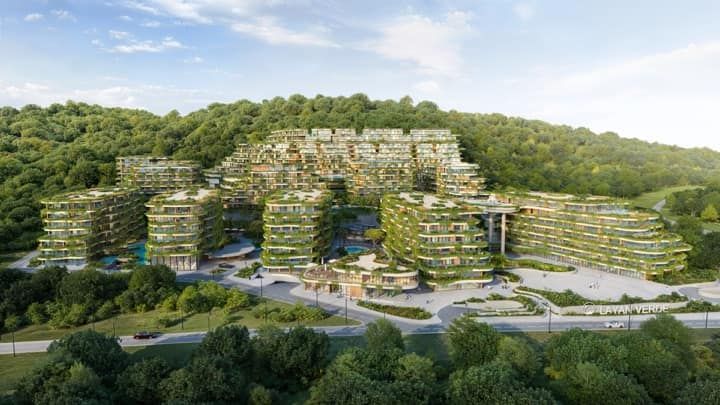
| Capital growth | Price growth over the construction period | Off-plan with an instalment plan, e.g. Layan Verde, completion in December 2028 | Delays, exit price below expectations |
| Personal use | A home for yourself and family plus partial payback | A unit with owner-stay rights and a pool for the remaining time | An emotional decision instead of a calculation |
| Hybrid | Part income, part growth | Two units at different stages | Diluted focus and double costs |
For the “cash flow” role the key metric is net yield after all costs; how to calculate it is covered in the article on calculating ROI in Phuket. For the “growth” role the key metric is the gap between the entry price and a realistic exit price after taxes and commissions; see the piece on exit strategies.
An important detail: the closer the role is to “personal use”, the less sense it makes to count the asset as part of the investment share of the portfolio. If you will live there three months a year, part of the value is consumption, not investment. Split it honestly: how much of the unit is “for living”, how much “for income”.
3. Four risks you add to the portfolio
Each risk below is real and can be assessed, but none of them is removed by diversifying inside Phuket itself.
1. Currency risk. Catalogue prices are quoted in dollars and baht, while rent and the owner’s costs are in baht. For an investor whose capital and liabilities are in another currency, the final result has two parts: the asset’s yield and the change in the exchange rate. The rate cannot be predicted reliably, so it is accepted as a risk and never built in as a source of profit. The Bank of Thailand regulates how money is brought into the country; the FET form is covered in a separate article.
2. Liquidity risk. Selling property takes weeks or months and is not an instant operation. A given project may have few resales, and the exit price depends on timing.
3. Jurisdiction and legal risk. A foreigner may own an apartment within the 49% condominium floor-area quota; rights over land are structured differently from those of a Thai resident. Rules and their interpretation change, so document due diligence is needed before the deal.
4. Operating and tax risk. Income depends on the management company and the season; rental income is taxable, and tax residency is determined by days spent in the country — see the materials on rental income tax and the 180-day rule.
None of the four shrinks if you buy two units in neighbouring buildings instead of one. They shrink only through the size of the share and the structure of the deal.
4. How to determine your share
There is no universal percentage — anyone who names “the right 25%” is talking about their own portfolio, not yours. But a framework exists, built from three checks.
- Liquid cushion. How many months of expenses will remain in liquid assets after the purchase, counting the deposit, furniture, taxes, registration and the first year of service charges? If it is under six to twelve months, the share is too large.
- The “frozen asset” stress scenario. Imagine the unit cannot be sold for 12–24 months and rent over that period halves. Does the portfolio survive without forced sales of other assets at a bad moment?
- Risk concentration. Add up every asset that depends on one factor. If your business or income is also tied to tourism or Southeast Asia, Phuket property amplifies that risk rather than balancing it.
Separately, calculate the full cost of entry, not just the unit price: reservation, instalments, furnishing, legal support and registration taxes. The breakdown is in the article on the cost of buying. Size the share from the amount you will actually invest, not from the price list.
One more point: the share is not a constant. It changes over time. Property that has risen in price increases its own weight in the portfolio, and an instalment plan stretches contributions over years. Review the proportion once a year, like any other.
5. Three scenarios: 10%, 20% and 30% of the portfolio
What follows illustrates the logic and is not a recommendation. The shares are notional; they show how portfolio behaviour changes.
| Share | Who it suits | What you get | What to watch |
|---|---|---|---|
| ~10% | An investor with a strong liquid core testing the market | Exposure to resort property, small cash flow | Entry must be real: the unit price threshold can itself set the share |
| ~20% | An experienced investor with a 7–10 year horizon and a cushion | A noticeable contribution to income and growth; the role of a “second core” | Needs an exit strategy and rental tax planning |
| ~30% and above | Someone for whom Thailand is a home or second residence | Personal use plus income | Concentration: liquidity and currency risk become systemic |
A practical caveat: property has a minimum entry threshold. If entry starts at $142,602 for a studio resale in Layan Green Park or $235,995 for a studio in Layan Verde, a 10% share makes sense for a portfolio at least several times larger than those sums. For smaller capital it is better to look for another form of exposure than to stretch the cheque.
And one last point on scenarios: the instalment plan affects the share. For Layan Verde, the 35% or 50% initial payment followed by payments every six months spreads the load over time. That makes entry more accessible but creates an obligation: payments must be planned in advance like debt, even if you take no loan.
6. Diversifying inside Phuket
If you decide the share is justified, a second question follows: how do you avoid turning it into a bet on one asset? Three axes apply.
Stage. A ready unit earns immediately; a unit under construction offers growth potential but requires waiting. Combining “a resale in an operating complex plus an off-plan unit with a 2028 horizon” spreads risk over time. More on the choice in off-plan vs ready.
Location. The district determines demand and liquidity. Layan is a quiet beach with growing infrastructure; Bang Tao is a more mature cluster with Laguna and Boat Avenue. For a comparison see Layan vs Bang Tao and the pages for Layan and Bang Tao.
Format. A studio, a multi-bedroom apartment and a villa have different audiences and seasonality. See condo vs villa.
What is not diversification: two units in the same project with the same operator. They share one pool, one season, one management and one reputation risk for the complex. That is a bigger bet, not a spread one.
| What you do | Is it diversification? | Why |
|---|---|---|
| A resale in a ready complex plus off-plan in another district | Partly yes | Different stages and different dependencies |
| Two units in one project | No | Same operator, season and pool |
| A Phuket apartment plus an asset in another country and currency | Yes, at portfolio level | Different jurisdictions and drivers |
| Buying “one bigger unit” for the same sum | No | Concentration in a single asset |
7. Liquidity and exit
Diversification without an exit plan is a collection of assets you cannot leave. Plan three things before buying.
Horizon. If you plan to hold for 10–12 years, the payback benchmark — about 12 years under the pool model — matches your horizon. If you need to exit in two or three years, you depend on the resale price, not rental income.
Exit channels. These are a secondary-market sale, an assignment during construction, holding for rent, and transfer by inheritance. Each carries its own tax and legal cost; they are covered in the article on exit strategies.
Deal terms. A resale in Layan Green Park is full payment: all of phase 1 is secondary market, and there is no instalment plan on resales. For the buyer that means a one-off withdrawal of capital from the portfolio rather than one spread over time. For Layan Verde the arithmetic is different: a 200,000 THB reservation, then payments under the chosen scheme.
Also account for the recurring costs that reduce real yield and stop you thinking of the unit as a “free” asset: for Layan Green Park a CAM fee of 75 THB/m² per month and a one-off sinking fund of 650 THB/m²; for Layan Verde 85 THB/m² per month and 850 THB/m² one-off. How these charges work is explained in the article on sinking fund and CAM.
8. Traps: when “diversification” is concentration
- “I’ll buy two units — the risk will split.” If both are in one project, they depend on one operator and one season. The risk does not divide; it doubles.
- Counting the price, not the outlay. Furniture, lawyers, taxes, instalment payments and service charges add a substantial part to the price tag. Portfolio share is calculated on real outlay.
- Taking yield from advertising. The 8–10% net benchmark is a pool programme target, not a guarantee. Assume scenarios worse than expected and check them against the management company’s actual statements.
- Ignoring currency. A good baht yield can be partly eaten by the exchange rate if your liabilities are in another currency. The rate is a risk, not a profit.
- Forgetting tax. Rental income and sales are taxable, and tax-resident status depends on days spent in the country. Consult a tax specialist before the deal.
- Buying out of fear of missing out. Price growth during construction is real — Layan Verde studios rose from the starting $224,776 to the current price list — but past growth does not guarantee future growth. More on mistakes in common investor mistakes.
- Leaving no cushion. Putting everything into an asset that cannot be sold quickly is the most common way to turn a planned investment into a forced sale.
This material is informational and is not legal, tax or investment advice. Take decisions on share size and deal structure with a licensed lawyer and tax adviser.
9. Mini-case: a $600,000 portfolio
A hypothetical example, not a real client. A European investor manages a portfolio of about $600,000: a liquid core in funds and bonds, a deposit and a small gold allocation. They are considering Phuket and want the role “cash flow plus a little growth”.
Step 1. Role. The main goal is rental income in baht, the secondary goal is capital growth. Personal use is two to three weeks a year.
Step 2. Share. They pick about 20% — roughly $120,000 of outlay, including costs. That means the unit price itself must be noticeably below this sum, leaving room for furniture, lawyers and taxes. If the minimum entry exceeds the desired share, they lower expectations about format rather than raise the share.
Step 3. Cushion check. After the purchase they still hold liquid assets covering more than a year of expenses. The stress test “unit frozen for two years, rent halved” does not force them to sell anything at a loss.
Step 4. Structure. Instead of two units in one project, they consider one ready unit in an operating complex — for income — and keep a reserve for a possible second position under construction later, if the first year confirms expectations. Contributions are thus spread over time.
Step 5. Exit. The horizon is 10–12 years, consistent with the payback benchmark of about 12 years. They write down in advance what counts as a reason to sell (for example, net yield staying below a threshold) and how they would act.
Takeaway: the size of the share was set not by how attractive the project looked but by the liquid cushion and the asset’s role. That is the order in which to decide.
10. Checklist and next step
- Name the asset’s role: income, growth, personal use or hybrid.
- Size the share from real outlay, not the unit price, and test the “frozen” scenario for 12–24 months.
- Assess the four risks: currency, liquidity, jurisdiction and tax, operations.
- Diversify by stage, district and format, not by the number of apartments in one project.
- Write down your horizon and exit conditions before the deal.
- Calculate net yield using the method in the ROI article and compare benchmarks on the /#roi section.
- Check the documents and engage a lawyer and tax adviser.
If you want to go through your own situation, start with selection built around your request: tell us about your capital, horizon and the asset’s role, and we will show which formats fit. We are an agency working with VillaCarte Group projects; the commission is at market rates, with terms discussed at the meeting. Review the current offers — Layan Verde and Layan Green Park — and write to us for the price list on the day of enquiry and a calculation for your portfolio share.