Last week the market lived in two realities at once. In the headlines: a flooded Bangkok, 3.14 million people affected across 21 provinces, and preparation for the IMF–World Bank meetings, which opened today, 12 October, at Bangkok’s Queen Sirikit National Convention Center. In the statistics: China’s Golden Week, which lifted the country’s weekly arrivals to 522,532, up 8.24% on the previous week. For a Phuket property investor, the task is to separate three things: what has actually changed, what is just the holiday calendar, and what remains an assumption. We go through the primary sources: Ministry of Tourism and Sports data, the Department of Disaster Prevention and Mitigation (DDPM) bulletin, Bank of Thailand statements and a JLL report on regional real estate.
The format is the same: the week’s numbers, their analysis, interpretation traps, a mini-case and a takeaway for buyers. The previous issue is digest week 41, where we covered the first days of the flooding, arrivals to 26 September and the Bank of Thailand rate decision. All external data is collected in the “Sources” block below the article.
Contents
- Arrivals to 3 October: 23.45M and −3.88%
- Golden Week: China +42% in a week
- Floods as of 11 October: scale and geography
- The Bank of Thailand on damage: what is known and what is not
- IMF–World Bank meetings: scenarios and what they mean for Thailand
- JLL on Phuket and Phang Nga: what the report says
- Rate and baht: what we do not know
- Traps of the week
- Mini-case: a buyer reads the flood news
- What this means for Layan and the rental pool, and the next step
1. Arrivals to 3 October: 23.45M and −3.88%
According to the Ministry of Tourism and Sports, published on 5 October (source: Nation Thailand), Thailand received 23,452,895 foreign tourists from 1 January to 3 October 2026. That is 3.88% fewer than in the same period of 2025. Revenue from foreign tourists year to date is about THB1.142 trillion, 2.26% below last year. Note that revenue is lagging noticeably less than visits (−2.26% against −3.88%). That is an observation, not a conclusion: the ministry does not break the gap down, and explaining it through spending mix or guest mix without data would be speculation.
In the week of 27 September–3 October the country received 522,532 foreign visitors. That is 39,781 visits, or 8.24%, more than the previous week (482,751); an average of 74,647 people a day.
| Metric | 26 September (week 41) | 3 October (week 42) |
|---|---|---|
| Cumulative arrivals since 1 January | 22,666,429 | 23,452,895 |
| Change vs 2025 | −3.65% | −3.88% |
| Visits in the week | 482,751 | 522,532 |
| Week-on-week change | +4% | +8.24% |
| Revenue year to date | ~THB1.105 trillion | ~THB1.142 trillion |
Two points deserve a close look. First: despite a good week, the year-on-year gap did not narrow but widened, from −3.65% to −3.88%. Week-on-week growth and the comparison with last year are different things: the same week of last year was also strong (the holidays coincide on the calendar), so the comparison was tougher. Second: the cumulative arithmetic does not add up at face value. Adding the weekly 522,532 to last week’s cumulative 22,666,429 gives about 23.19 million, while the ministry reports 23.45 million. The gap is roughly 264 thousand visits; we do not know the cause — the ministry may have revised earlier data. We have not checked this against separate publications, so we leave it as a caveat: read the ministry’s cumulative figures as official estimates that may be updated.
What this means for an investor. National arrivals are background for Phuket’s rental market, not its direct metric: the island receives its share through its airport and charters, not through the national entry statistics. We covered this difference in detail in the piece on Phuket tourism statistics.
🔗 Live snapshot of the index, type medians and every weekly digest on one permanent page: Phuket property market hub →
2. Golden Week: China +42% in a week
The main driver of the week was the Chinese holiday. According to Nation Thailand, 133,946 people arrived from China during the week, 41.98% more than the week before. Tourism and Sports Minister Surasak Phancharoenworakul attributed the rise to demand on short- and long-haul routes supported by regional holidays; he separately named the breaks around Hong Kong’s National Day and South Korea’s National Foundation Day. India added 16.53%, Russia 14.23%.
| Market | Visits in the week | Change vs previous week | Cumulative since 1 January |
|---|---|---|---|
| China | 133,946 | +41.98% | 3,999,854 |
| Malaysia | 59,871 | −0.64% | 2,982,095 |
| India | 46,942 | +16.53% | 1,751,485 |
| Russia | 22,326 | +14.23% | 1,281,214 |
| South Korea | 21,219 | +3.66% | 860,655 |
At least two clarifications. First, the weekly spike from China is a calendar effect: after the holidays the flow returns to normal, and the minister explicitly expects a decline in the following week as travel from China, South Korea, Hong Kong and Malaysia normalises. Second, the minister noted that some airline flights were cancelled, which slightly limited arrivals. In other words, even in the “best” week the infrastructure did not run without hiccups.
The cumulative total for China — almost 4 million visits — makes it the country’s largest market. But for rentals in Layan what matters is not the market itself but the guest mix: in practice it is mixed across premium resort units, and occupancy is held up by seasonality, not by one holiday. How the annual cycle works is covered in the piece on seasonality and occupancy in Phuket. Russia, with 1.28 million visits, remains the fourth-largest market, and in our experience talking to buyers it is a significant source of both investors and tenants, although these data give no precise share for Phuket.
3. Floods as of 11 October: scale and geography
The topic that opened the previous issue did not close during the week. According to the DDPM bulletin (source: Nation Thailand, update as of 11 October), the floods affected 3,144,421 people in 1,126,853 households across Bangkok and 21 provinces; 100 districts, 819 subdistricts and 6,201 villages are flooded. The cause is heavy to very heavy rain and water flowing south from northern Thailand into the central region. Four deaths have been reported in Bangkok. Water levels in the capital are generally falling and several central provinces are stabilising, but more heavy rain and gusty winds are forecast for 11–13 October.
| Area | Affected households (DDPM, 11 October) |
|---|---|
| Bangkok | about 329,000 |
| Pathum Thani | 248,818 |
| Samut Prakan | 225,442 |
| Ayutthaya | 67,360 |
| Suphan Buri | 20,369 |
The east (Prachin Buri, Nakhon Nayok, Chachoengsao) suffered widespread damage — tens of thousands of households each in the first two provinces; in the north the situation is easing overall, but water persists in Bang Rakam district (Phitsanulok) and in Nakhon Sawan. Important for our readers: the bulletin text does not mention Phuket or the southern provinces. That is not a guarantee of no local problems, merely a statement: in the official report on the main hotspot, the island does not appear.
What remains for Phuket is logistics. Bangkok is the country’s main transit hub, and disruption there is felt by those who fly to the island with a connection. The practical consequence: when routing via the capital, leave a buffer for the connection and baggage. In addition, the south is having its usual seasonal rain; how that looks on the island is covered in the piece on the Phuket rainy season.
4. The Bank of Thailand on damage: what is known and what is not
On 1 October the Bank of Thailand’s Assistant Governor for Corporate Relations, Chayawadee Chai-Anant, said (via Nation Thailand) that the flood’s impact on GDP cannot yet be quantified because the flooding is ongoing. Various estimates put property damage at roughly 0.03–0.1% of GDP, while reconstruction work may partly offset the losses. Damage is concentrated in services — transport, goods distribution, retail and wholesale; work at some construction sites has been temporarily suspended; the tourism impact is so far limited, and no severe damage has been reported in manufacturing.
Banks responded to help borrowers: 16 financial institutions (10 commercial banks and six specialised lenders) introduced relief — payment holidays, lower instalments, emergency loans. From the August macro data: headline inflation rose to 2.53% from 1.95%, core inflation was 1.44%, the current account surplus was US$2.4 billion, and foreign arrivals in August were 2.5 million (+1.8% month on month).
| Indicator | Value | Comment |
|---|---|---|
| Property damage estimate | ~0.03–0.1% of GDP | estimates, not a final tally; 1 October statement |
| Borrower relief offered by | 16 institutions | 10 commercial banks, six specialised lenders |
| Inflation, August | 2.53% (was 1.95%) | core 1.44% |
| Current account, August | +US$2.4 billion | surplus |
| Foreign arrivals, August | 2.5 million | +1.8% m/m |
An important warning: the damage figures are preliminary, made in the middle of the event, and will be revised. Construction sites where work has stopped are a topic for those buying off-plan: any delay in supply and work in a region that sources resources can shift schedules. Handover of Layan Verde is planned for December 2028 and the catalogue timeline has not changed; we have not seen a developer statement about postponement due to the floods, but the habit of confirming the schedule in the contract with every macro headline is good practice. How to vet a developer is covered in the piece on due diligence.
5. IMF–World Bank meetings: scenarios and what they mean for Thailand
Today, 12 October, the annual IMF–World Bank meetings opened in Bangkok at the Queen Sirikit National Convention Center and will run until 18 October. Thailand is hosting them for the first time in 35 years. More than 10,000 delegates from 191 countries are expected, along with nearly 400 world leaders and senior officials — mainly finance ministers and central bank governors. On 5 October Prime Minister Anutin Charnvirakul ordered tighter airport and travel arrangements and a review of flood plans. Business leaders, according to Nation Thailand, hope to use the platform to push for investment and regulatory reform.
For the event, organisers prepared four hypothetical “water contingency” scenarios:
| Scenario | Water level | Response |
|---|---|---|
| 1 | 15 cm on roads | police command centre keeps control, drainage sped up |
| 2 | 25 cm, no safe routes for electric cars | BMW convoys switch to buses |
| 3 | 50 cm, road travel difficult | secretariat crisis team takes over, delegates move to BTS and MRT |
| 4 | 3 m, water entering Level G of the venue | recommendation to cancel; decision by IMF, World Bank, finance minister and Bank of Thailand heads |
What does this mean for a property investor? Real estate decisions are not taken at such meetings, and we will not invent an “impact on prices”. The significance is different: the event is a demonstration of the country’s ability to host an international agenda at a difficult moment, and the economic boost expected from hosting it is put at THB9 billion (as Nation Thailand reports of organisers’ expectations). That is an expectation, not an outcome. Watch public statements about Thailand: they create an information backdrop for the exchange rate and risk premium, but actual rate decisions are made by the Bank of Thailand’s committee at its 28 October meeting.
6. JLL on Phuket and Phang Nga: what the report says
On 11 October Nation Thailand summarised the JLL report “Planning for a Multipolar World: Real Estate Strategies Across Southeast Asia in 2026 and Beyond”. For Thailand it highlights two directions: the Eastern Economic Corridor (EEC) — driven by infrastructure and the “China+1” strategy (manufacturing, electronics, electric vehicles, logistics) — and tourism destinations. For Phuket and Phang Nga, investors, per the text, are looking at hotels, high-end housing, retail and wellness projects; the key factor is the purchasing power generated by tourism, including long-stay visitors.
Among the risks the report names fluctuating visitor numbers, development costs, new supply and the need to match assets to target buyers. Specific numbers — investment volumes, price growth or occupancy figures — are absent from the summary. That is an important caveat: we are quoting qualitative conclusions, not measurements.
How we read it as an agency. First, “long-stay visitors” is exactly the segment Layan projects serve: some tenants rent for months rather than days, which smooths seasonality. Second, the “new supply” risk is real and must be checked when choosing: how many competing units will reach the market in the area by the time your property is delivered. Third, “matching assets to target buyers” is an argument for selection against the client’s brief rather than for a particular building. District comparisons are on the pages for Layan and Bang Tao, and the general context is in the Phuket real estate market 2026 overview.
7. Rate and baht: what we do not know
In this issue we deliberately do not give the baht-dollar rate for 12 October. While preparing the material we could not find a verifiable quotation for this week from primary sources: the previous digest had about 33.55 per Trading Economics on 2 October, and we do not want to repeat a stale figure as current. Check the rate for your transfer date against the Bank of Thailand or your bank.
On the policy rate the picture is unchanged: the Bank of Thailand’s policy rate is 1.00% (the decision we covered in the previous issue), and the next monetary policy committee meeting is on 28 October 2026. We found no new official signals during the week. The only new macro data point is August inflation: 2.53% against 1.95% a month earlier. A committee decision cannot be “derived” from it: the central bank itself spoke of various possible outcomes, and any forecast for 28 October is precisely that — a forecast.
| What to watch | Date | Why it matters to a buyer |
|---|---|---|
| Bank of Thailand committee meeting | 28 October 2026 | signal on the rate and the baht |
| IMF–World Bank meetings in Bangkok | 12–18 October 2026 | information backdrop for the economy |
| Golden Week results in arrivals data | upcoming ministry releases | check whether the spike was a one-off |
| Flood clean-up and recovery | through October | recovery timing and construction schedules |
For a buyer paying in dollars and earning in baht, or the reverse, the exchange rate’s effect on a deal is always direct. More on the mechanics in the piece on the dollar-baht rate when buying, and on financing terms for foreigners in the article on mortgages for foreigners.
8. Traps of the week
- “+8.24% is a turnaround.” No: it is the Golden Week holiday effect, and the minister himself expects normalisation next week. Meanwhile the cumulative gap widened to −3.88%.
- “China +42% = rising demand for Phuket.” The figure covers the whole country, not the island; Phuket’s share of the Chinese flow is not given in these data.
- Cumulative figures “do not add up”. Add the weekly gain to last week’s total and you get about 23.19 million instead of 23.45 million. Probably a revision of past data; official cumulative figures may be updated.
- “The floods are Phuket.” The DDPM bulletin does not mention the island. The effect is through connection logistics and perception, not flooding.
- The 0.03–0.1% of GDP estimates are a final tally. No: the central bank says directly that the impact cannot be assessed while flooding continues.
- “The IMF meetings will lower/raise property prices.” There is no such link in the sources. The THB9 billion expected effect is an organisers’ forecast and concerns the economy as a whole.
- The JLL report means numbers for Phuket. The Nation Thailand summary has no specific indicators; these are qualitative theses and a list of risks.
- Weekly statistics ≠ your unit’s yield. Yield through the rental pool is determined by occupancy over the year and the contract terms.
9. Mini-case: a buyer reads the flood news
A hypothetical example, a composite; figures are illustrative apart from the price list. An investor from Minsk has been reading Bangkok flood headlines for a second week and writes to the agent: “Maybe I should postpone choosing and wait until everything calms down and the market gets cheaper?” They are looking at a studio in phase 2 of Layan Green Park and at options in Layan Verde.
The review ran in four steps. Step one — separate the event from the market. The agent opened the DDPM bulletin with them: Phuket is not mentioned; the affected areas are Bangkok and the centre, east and north. For the island the issue is connection logistics, not flooding. Step two — prices. They checked the price list in the catalogue: a phase 2 studio costs 7,424,784 THB ($224,043), a Layan Verde studio 7,833,125 THB ($235,995). Layan Verde handover is December 2028, with an instalment plan per the catalogue. The agent explained: the projects’ price list did not change over a week of news, and waiting for “cheaper” without grounds is a bet on something the sources do not show. Step three — construction risk. Since some Bangkok-area construction was reported suspended, the agent recommended fixing in the contract the procedure for notifying schedule slippage and the penalty, rather than relying on verbal promises. Step four — yield expectations. They recalled the projects’ benchmark: about 8–10% net per year through the rental pool (60% of net profit to the owner, 40% to the management company) and a payback of roughly 12 years; the whole phase 1 price list of Layan Green Park is resales from owners.
Outcome: the investor did not drop the idea but changed the order of actions — requested the draft contract and payment schedule, checked the rate for the transfer date and booked an online viewing. They made the purchase decision after studying the documents, not after the news. The lesson: the week’s events are a reason to check logistics, the contract and the exchange rate, not a reason to change the assessment of a project. More on buyer mistakes in the piece on common investor mistakes.
10. What this means for Layan and the rental pool, and the next step
Let us put the week together. National arrivals to 3 October are 23.45 million, 3.88% below last year; the weekly spike of 8.24% is a Chinese holiday, and the minister expects a return to normal. The floods remain a major event for the centre of the country (3.14 million affected), but the DDPM bulletin does not mention Phuket; the Bank of Thailand puts property damage at 0.03–0.1% of GDP, stressing the estimates are preliminary. The IMF–World Bank meetings are under way in Bangkok, and JLL, as summarised by Nation Thailand, names Phuket and Phang Nga as destinations of investor interest while listing the risks — visitor fluctuations and new supply.
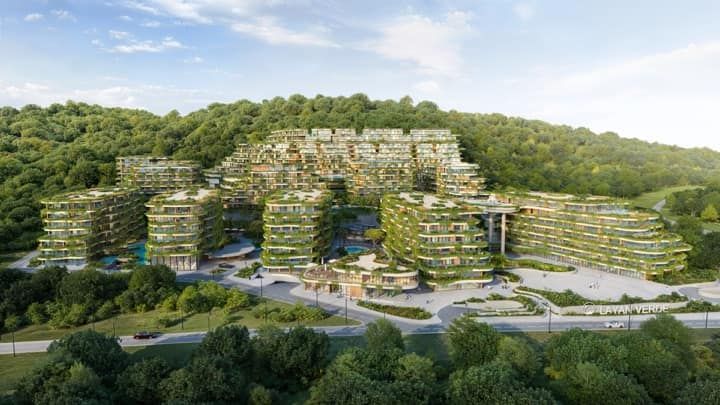
For Layan this means the following. The district does not depend on a single guest market, and the projects’ rental model is built on the annual cycle and a management company. For Layan Verde (700 m to Layan beach, handover December 2028) and phase 2 of Layan Green Park (handover 2026) the benchmark stays the same — about 8–10% net per year and a payback of roughly 12 years; the whole phase 1 price list of Layan Green Park is resales. What to track over the coming weeks: Golden Week results in the ministry data, the end of the flooding and the recovery timeline, and the Bank of Thailand meeting on 28 October. If you are choosing an entry point, see the best time to buy property in Phuket and the district comparison — Layan and Bang Tao.
I will send the current price list, fresh rental pool occupancy figures and a yield calculation for your budget — leave a request or see the terms on the Layan Real Estate page. The commission is at market rate; terms are discussed at a meeting.
This material is for information only and is not legal, tax or investment advice. Figures are given from the sources as of the publication date; forecasts remain forecasts. Check current rules and indicators at the time of the transaction.