When people talk about renting in Phuket, they usually mean either a hotel for a week or “a villa for $3,000 a month that a friend found”. Between those poles sits a separate market — long-term rental from 30 days: relocators, remote workers, winter visitors and families who want to test the island before buying. It has its own pricing logic, its own lease, its own calendar and its own traps — for tenants and owners alike. If you own a unit (or are only thinking of buying one), a long-term let is one of three strategies alongside nightly letting and a rental pool. This guide looks at the market from the inside: who is on it, how the rate is formed, what the lease must say, which taxes to account for, and when a long-term let loses to a managed programme.
A note on scope first. Layan Real Estate is a sales agency, not a rental operator: we pass long-term rental enquiries to vetted partners, and the rates in this article are guidance from open overviews, not an offer. All ranges are dated October 2026.
Contents
- What long-term rental means in Phuket
- Who rents: four demand profiles
- Rates by area and property type
- Seasonality: when rates are higher and when to negotiate
- The lease: what must be written down
- Deposit, utilities, hidden charges
- Owner taxes and costs
- Long-term let vs rental pool: the calculation
- Traps
- Mini case and next step
1. What long-term rental means in Phuket
The line between “nightly” and “long-term” in Phuket is drawn not by the market but by law. Letting a home for less than 30 days falls under the Hotel Act and requires a hotel licence — the authorities have confirmed this repeatedly, and daily condo letting has been publicly discussed by both Nation Thailand and the Bangkok Post. More on legality is in our guide to Airbnb and nightly rental in Phuket. Hence the practical definition: a long-term rental is a lease of 30 days or more.
Within that definition there are three formats:
| Format | Typical term | Features |
|---|---|---|
| Long-stay | 1–3 months | Higher monthly rate, furniture and utilities often “all-in”, popular with winter visitors |
| Seasonal / half-year | 6 months | Covers the high or low season, rate below the monthly one |
| Annual | 12 months | Lowest monthly rate, most stable income for the owner |
For the owner this is the key choice: the longer the term, the lower the rate but the fewer the gaps between tenants. For the tenant it is the other way round: they pay a premium for flexibility. A comparison with the nightly model on yield and operations is in short-term vs long-term rental: what an investor should choose; here we go deeper into the long-term side.
It also helps to understand what a long-term let is not. It is not a “buy and forget” model: somebody has to find the tenant, hand over the unit, inspect it at move-out, and decide what to do about a broken air-conditioner on a Saturday evening. If the owner lives abroad, those functions must be delegated to an agent or a management company, and their cost must be deducted from income (see what property management costs).
2. Who rents: four demand profiles
The rate and terms on the market are set by who sits across the table. In Phuket’s long-term segment there are four typical profiles.
Winter visitors. They come for 1–3 months in high season and care about a ready, turn-key home, fast internet and proximity to the beach. They are usually willing to pay a higher monthly rate for a short term and rarely haggle. For the owner this is the best segment by rate but the most fragmented by calendar.
Relocators and remote workers. They take a home for 6–12 months, often alongside a visa application (see Phuket for remote workers and the DTV). They need stable internet, a place to work and a clear lease. In the low season, when tourists are fewer, they make up a noticeable share of demand.
Families. They look for 2–3 bedroom villas or spacious condos, guided by schools, clinics and daily life (more in international schools in Phuket). These tenants stay long and look after the property better, but are more demanding about the condition of the unit.
“Try before you buy”. Prospective buyers who rent for a few months to understand the area and the seasons before a purchase. For the owner they are both a tenant and a potential buyer; our long-term rental page has a dedicated rent-to-buy block for such cases.
The practical conclusion: write the listing for a specific profile. For a winter visitor — “view, beach, kitchenware, linen, internet”; for a relocator — “internet speed, work area, 12-month lease”; for a family — “schools nearby, safety, garden”. A universal listing performs worse than any of the three.
3. Rates by area and property type
There is no open official statistic for long-term rental rates in Phuket: the market is fragmented and much of it is done directly. So we use the guidance from our overview of rent prices in Thailand as of October 2026 — these are ranges, not a price list.
| Property type | Monthly rate | Comment |
|---|---|---|
| Studio away from the sea | $500–800 | The minimum budget for the island |
| Studio or 1BR, Layan – Bang Tao | $700–1,500 | Walking distance to the beach, shops and schools |
| 2BR villa | $1,200–2,200 | Standard for a couple or a small family |
| 2–3BR villa or house, Layan – Bang Tao | $1,500–4,000 | Beachfront and Laguna sit at the top of the range |
| 3BR+ villa with pool | $2,000–4,000+ | Premium segment, often beachfront |
What drives the spread within a single row:
- Distance to the beach. The difference between “five minutes on foot” and “fifteen minutes by scooter” often matters more than floor area.
- Complex infrastructure. A pool, gym and reception raise a condo’s rate compared with an isolated studio of the same size, but save the tenant money on leisure and transport.
- Condition and fit-out. Fresh renovation, a proper kitchen, air-conditioning in every room — grounds for holding the top of the range. More on how the fit-out affects price is in the article on the furnishing package in Phuket.
- Area. For a comparison of areas for investment see the best areas of Phuket for investment, and for the two key north-west areas, the pages for Layan and Bang Tao.
It is important to understand that the rates in this table are what a tenant is willing to pay, not what the owner takes home. From the rate you must subtract vacancy, the agent’s or management company’s commission, repairs and taxes — see sections 7 and 8.
4. Seasonality: when rates are higher and when to negotiate
Long-term rental depends on the tourist calendar less than nightly letting, but does not escape it. The logic by period:
| Period | Demand | What it means |
|---|---|---|
| November – March/April (high season) | Peak, especially December–February; winter visitors take 1–3 months | Top of the range for short terms; the best units go early |
| April and November (shoulder) | Medium, wider choice | A convenient moment for a 12-month lease |
| May – October (low season) | Fewer tourists, more relocators and remote workers | Short-term rates lower; for a year-long lease negotiation is reasonable |
Three consequences for the owner.
First: plan a 12-month move-in for the shoulder season. If you sign a year-long lease in November–December at a “low-season” rate, you lock in for 12 months a price you could have exceeded at the peak. If you sign in May, the high season falls in the middle of the lease and the tenant gets a “term discount”.
Second: different units, different strategies. A studio by the sea makes sense as a seasonal let for 3–6 months in winter and then, for summer, a cheaper long-term tenant. A 3-bedroom villa, by contrast, works better with a family for a year.
Third: the low season is not a failure. Demand shifts toward relocators, and that is normal. More on how occupancy behaves by month is in rental seasons and occupancy in Phuket and the guide to the rainy season. Market occupancy data changes every year — check current reports rather than a retelling of last year’s statistics.
5. The lease: what must be written down
A good long-term lease is not a legal formality but a tool that answers in advance the questions that later spoil relationships. In Phuket the lease usually includes the following.
Parties and the right to let. The landlord must prove ownership of the unit with documents (for a condo, the title to the unit; for villas, the land and house documents) and their identity. If a representative signs, a power of attorney is needed. The tenant should check this before paying any money; the logic of title checking is described in how to verify a chanote and due diligence when buying — simpler for a tenant, but the principle is the same.
Term, rate, currency. The term, move-in date, rate in baht and deposit amount are written as numbers. It is better to fix the currency explicitly: if the rate is expressed in dollars but paid in baht, you need a conversion mechanism.
Rent-increase and renewal rules. For a 12-month lease, state how the price is reviewed at renewal (a fixed percentage, a market valuation, agreement 60 days ahead).
Early exit. The notice period (usually 30–60 days), the fate of the deposit, a penalty or its absence. For the owner this protects against a sudden “I’ve left”; for the tenant it guarantees the deposit will not “burn” without reason.
Subletting and nightly re-letting. Normally prohibited by both the lease and the condominium rules. For the owner a breach means Hotel Act risk; for the tenant, grounds for termination.
Registration. Under the Thai Civil and Commercial Code, a lease of immovable property for more than three years must be registered with the competent official (at the Land Department) — otherwise it is enforceable only for the first three years, and the maximum term of a lease of immovable property is 30 years. Standard 6–12-month leases do not need registration. Official information on registration procedures is on the Land Department website, but complex cases need a lawyer.
Inventory and handover report. A list of furniture and appliances, meter readings and photographs on the move-in date is the most underrated document. It settles 90% of deposit disputes.
This material is for information only and is not legal advice: before signing a lease of significant value or length, consult a licensed lawyer in Thailand.
6. Deposit, utilities, hidden charges
Money at the start and “tails” during the lease are the main source of misunderstandings. The usual market picture looks like this.
| Item | Common practice | What to look at |
|---|---|---|
| Deposit | 1–2 months’ rent plus the first month in advance | What can be deducted and how soon it is returned |
| Electricity | By meter, paid by the tenant | The per-kWh rate: it may exceed the government tariff |
| Water | By meter, paid by the tenant | Payment procedure and tariff |
| Internet | Usually at the tenant’s expense | Speed and who signs with the provider |
| CAM fee (common areas) | Paid by the owner, built into the rate | Should not be billed to the tenant separately unless stated |
| Cleaning and linen | By agreement | Whether included in the long-stay rate |
Electricity is especially tricky. If the owner resells power to the tenant at an inflated tariff, with the air-conditioning on, the monthly bill can noticeably exceed expectations. The tenant’s rule is simple: find out the per-kWh rate before signing. The owner’s rule: fix it in the lease and do not inflate it above the tariff — otherwise you get a conflict and a bad review instead of a small extra margin.
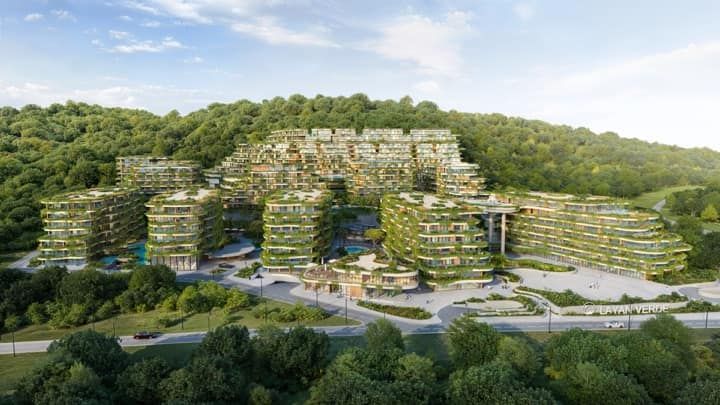
The owner also has the flip side: the costs that stay with them. These are the monthly CAM fee and the one-off sinking fund at purchase; how they work is explained in the article on sinking fund and CAM fees. In our projects: in Layan Green Park the CAM fee is 75 THB/m² per month, in Layan Verde 85 THB/m² per month. Subtract this from income before you call anything a “yield”.
7. Owner taxes and costs
Rental income in Thailand is taxable, and the procedure depends on the owner’s tax status. The Revenue Department publishes an overview of rates and the withholding procedure; non-residents receiving rental income are subject to withholding rules, while residents file under the progressive scale. Which scheme applies to you depends on days spent in the country and the source of income; we have covered this in rental income tax in Thailand, tax residency and the 180-day rule and income tax rates for foreigners. A double tax treaty can affect the outcome — see double tax treaty.
A practical minimum for calculating net income:
- Gross rent for the year (rate × paid months, not × 12).
- Less vacancy between tenants — plan for at least one month per tenant change.
- Less commission to the agent for finding the tenant and/or the management company. On the market it is a market commission negotiated individually; in our partner model, a market commission with terms agreed at a meeting.
- Less fixed costs: CAM fee, insurance, minor repairs, furniture wear, utilities during vacancy.
- Less tax according to your status.
Only then do you get a figure that can be compared with other strategies. A step-by-step method is in how to calculate ROI in Phuket. This is general information, not tax or legal advice: have a personal calculation done with a tax adviser.
8. Long-term let vs rental pool: the calculation
Now the main question for an investor: if the unit is in a project with a rental programme, what pays better — letting it yourself for a year or putting it in the pool? First the terms in our projects (from the catalogue): in Layan Verde and Layan Green Park the owner receives 60% of the pool’s net profit, with 40% going to the management company; the yield guide is ~8–10% net per year, which is the programme’s target, not a guarantee. The owner also has 30 days of personal use per year (May–October). Payback at that guide is around 12 years.
Now an illustration of a long-term let. Suppose you bought a studio in Layan Green Park on the secondary market: all of phase 1 is resales, and studios from 30 m² are priced from $142,602. Suppose you let it for a year at $1,000 a month — within the $700–1,500 range for studios in the area. This is a hypothetical calculation for illustration, not a forecast or a promise.
| Item | Value |
|---|---|
| Gross rent at $1,000/month for 12 months | $12,000 |
| Gross yield on a price from $142,602 | ≈8.4% |
| Vacancy between tenants (1 month) | −$1,000 |
| CAM fee: 75 THB/m² × 30 m² | 2,250 THB per month |
| Other costs, commission, tax | depend on your status and arrangement |
What the table shows. First, “gross 8.4%” is not 8–10% net: after vacancy, CAM fee, commission and tax the result will be noticeably lower. Second, $1,000 for a studio is an optimistic scenario within the range; at $700 the gross yield falls proportionally. Third, a rental pool at 60% of net profit removes tenant search, repairs and operations from the owner — which is exactly why the comparison should be made not on gross rate but on net cash flow and on your time.
When a long-term let makes sense:
- the unit is outside a project with a rental programme (a standalone villa, a condo without a management company);
- you live on the island or have a reliable agent there;
- you want a stable, predictable payment independent of the season;
- you plan to use the unit yourself during the year and let it for the season.
When the pool is better:
- the unit is in a licensed condotel with a management programme: how the programme works;
- you live abroad and do not want to handle operations;
- the goal is the maximum total income from nightly letting in high season rather than a fixed rate.
The scenarios can be combined, but not within one unit at the same time: participation in the pool normally excludes a separate long-term let. More on yield by type is in rental yield in Phuket and the ROI calculator on the home page.
9. Traps
Typical mistakes we see among owners and tenants.
- Counting on 12 months of rent a year. Real income is the rate times occupied months minus vacancy. Build in a scenario with an empty month.
- Nightly letting disguised as long-term. A 30-day lease renewed every month for a different tenant is not a long-term let. The Hotel Act fine risk falls on the owner.
- No handover report. Without photos and meter readings it is impossible to prove that a scratch on the table was there before the tenant (or after).
- Deposit to an intermediary’s card. Money goes to the owner or a partner company against a receipt or contract, not to the personal card of a stranger. “Rental” scam schemes are covered in property scams in Thailand.
- Inflated electricity tariff. A conflict in the first month, a bad review and an early move-out.
- Verbal renewal. “You stay another year on the same terms” without a written addendum is the most common cause of disputes over deposit and rate.
- Ignoring taxes. Rental income must be accounted for under your tax status; “we’ll sort it out later” turns into a fine and interest.
- Comparing gross yield with net. You cannot put “8.4% from rent” beside “8–10% net from the pool”: they are different quantities.
- Choosing the property for the strategy after the purchase. If you plan a long-term let, you need a unit with a clear legal status and no rental ban in the condominium rules. If you plan the pool, a unit in a project that has one.
10. Mini case and next step
Mini case (hypothetical, for illustration). A European investor buys a studio on the secondary market in Layan Green Park and in year one wants to “test” a long-term let. They sign a 12-month lease at $1,000 a month, but learn three things: finding a tenant took six weeks of vacancy; receiving the unit remotely and dealing with the air-conditioner has to go through an acquaintance who acts as an agent; and after CAM fee, commission and tax the result turned out noticeably below the gross 8.4%. In year two they move the unit into the rental pool: the owner receives 60% of the pool’s net profit, the management company runs it, and the 30 days of personal use per year (May–October) are kept for visits. The moral is not that the pool is “always better”: it removes operations and moves the result toward the ~8–10% net guide, but shares profit with the management company. A long-term let keeps control and suits you when you are nearby and the unit is not in a programme.
What to do next.
- If you are choosing a unit to let, compare projects that have a management programme: Layan Verde (studios from $235,995, completion in December 2028, 35%/50% instalment plans) and Layan Green Park (phase 1 resales from $142,602, a finished complex).
- If you need a rental — for a month or a year — leave an enquiry on the long-term rental page: we will pass it to vetted partners.
- If you are still deciding on a strategy, read short-term vs long-term rental and the rent prices overview.
- If you need a personal calculation for your budget and term, we will go through it at a meeting: about the agency has contacts and how we work.
Layan Real Estate is an authorised sales partner for VillaCarte Group projects. We select a property for the client’s brief, not for our own construction sites: if a long-term let suits you better than the pool, we will say so plainly. Partnership terms — a market commission, details at a meeting.