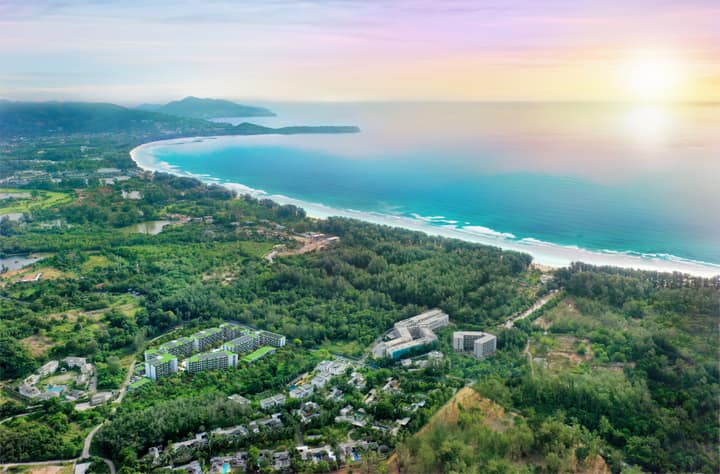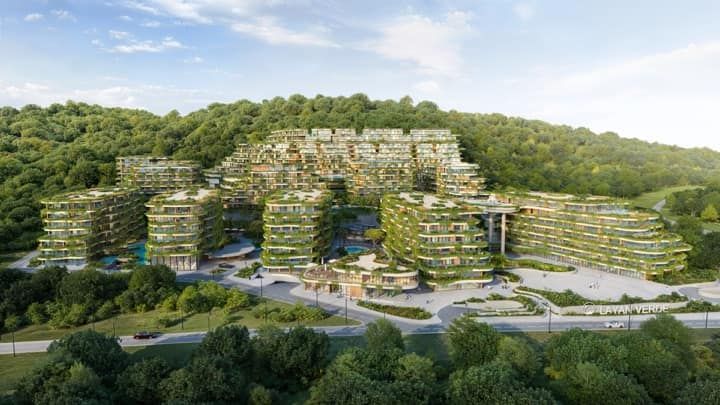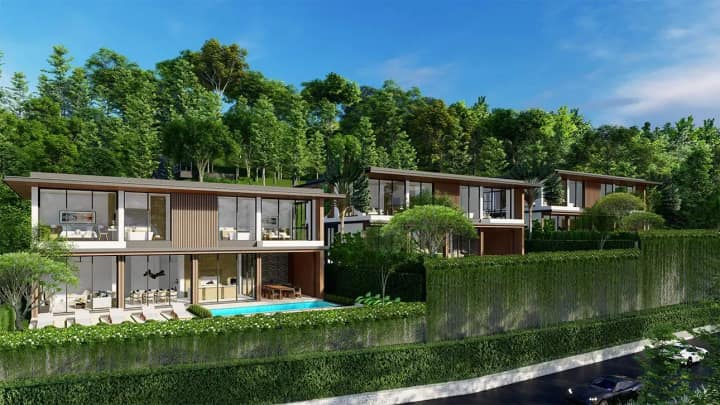
Batumi keeps coming up lately in conversations about a “second seaside property” alongside Phuket — both cities sell an investor a waterfront, a resort crowd and apartments in new towers. That is roughly where the similarity ends. Georgia offers a foreigner something Thailand simply does not — full freehold ownership with no quota on any apartment, plus a visa-free year of stay — but in exchange it carries something Phuket largely shed years ago: an unstandardised yield model, an entry price that has jumped sharply in 2025–2026, and an EU accession process the government itself froze at the end of 2024 against a backdrop of street protests. We compare both markets on one methodology — from entry price to political risk — so the decision rests on the market structure of 2026, not on postcard photos of Batumi’s boulevard or Patong.
Contents
- Two markets, two very different risk profiles
- Entry price and typical product
- Ownership structure for a foreigner
- Yield and rental management models
- Taxes and fees
- Visas and residency through property
- Currency, macro and political risk
- Infrastructure, logistics and lifestyle
- Traps
- Case: choosing between Batumi and Phuket
1. Two markets, two very different risk profiles
Phuket and Batumi are resort cities where real estate plays a similar economic role — tourist flow, foreign capital, a waterfront as a showcase — but they grew out of very different legal and political contexts.
- Batumi (Georgia). The capital of the Adjara Autonomous Republic on the Black Sea coast, with a city population of around 170,000. Its property market has long fed on foreign demand thanks to one of the most liberal ownership regimes in the world — no quota, no citizenship condition, almost no bureaucracy. Title registration runs through the National Agency of Public Registry (napr.gov.ge), and since late 2024, against the backdrop of the country’s suspended EU accession process, Tbilisi and Batumi have seen recurring protests that do not by themselves change property law, but do create a backdrop investors have to factor in.
- Phuket (Thailand). An island where real estate is part of the tourism industry, and demand is driven by tourist arrivals and air connectivity rather than migration policy. The single national title registrar — the Department of Lands — has not changed in decades, and the basic ownership rules (freehold within a 49% quota for condos, leasehold for villas) remain among the most stable in Southeast Asia.
It is worth not confusing “liberal ownership rights” with “low risk” — these are different axes of comparison, and Georgia is a good example of how the first can coexist with a fairly unimpressive version of the second. For how Phuket stacks up against other international markets, see our comparisons Thailand vs Dubai, Thailand vs Bali, Thailand vs Turkey and Thailand vs Portugal, which apply the same method to other pairs.
2. Entry price and typical product
Batumi formally looks noticeably cheaper than Phuket per square metre — but that figure hides a different product and a different growth rate.
| Parameter | Batumi (Georgia) | Phuket (Thailand) |
|---|---|---|
| Typical format | Apartment in a waterfront condo tower, often with no unified rental model | Condo-hotel / residence in a rental pool |
| Average price per m² | ~$1,395 city-wide average (mid-2026, +16.5% year-on-year); new builds ~$1,455 (+22.6% year-on-year) | Studio from $235,995 (payment plan tied to construction) |
| Top locations | New Boulevard ~$1,787/m²; Rustaveli and the Old Town $1,800–3,500/m² | Ready resale unit at Layan Green Park — $142,602, straight into the rental pool |
| Recent price trend | Double-digit year-on-year growth amid a high-rise construction boom | Growth tied to a specific project’s construction stages (Layan Verde studios rose from $224,776 to $235,995) |
| Foreign buyer share | Up to 47% of Batumi apartment transactions in April 2026; main buyers from Israel, Kazakhstan, EU countries | Main demand from CIS, European and Middle Eastern buyers |
Batumi sells entry at a low price per metre into a city in the middle of a high-rise construction boom: in recent years the waterfront has filled with dozens of towers, some under hotel brands, others ordinary residential complexes with no unified management structure at all. Phuket sells a finished resort product: a unit in a complex with its own infrastructure, where the developer controls construction and handover and a management company delivers income under a transparent formula.
The double-digit annual price growth in Batumi (+16.5–22.6% depending on the segment) signals not just demand but an overheated market: a similar pattern in 2026 showed up in Portugal (+17.8% year-on-year, covered in Thailand vs Portugal), and in both cases it came with rising cost of living pressure for local residents. On Phuket, price growth at Layan Verde and Layan Green Park studios is tied to specific construction milestones of a specific project rather than city-wide dynamics — these are different kinds of processes, so comparing them directly as percentages is not entirely fair.
3. Ownership structure for a foreigner
This is where Georgia offers the broadest rights of any international pair we have compared — broader even than Portugal.
Georgia. A foreigner of any nationality can own residential and commercial property in full freehold with no quota, no residency requirement and no obligation to set up a local company. Deals register through the National Agency of Public Registry — one of the fastest and most transparent registries in the region. The one systemic restriction is agricultural land: since the 2017 constitutional reform, only Georgian citizens (or the state, or associations of citizens) can own it directly; a foreign investor is left with long-term leasing (up to 49 years) or narrow exceptions via a separate government decision for strategic projects. It does not apply at all to apartments in Batumi condo towers sitting on non-agricultural land.
Thailand. A foreigner can own a condominium unit as freehold within a quota — up to 49% of a building’s floor area can be held directly by foreign owners, registered through the Department of Lands nationwide. For a villa on land, leasehold is available — a registrable 30-year land lease with renewal options. Details in leasehold vs freehold in Thailand.
| Criterion | Georgia | Thailand |
|---|---|---|
| Foreigner’s right to housing | Full freehold, no quota | Freehold within a 49% quota (condo) or leasehold (villa) |
| Local company required | No | No, for freehold condos |
| Asset-type restriction | Agricultural land — Georgian citizens only | Land under a villa — not directly foreign-owned |
| Registrar | National Agency of Public Registry | Department of Lands |
| Typical deal registration time | One of the fastest in the region | Standard procedure, timing set by contract |
Bottom line: on breadth of ownership rights, Georgia beats both Thailand and Portugal — no housing quota, no leasehold for apartments. But that same ease of entry, paired with the lack of a unified industry standard for rental management (section 4), is exactly why Batumi’s market has for years filled up with projects of wildly uneven quality — from units under recognised hotel brands to unnamed towers with no coherent income model at all.
4. Yield and rental management models
This is the section where the gap between the two markets is most tangible in practice — and it does not favour the ease of entry described in section 3.
Thailand. The core instrument at flagship projects is the rental pool: identical units are pooled together, a management company rents them out and distributes net profit under a formula, typically 60% to the owner / 40% to the operator. At Layan Verde and Layan Green Park this targets ~8–10% net annual yield — a target figure backed by the working operation of Layan Green Park’s completed phase 1 since 2024. The calculation method is covered in how to calculate ROI in Phuket.
Batumi. There is no industry standard comparable to Thailand’s rental pool with a fixed, published formula. Instead, recent years have seen the spread of a marketing programme called “guaranteed yield”: a developer promises a fixed annual percentage or to buy the unit back after a set period. According to industry reviewers, the 4–5-year payback periods advertised are realistic only under a speculative strategy or in exceptional cases, and net yield after management fees, utilities and periodic repairs is often 30–40% below the advertised gross figure. The scheme’s key weakness is that the guarantee is backed not by law or an industry regulator, but purely by the financial strength of the specific developer — if its cash flow weakens, the “guaranteed” payment is usually the first thing cut.
| Parameter | Thailand (flagship pool) | Batumi (typical unit) |
|---|---|---|
| Management model | Developer’s management-company rental pool | Developer “guaranteed yield” or self-managed rental |
| Distribution formula | 60% owner / 40% operator, fixed in the contract | Individual terms per developer, often without calculation detail |
| Legal backing of the guarantee | Contract with a working pool’s payment history | Equals the financial strength of one company, not law |
| Advertised yield | Target of ~8–10% net | Advertised 4–5-year payback — usually unrealistic |
| Actual net yield | Confirmed by phase 1 LGP’s operation since 2024 | Often 30–40% below the advertised gross figure |
Practical takeaway: on Phuket, yield is typically a formula in a contract with the developer’s management company, backed by a verifiable payment history. In Batumi, an attractive percentage on a billboard is first and foremost one seller’s marketing — before buying, ask for historical reports from the same operator’s existing buildings, not a promotional slide.
5. Taxes and fees
Georgia. Income from renting residential property to an individual is taxed at a flat 5% of gross income with no deductions, provided the landlord is registered with the Revenue Service (rs.ge). Without registration, a corporate tenant must withhold tax at 20% instead. There is no separate annual property tax for most owners: from October 1, 2026, the annual family income threshold above which property tax even applies has been raised to GEL 100,000 (from GEL 40,000), with rates for those above the threshold ranging from 0.05–0.2% up to 0.8–1% of market value depending on income level. On sale, capital gains are fully exempt from tax if the property has been owned for more than 2 years (renting it out during that period does not forfeit the exemption); below 2 years of ownership, a 5% rate applies to the gain on residential property.
Thailand. A transfer fee at the Department of Lands on each sale (split with the seller by agreement), rental income tax typically withheld at source for a non-resident, capital gains tax and a specific business tax on sales within five years of ownership. At finished projects there is a monthly CAM fee (85 THB/m² at Layan Verde, 75 THB/m² at Layan Green Park) and a one-off sinking fund (850 and 650 THB/m² respectively). Details in property taxes in Thailand and sinking fund and CAM explained.
| Cost item | Georgia | Thailand (Phuket) |
|---|---|---|
| Tax on rental income | 5% if registered in the landlord register | Withheld at source for a non-resident |
| Annual property tax | None for most owners (threshold: family income above GEL 100,000 from 01.10.2026) | No separate ownership tax (aside from CAM/sinking fund) |
| Capital gains tax | 0% after 2 years of ownership; 5% if shorter | Applies on sale, including specific business tax within 5 years |
| Common-area / repair fund | Not standardised — varies by tower | CAM fee + sinking fund, known upfront from the price list |
| VAT / taxpayer registration | Mandatory once rental income exceeds GEL 100,000 over 12 months | Not applicable to a private non-resident owner in this model |
On paper, Georgia’s tax system is gentler than Thailand’s — especially the capital gains exemption after two years of ownership. But it offers less predictability at the level of a specific building: common-area maintenance costs across Batumi’s towers are not standardised and are not always transparent upfront, whereas at Layan Verde and Layan Green Park the CAM fee and sinking fund are fixed in the developer’s price list before the deal is even signed.
6. Visas and residency through property
This is the one section where the gap clearly favours Georgia — and it is usually the reason investors look at Batumi in the first place.
Georgia. Citizens of roughly 95 countries, including the EU, the US, the UK, Russia, Ukraine, Belarus and Kazakhstan, can stay in the country for up to 365 days a year without a visa — one of the longest visa-free regimes in the world; since January 2026, border control has also required proof of medical insurance with at least $30,000 of coverage. Separately from the visa regime, a residence permit through real estate purchase exists: from March 1, 2026, the threshold rose from $100,000 to $150,000 (based on an accredited appraiser’s valuation, counting the combined value of all properties owned); permits registered before that date keep the old threshold on renewal. There is also a second track — the investment residence permit with a shorter path to permanent residency, requiring at least $300,000 in real estate or a business. Neither route grants citizenship directly — naturalisation remains a separate, lengthy process.
Thailand. Buying a condo or a villa has never granted a visa on its own — a separate line-up of instruments is used instead: LTR — a visa for wealthy residents, pensioners and remote professionals with tax benefits on foreign income (details in our LTR visa overview); DTV — a 5-year visa for digital nomads (more in our Destination Thailand Visa overview); and the classic Non-O/O-A retirement visa. Thai citizenship through investment does not exist as a legal pathway at all.
| Parameter | Georgia | Thailand |
|---|---|---|
| Visa-free period | Up to 365 days a year for ~95 countries | Standard visa-free tourism/transit — weeks, not a year |
| Residence permit via property purchase | Yes, from $150,000 as of 01.03.2026 (up from $100,000) | No such route exists |
| Investment residency with a faster path to PR | From $300,000 in property or a business | LTR/DTV — based on income and status logic, not a property amount |
| Citizenship through investment | Not available | Not available |
Practical takeaway: if the goal is to stay in a country for long stretches without visa hassle and hold a residence permit as a backup, Georgia offers the lowest entry threshold of any market we have compared. If the goal is yield and stable rules rather than migration status, the gap narrows quickly in Phuket’s favour (sections 4 and 7).
7. Currency, macro and political risk
This is the section with the sharpest divergence between the two markets — and it does not favour Batumi.
Georgia. The lari (GEL) has a history of sharp devaluations: during the 2008 war and at the height of the COVID-19 pandemic in 2020, it lost a significant share of its value against the dollar, though the National Bank of Georgia kept the rate within a relatively narrow band through 2025–2026. Far weightier than currency risk is the political one: in July 2024 the European Union suspended Georgia’s EU accession process over a parliament-passed “foreign agents” law, and on November 30, 2024 the country’s prime minister announced that EU membership talks would be postponed on the government’s own initiative — until 2028. The decision triggered a wave of protests in Tbilisi and Batumi that has continued intermittently into 2025–2026. For the property market, this is not a one-off shock but a prolonged period of uncertainty: part of the foreign demand for Georgian real estate in recent years was a bet on the country’s European trajectory specifically, and freezing that trajectory changes the underlying logic of the investment.
Thailand. The Thai baht has historically been stable against the dollar, and Phuket’s flagship projects price and pay yield in dollars, removing part of the currency risk from the investor at the contract level. Basic rules on ownership, rental and taxation on the island have not changed in years; the only current area of regulatory attention in 2025–2026 is nominee Thai companies used to circumvent land law (more in owning a villa through a Thai company). Political turbulence on a scale comparable to Georgia’s has not occurred on Phuket during this period.
| Risk factor | Georgia | Thailand (Phuket) |
|---|---|---|
| Currency stability | Lari — history of sharp devaluations (2008, 2020), relative stability in 2025–2026 | Baht relatively stable against the dollar; flagship prices in USD |
| Political / regulatory risk | High — EU accession suspended until 2028, protests since November 2024 | Low — basic rules unchanged for years |
| Main structural risk | Uncertainty over the country’s foreign-policy direction | Nominee Thai companies circumventing land law |
| Effect on resort demand | Part of demand was tied to the country’s “European story” | Demand is driven by tourist flow, not migration policy |
Practical takeaway: an investor choosing Batumi should factor in not just the lari’s exchange rate but the likelihood that the country’s political context will stay unstable for the next few years — this is not a hypothetical scenario but a pause the government itself announced through 2028.
8. Infrastructure, logistics and lifestyle
- Airports and flights. Phuket has an international airport (HKT) with direct flights to Europe, Asia and the Middle East, 15–25 minutes from the west coast, including Layan and Bang Tao. Batumi has its own international airport (BUS), but most intercontinental flights route through Tbilisi — another roughly 350–370 km and about 5–6 hours by road, or a short domestic flight.
- Resort season. Phuket runs on year-round tourist flow, with a clear high/low season split by rainfall but working infrastructure all year. Batumi is a Black Sea resort with a pronounced peak in June–September and a noticeably quieter off-season, when part of the boulevard’s cafes, bars and services close for winter.
- Beach and sea. Phuket has sandy Andaman Sea beaches with turquoise water in the dry season. Batumi has pebble beaches on the Black Sea, with cooler water and a less pronounced turquoise tint; the resort leans more on its city promenade and nightlife than classic beach relaxation.
- Healthcare and schools. Phuket has a network of international-standard private clinics (Bangkok Hospital Phuket) and international schools 20–25 minutes from most resort areas. In Batumi, international infrastructure for expats is noticeably less developed than in Tbilisi — most families with school-age children look to the capital instead.
- Cost of everyday life. Both destinations are noticeably cheaper than northern Europe, but Batumi’s double-digit annual property price growth in recent years is gradually pushing up rents for local residents, while everyday costs on Phuket are rising at a more moderate pace.
9. Traps
- Trusting the advertised “guaranteed yield” percentage. That guarantee is backed by the developer’s financial strength, not by law; if its cash flow weakens, the payment is usually the first thing cut.
- Not checking the land status under the property. The restriction covers only agricultural land, but when buying a house or plot outside central Batumi, confirm the land’s designated use in the registry before signing.
- Planning a backup residency strategy around the old threshold. From March 1, 2026, the minimum for a temporary residence permit via property is $150,000, not $100,000 — calculations from outdated articles online no longer apply.
- Treating the frozen EU accession as a temporary formality. The decision to postpone talks until 2028 was announced by Georgia’s own government in late 2024 amid ongoing protests — this is not external pressure that could quickly reverse, but the ruling party’s own policy.
- Comparing Batumi’s gross yield to Thailand’s net pool yield. Advertised percentages from Batumi developers are usually gross, before management fees and utilities; the ~8–10% benchmark on Phuket is already a net figure to the owner under the 60/40 formula.
- Underestimating uneven construction quality. Amid the recent high-rise construction boom, Batumi’s market includes projects with delayed handovers and quality complaints — a specific developer’s track record deserves the same scrutiny as on Phuket (method in how to choose a developer in Phuket).
10. Case: choosing between Batumi and Phuket
An investor with a budget of around $250,000 was looking at apartments in a new tower on Batumi’s waterfront back in 2023 — drawn in by the low price per metre, full ownership with no quota, and the prospect of a visa-free year in a country on a path to the EU. Returning to the numbers in 2026, the picture had changed: the entry price had risen 16–22% depending on the segment, the developer’s promised “guaranteed yield” turned out in practice to be a third lower than advertised after management fees, and the country’s European prospects — the very asset that made Batumi appealing in the first place — had been frozen by the government itself until 2028 amid ongoing protests.
A studio at Layan Green Park near Layan beach, by contrast, went straight into a working rental pool with a 60/40 formula and a ~8–10% net dollar-yield target, freehold registered within the quota with no company required, and deal terms and ownership rules unchanged since the purchase date. The investor chose Phuket — not because Batumi had become a bad city to live in, but because they were after predictable yield and stable rules for years ahead, not the lowest entry threshold available today.
Conclusion. Georgia and Thailand are fundamentally different propositions for a 2026 investor. Batumi offers the most liberal ownership rights and the longest visa-free regime of any market we have compared, but in exchange comes a market with no unified yield standard, a sharply higher entry price, and political uncertainty the government itself has announced through 2028. Phuket suits those who value predictable dollar-denominated yield, a ready-made net-income formula in a contract with a management company, and rules that have not changed in years. For a wider view, see our comparisons Thailand vs Dubai, Thailand vs Bali, Thailand vs Turkey and Thailand vs Portugal, which apply the same method to other market pairs.
I can help compare specific properties on Phuket for your budget and goals, with a yield estimate from the ROI calculator — or we can discuss strategy through Layan Real Estate. Our group’s own projects are Layan Verde and Layan Green Park.
A shortlist matched to your strategy
By submitting this form, you agree to the privacy policy.