“Branded residence” is one of the loudest terms on the Phuket market and one of the vaguest. For one seller it is a villa “managed by Marriott”, for another it is an apartment next to a hotel where “there is a reception and a spa”. That does not make life easier for the buyer: a name on the façade looks good in a presentation, but money and risk are determined not by the logo but by the contracts behind it and by who is responsible for what. We have already covered the price of a brand per square metre and the payback of the premium and the industry reports by Savills and C9 Hotelworks. This is the third, practical layer: how the model works from the inside, who the players are, which contract formats exist, what an owner’s costs consist of and what happens when the brand leaves. At the end there is a walk-through using Layan Verde and a checklist of questions for any project.
Contents
- What a branded residence is — and what it is not
- Four roles: developer, brand, operator, owner
- Three formats of the link with the brand
- The market in numbers: what is known today
- Where income comes from and how it is split
- Owner costs: what you pay for besides the unit price
- Case: Layan Verde and Dusit International
- If the brand leaves: exit, resale, legacy
- Pitfalls: what most often goes wrong
- Mini-case and checklist of questions
1. What a branded residence is — and what it is not
The classic definition is short: residential real estate sold and serviced under the name of a hotel or lifestyle chain. The buyer becomes the owner of a unit, and the chain provides three things: the name, service standards and (most often) the infrastructure of a resort hotel — pools, restaurants, a spa, concierge, cleaning and technical maintenance. For a resort such as Phuket this is a natural format: most buyers do not live on the island all year round, and they need an asset that “lives by itself”.
To tell a real brand from marketing, it helps to know what a residence is not:
- A developer’s brand. If a developer has an attractive name of its own, that does not make it an operator. A loud name of a group of companies does not mean the units are managed by an international chain.
- A hotel next door. A line such as “a step from a 5* hotel” in a brochure is about location, not about a contract. A project becomes branded when the chain is signed specifically to manage these residences.
- A guaranteed income. The brand is not obliged to pay you anything. Income is a separate rental programme, and its terms sit in a different document.
- A legally special type of title. Title to a branded apartment is registered in the same way as for an ordinary one: freehold within the foreign quota, or leasehold. Registration is handled by the Department of Lands (dol.go.th), and the specifics of the format live in the contracts, not in the title. More on title in the article freehold or leasehold.
It is also worth remembering that the format overlaps with the condotel: in many branded projects in Phuket the units are let through a rental pool. We covered the pool mechanics in the article condotel explained; what matters here is something else — who stands above the pool.
2. Four roles: developer, brand, operator, owner
Four parties work behind the façade of a branded project. Confusion between them is the main source of misunderstandings.
| Role | What it does | What you need to find out |
|---|---|---|
| Developer | Buys the land, builds, sells the units, hands over the building | Completed projects, financing, construction schedule |
| Brand owner | Licenses the name, sets the standards, checks quality | Whether a contract is signed and for what term |
| Operator | Runs the property daily: staff, bookings, cleaning | Which company manages the residences and under what scheme |
| Owner (you) | Owns the unit, pays fees, receives a share of income | Which rights and obligations are fixed in the contract |
Sometimes the brand owner and the operator are the same chain, and then quality control is at its strongest: the name and the responsibility sit with one company. In the other variant some give the name, while a local management company runs the property “to the chain’s standards”. Both variants are legal, but they are different products with different risk: in the second case the standards work for as long as the licence contract lives, and the team on site is not from the chain.
The practical conclusion is simple: to the question “who manages it” you should be given a legal entity, not just a brand. The operator’s name in the contract, the term of its authority and the replacement procedure are the first things to write down at a meeting. A general list of warning signs for developers is collected in the article developer red flags, and on choosing a company see how to choose a developer in Phuket.
The owner is also a party, and not a passive one. Your task is to understand what you sign: the sale and purchase agreement (with the developer, or with the previous owner on a resale), the contract joining the rental programme and the rules of the complex. Three documents, three different logics, and a conflict between them is a common trap.
3. Three formats of the link with the brand
Not all branded projects are “branded” to the same degree. Roughly, they can be divided into three formats, and this is one of the key questions to put to the seller.
| Format | How it works | Strength | Weakness |
|---|---|---|---|
| Management agreement (HMA) | The chain itself manages the property with its own team | Responsibility and quality sit with one company | Fees and terms are usually stricter |
| Name licence | The chain gives the name, a local company manages to the standards | More flexible on cost | Weaker quality control, depends on the contract |
| Developer’s own brand | The developer’s name, the operator can be anyone | Simplicity, a single point of responsibility | It is not an international chain, so do not expect a premium for the name |
In practice the format determines how much you pay for the brand and what you get in return. Under an HMA the operator answers with its reputation: if the service fails, a world-famous name suffers. Under a licence the incentives are weaker: the name on the sign rests on a contract, while the daily work is done by a local team.
Another difference is what exactly is included in the “brand”. Sometimes the name is present only on the hotel on site, while the residences are sold as ordinary condos with the option of a rental programme. Sometimes it is the other way round: the residences are part of the hotel system in full, with shared booking, guest loyalty and a single standard. Ask a direct question: “Which units and which services are under the brand, and which are not?” An answer of “everything” without contract details is a reason to dig further.
Finally, the term. Contracts with chains are usually long, running for years and decades, with a possibility of renewal, but every contract has termination terms. We discuss them in detail in section 8.
4. The market in numbers: what is known today
So that the format does not look like a niche, it helps to look at the scale. The data below is dated; these are snapshots from different sources, not forecasts “for all time”.
| Indicator | Value | Source and date |
|---|---|---|
| Completed branded market of Thailand | THB 205.3 billion, +13.3% over the year | C9 Hotelworks, June 2026 (via The Nation Thailand) |
| Units in Phuket | 3,465 | C9 Hotelworks, 2026 |
| Thailand’s position by pipeline in Asia Pacific | 2nd place | Savills, via Bangkok Post, 23.09.2026 |
| Forecast growth of the APAC pipeline by 2032 | +97% | Savills, forecast |
| Branded projects in the Layan Real Estate catalogue | 25 of 348 | Catalogue as of 26.08.2026 |
| Median $/m² with and without a brand | $6,274 versus $3,298 | Catalogue as of 26.08.2026 |
Two caveats. First: a pipeline is future supply, not yield. A growing list of announced projects means stronger competition between brands for the same buyer and tenant, not an automatic rise in prices. Second: the per-metre premium calculated from the catalogue is the difference between medians across different formats, not a guaranteed markup on your price. Within a single format it is noticeably more modest; we put the detailed calculation and an honest correction into a separate analysis.
What follows from this in practice? The segment exists and is growing, but competition is growing too. In a few years the island will have more projects with well-known names, and telling them apart will come down to actual operation: occupancy, guest reviews, team stability. That is why the track record of a working property is worth more than the promise of a new one.
5. Where income comes from and how it is split
The income of a branded residence almost always comes through the operator’s rental programme, and there are three main models.
- Rental pool. The income of all units is added up, costs are deducted, and the net profit is split between owners and the management company. In VillaCarte Group programmes it is 60% of net profit to the owner and 40% to the management company. The benchmark for Layan Verde and Layan Green Park is about 8–10% net per year, with a payback of around 12 years. This is a target, not a guarantee.
- Contractual guarantee for the first years. Some projects back the forecast with a promised minimum for a limited period. In our catalogue such promises appear, for example, at La Vita (6% for 2 years), MGallery MontAzure (6% for 3 years) and Wyndham Grand Nai Harn (a programme with 7% for 5 years). A guarantee is not a gift: it is built into the unit price, and the main question about it is what happens when the term ends.
- Letting it yourself using the infrastructure. A rare variant: you find guests yourself, while the operator provides the service for a fee. The income potential is higher, but so is the workload.
To compare such offers with each other, count not the stated percentage but the net cash flow after all fees and tax. How to do that step by step is shown in the article how to calculate ROI in Phuket, and our general payback benchmark is collected in the calculator on the page /#roi. On how management programmes are built, read the analysis rental management programme.
Tax on rental income is a separate topic: it depends on your tax status and can noticeably change the final result. We covered it in the article tax on rental income in Thailand. Do not take the gross figure from a brochure for money that will reach your account.
6. Owner costs: what you pay for besides the unit price
The brand premium lives not only in the price per metre but also in the cost of ownership. Chain standards cost money: more frequent furniture refreshes to specification, funds, maintenance of common areas at hotel level. So the right question is: what is the full table of owner costs?
We do not publish the chain fees of other developers’ projects (they differ and change), but here is what costs look like in the group’s projects according to the catalogue:
| Item | Layan Verde | Layan Green Park |
|---|---|---|
| CAM fee (common area maintenance) | 85 THB/m² per month | 75 THB/m² per month |
| Sinking fund (major repairs, one-off) | 850 THB/m² | 650 THB/m² |
| Leasehold registration | 1.1% every 30 years | — |
| Electricity and water | at tariff | state tariff |
Let us calculate for a 36.2 m² studio in Layan Verde: CAM comes to 85 × 36.2 = 3,077 THB per month (36,924 THB per year), and the sinking fund to 850 × 36.2 = 30,770 THB one-off. For a 30 m² studio in Layan Green Park, CAM is 2,250 THB per month and the sinking fund is 19,500 THB. These are meaningful lines, but they are known in advance and can be built into the calculation. The fees you were not shown are the dangerous ones.
What to ask the seller for in writing:
- the monthly CAM and the rules for its indexation;
- one-off and periodic contributions to funds (major repairs, furniture refresh);
- fees for use of the brand and for management, if they are charged to the owner;
- the cost of the furniture package to the operator’s specification and how it is replaced;
- rules for changing fees in future: who decides, and how.
How CAM and the sinking fund work is shown in detail in the article CAM fee and sinking fund in Phuket, and the overall budget of a deal in the analysis how much it costs to buy property in Phuket.
7. Case: Layan Verde and Dusit International
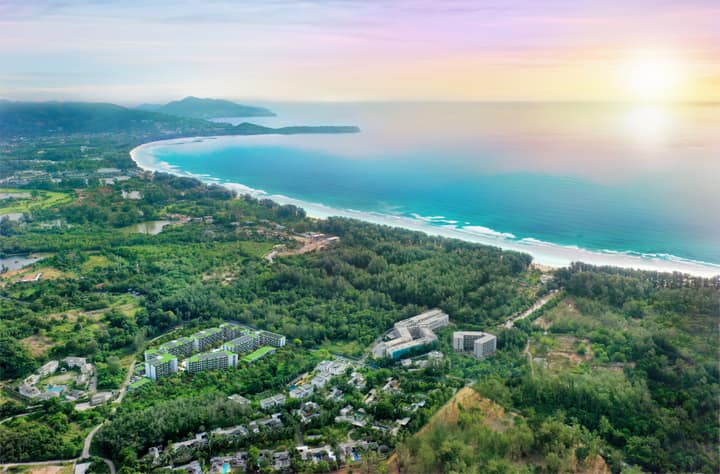
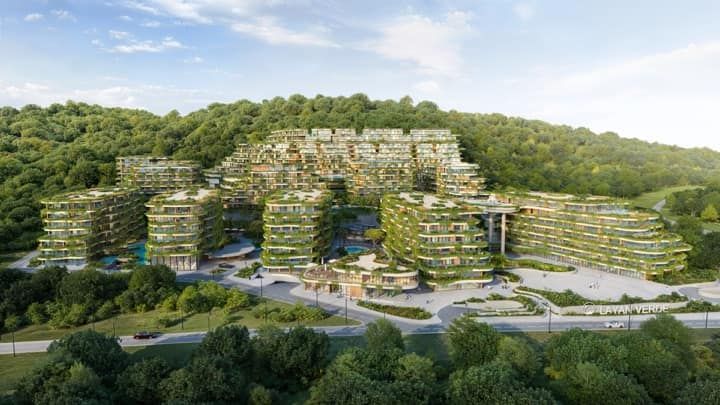
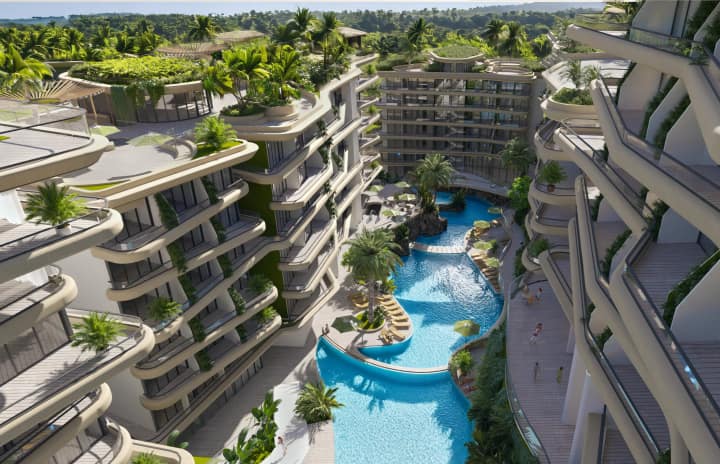
Layan Verde is an example of a project where a hotel brand is built into the district. According to the catalogue, it has 774 residences on a 7.5 ha site, about 700 m (roughly a 9-minute walk) from Layan beach, with the hotel operator Dusit International: it manages the premium buildings and the 5* hotel on site. On site there are lagoon pools, a community mall with a waterfall and an ocean club with a sunset view. Handover is planned for December 2028.
The starting price is a studio from $235,995 (per the price list of 01.09.2026), with two instalment schemes: 35% upfront and 5 payments of 13% every 6 months, or 50% and 5 payments of 10%. The reservation is 200,000 THB. A detailed review of the project is in the Layan Verde review, and the Layan Verde page shows the current price list.
What matters in this case from the “who is responsible for what” point of view:
| Role | In Layan Verde |
|---|---|
| Developer | VillaCarte Group |
| Hotel operator | Dusit International (premium buildings and the 5* hotel) |
| Rental programme | Pool: 60% of net profit to the owner, 40% to the management company |
| Owner | Freehold or leasehold within the foreign quota |
The caveat we make in every piece: Layan Verde is still under construction, and the yield of ~8–10% net per year is a target of the programme, not a guarantee. We go through the terms of the contract with the operator and of the management programme with the buyer at a meeting and show them in the developer’s documents: that is where to look, not at advertising copy. A buyer at the construction stage bets on two things at once: on a price rise by handover and on the future rental programme. For comparison with a completed property, study Layan Green Park: an eco condo-hotel with EDGE certification and without a third-party hotel brand, where phase 1 has been operating since 2024 and the whole phase 1 price list is now resales. A direct comparison of the two projects is in the article Layan Verde vs Layan Green Park.
The area also affects a branded product: Layan is a quiet beach with a lower building density than its neighbours. Details are on the Layan area page, and the comparison with neighbouring Bang Tao is in the piece Layan or Bang Tao.
8. If the brand leaves: exit, resale, legacy
The least discussed question is what happens when the contract between the developer or owners and the chain ends or is terminated. Such cases do occur in markets around the world: the chain’s strategy changes, the term expires, the parties fail to agree on renewal. What is left to the owners?
The property remains. Title to the unit does not disappear together with the sign: it is registered in your name at the Department of Lands. This is a fundamental difference from a “share in a business”.
Everything else may change. The name, the service standards, the booking programme, the ratings on platforms, and therefore occupancy. If the brand was part of the reason for buying, its departure affects the resale price, especially in a segment where buyers look at the name.
So before buying it is useful to find out:
- The term of the contract with the operator and the renewal conditions.
- Grounds and procedure for termination: who can initiate it, with what notice, who bears the costs.
- Who holds the reserve funds and what backs them.
- What happens to the rental programme: whether it passes to a new operator and how the terms change.
- Rights to use the name: whether the project can keep its former name after the brand leaves.
As for resale, a branded unit sells well when the property has an operating history: occupancy reports, guest reviews, a proven rental programme. We described the general exit logic in the article how to resell property in Phuket. Exit strategies are a separate topic, and we will return to it in this blog. For now remember one thing: exit terms must be read before buying, not at the time of sale.
9. Pitfalls: what most often goes wrong
- A brand from the brochure. A hotel is mentioned in marketing, but no contract for managing the residences is signed. Ask for the name of the legal entity and a copy of the relevant part of the contract.
- Confusing the hotel with the residences. The brand manages the hotel on site, while your units live under ordinary condo rules. Ask what exactly is included in the programme.
- Taking a guarantee for yield forever. The contractual period is limited. After it, the unit lives on actual occupancy.
- Not calculating the cost of ownership. Chain standards are more expensive. If the entry premium pays back through rent and the fees eat the difference, the maths does not add up.
- Comparing a branded studio with a villa. A correct comparison is only possible within a format. What to choose between a condo and a villa we covered in the article condo or villa.
- Not reading the complex rules. Pets, limits on personal stays, furniture requirements: all of this is fixed in the rules and affects how you can use your unit.
- Believing a price growth forecast as a fact. A developer’s capitalisation forecast remains a forecast. Assess it by comparing price lists across construction stages.
- Trusting market reports without a date. Data from Savills and C9 Hotelworks describes the market as a whole, not a specific project. The decision is made on the property’s documents.
- Skipping the developer check. A contract with a chain does not build the building. The brand adds a second filter but does not replace checking the company that builds. See due diligence.
A general list of buyers’ mistakes is collected in the article investor mistakes in Phuket.
10. Mini-case and checklist of questions
Mini-case (an illustration, not the story of a specific client). A buyer lives abroad and chooses between two studios on the west coast. The first is in a branded project with a chain operator and a fixed promise for the first years. The second is in a project without a third-party brand but with a working rental programme and an occupancy history. On price the first looks more attractive thanks to the “guarantee”. The buyer takes three steps.
- Requests the full table of fees of both projects and calculates the owner’s costs over 5 years.
- Finds out what happens after the guarantee period ends, and asks to see actual occupancy reports for the phases already operating.
- Reads the terms of termination of the operator contract and the procedure for transferring the rental programme.
It turns out that the guarantee compensates for a high price, and the return after it carries no commitments. The second studio pays back more evenly. The buyer’s conclusion: a brand is a tool, not a result; compare cash flows, not signs. A similar calculation can be made for any two projects, and we do it together with clients.
Checklist of questions for any branded project:
- Who legally manages the residences, and for what term is the contract signed?
- What is the format: chain management, a name licence or the developer’s own brand?
- Which units and services are under the brand, and which are not?
- What are all the owner’s fees: CAM, funds, furniture, chain and management contributions?
- What is guaranteed in writing, and what is a forecast?
- What is left to owners if the operator contract is terminated?
- What actual occupancy and review data exist for operating properties?
- What is the developer’s record of completed projects?
Summary. Branded residences are a real and growing segment of Phuket, but the value in it is created not by the logo but by the contractual structure and operating discipline. Buy not a name but a clear chain of responsibility and a calculated cash flow.
This material is informational and is not legal advice: check contract terms, property rights and tax consequences with a licensed lawyer and a tax adviser.
What next. If you want to compare a branded and a non-branded project against your budget, write to us: we are the Layan Real Estate agency, an authorised sales partner for VillaCarte Group projects, and we select a property for your request — market commission, terms discussed at a meeting. See the current price list for Layan Verde and Layan Green Park and leave a request for a consultation.