Last week brought the market back to dull but useful arithmetic. The Chinese holiday surge ended, the flooding in central Thailand began to recede, the IMF and World Bank meetings in Bangkok ran as planned, and the Tourism Authority of Thailand (TAT) named its target for the year: about 33 million foreign visitors. Cumulative arrivals to 10 October stand at about 23.94 million, 4.04% below last year. For someone investing in Phuket property, the point is not to be carried away by headlines but to split the week into three layers: what is confirmed by official data, what we calculated ourselves, and what remains an expectation.
The format is unchanged: figures of the week, analysis, interpretation traps, a mini-case and a conclusion for the buyer. The previous issue was week 42, covering Golden Week, the first flood data and the JLL report. External data is collected in the “Sources” block under the article. Wherever a figure is our own calculation from published data, we say so.
Contents
- Arrivals to 10 October: 23.94M and −4.04%
- After Golden Week: what the change in cumulative figures shows
- Nine-month markets: who is up, who is down
- The maths of the 33M target: what Q4 requires
- Visas and a strong baht: two factors TAT talks about
- Floods as of 13 October: numbers falling, but not consistent
- IMF–World Bank meetings done, the 28 October meeting ahead
- “Phuket’s market is polarising”: how to read a developer press release
- Traps of the week
- Mini-case and conclusion for Layan and the rental pool
1. Arrivals to 10 October: 23.94M and −4.04%
According to Ministry of Tourism and Sports data reported by Thaiger on 14 October, Thailand received about 23.94 million foreign tourists from 1 January to 10 October 2026. That is 4.04% fewer than in the same period of 2025. Foreign tourism revenue year to date is about 1.165 trillion baht, 2.47% below last year. The report covers the ministry’s week 41 (4–10 October). Domestic tourism, meanwhile, is growing: 157.8 million trips (+2.38%) and 925.8 billion baht in revenue (+3.09%).
| Indicator | To 3 October (wk 42) | To 10 October (wk 43) |
|---|---|---|
| Cumulative arrivals | 23,452,895 | about 23.94 million |
| Change vs 2025 | −3.88% | −4.04% |
| Revenue year to date | about 1.142 trillion baht | about 1.165 trillion baht |
| Revenue change vs 2025 | −2.26% | −2.47% |
First observation: the year-on-year gap kept widening, from −3.88% to −4.04%, and for revenue from −2.26% to −2.47%. Second: revenue still lags by less than the number of visits. That is an observation, not a conclusion: the ministry does not break the difference down, and explaining it by spending structure without data would be guesswork. Third: by our calculation from the difference in cumulative values (23.94 million minus 23.45 million, both rounded), roughly 0.49 million visits were added during the week versus 522,532 a week earlier. Such subtraction is imprecise, so read it as an order of magnitude.
What it means for an investor. National arrivals are a backdrop for the Phuket rental market, not a direct metric of it: the island gets its share through the airport and charters. We explain the difference in detail in the piece on Phuket tourism statistics.
2. After Golden Week: what the change in cumulative figures shows
In the previous issue we wrote that China’s +41.98% weekly jump was a calendar effect, with the minister expecting normalisation. Now there is data to test that. The 10 October report lists cumulative visits for the largest markets; comparing them with the 3 October figures lets us estimate weekly increments.
| Market | Visits in week 27 Sep–3 Oct | Increment 4–10 Oct (our calculation) | Change |
|---|---|---|---|
| China | 133,946 | about 78,300 | about −42% |
| Malaysia | 59,871 | about 57,700 | about −4% |
| India | 46,942 | about 43,200 | about −8% |
| Russia | 22,326 | about 25,800 | about +15% |
| South Korea | 21,219 | about 17,900 | about −16% |
The picture matches the minister’s expectation: Chinese flows returned to normal values, and the holiday peak did not hold. Russia is the only market in the top five up week on week; however, that is a ±3–4 thousand visit swing, and we will not turn it into a trend.
An important caveat: cumulative ministry figures can be revised (in the previous issue we already saw a discrepancy in the running-total arithmetic). So the table is an estimate, not official weekly statistics. How seasonality affects occupancy in different months is covered in Phuket rental seasons and occupancy.
3. Nine-month markets: who is up, who is down
To assess the mix of guests, it is more useful to look at cumulative dynamics than at weekly spikes. According to TAT data for January–September (Nation Thailand, 14 October):
| Market | Visits, Jan–Sep 2026 | vs 2025 |
|---|---|---|
| China | 3,935,434 | +15.16% |
| Malaysia | 2,950,327 | −15.19% |
| India | 1,727,437 | −2.46% |
| Russia | 1,270,703 | −0.13% |
| South Korea | 848,647 | −25.43% |
| Taiwan | 797,056 | +7.86% |
| Japan | 769,970 | −4.2% |
| United States | 754,840 | +1.1% |
| United Kingdom | 730,987 | −3.56% |
| Germany | 640,674 | −2.47% |
What matters here. China is up 15.16% and remains the first market, while Malaysia (−15.19%) and South Korea (−25.43%) are shrinking noticeably; the overall −3.8% is made up of exactly such opposing moves. Russia is almost flat on last year (−0.13%), the fourth-largest market with 1.27 million visits. On the Middle East, TAT says the cumulative decline has narrowed to 6.5%, whereas a 25–28% fall had earlier been forecast if the conflict continued; a return to growth by year-end is possible — that is the agency’s estimate, not a fact.
For Phuket this offers only an indirect reference point: the nationality mix on the island differs from the national one. But the market mix is a reminder that rentals of premium units should not depend on a single source of guests. More on how flows have changed on the island is in the piece on the Phuket real estate market in 2026.
4. The maths of the 33M target: what Q4 requires
TAT governor Thapanee Kiatphaibool, as reported by Nation Thailand, says the agency aims for about 33 million foreign visitors in 2026, or at least the 2025 level (32.97 million); revenue, according to the governor, should improve. By the outlet’s calculation, reaching 33 million requires about 9.8 million arrivals in the fourth quarter, counting from 23.2 million on 30 September.
We ran the numbers again from the latest available data point:
| Indicator | Value |
|---|---|
| Cumulative arrivals to 10 October | about 23.94 million |
| TAT target | about 33 million |
| Still to gain | about 9.06 million |
| Days until 31 December | 82 |
| Required average flow | about 110,000 a day |
| Average flow 1 January–10 October (283 days) | about 85,000 a day |
The required pace is roughly 30% above the year’s average. On its own that is no verdict: the fourth quarter is the start of the high season, and by normal logic its flow is above the annual average. TAT’s year-end event list includes the Royal Barge Procession, Loy Krathong, New Year celebrations in Bangkok, Tomorrowland Thailand in Chon Buri and Electric Daisy Carnival in Phuket in December. The last item matters to us: a festival on the island is a one-off driver of short-stay demand, but not a reason to change annual yield calculations.
A methodological warning: our calculation relies on rounded figures and assumes an even flow, which reality does not deliver. The 36.7 million target mentioned in the Thaiger report and TAT’s 33 million are different reference points, so do not mix them. Forecasts remain forecasts.
5. Visas and a strong baht: two factors TAT talks about
TAT itself named two reasons for the current shortfall. The first is visa rules. According to Nation Thailand, a revised visa-exemption scheme has applied since 15 September 2026: 60 countries and up to 30 days instead of 93 countries and up to 60 days. Part of the decline in Indian arrivals (−2.46%) is linked to the transition period. How the rules evolved over the summer is covered in our pieces on the 30-day visa exemption and the September confirmation of the new rules.
The second is the exchange rate. In the governor’s words, a stronger baht makes the country more expensive for guests from neighbouring regions: travellers have alternatives less affected by exchange rates. At the same time TAT noted very strong advance bookings from Europe and the Americas, and expects more Thais to travel abroad in the fourth quarter because trips have become cheaper.
| Factor | What was stated | How to read it |
|---|---|---|
| Visa exemption, 60 countries / 30 days | in force since 15 September | effect on flows is still assessed from indirect data |
| Strong baht | makes nearby markets more price-sensitive | for a buyer it is a question of the rate on transfer day |
| Bookings from Europe and the Americas | “very strong” per TAT | agency’s assessment, no figures in the source |
| Thai outbound travel | growth expected in Q4 | reduces domestic demand, but is not the premium-unit rental market |
For a buyer paying in dollars, euros or sterling, the baht rate is direct deal arithmetic, not news to read. How conversion and transfer work is in our piece on the USD to THB rate when buying. We do not give a quote for 19 October here: we did not find a verifiable value from a primary source for that date, and we do not want to repeat an outdated figure as current.
6. Floods as of 13 October: numbers falling, but not consistent
As of 13 October, per Bernama (via The Star), flooding persisted in 20 provinces and Bangkok; more than 2.45 million people were affected, 906,083 households, 99 districts, 804 subdistricts and 6,037 villages. Water levels in many areas began to recede. The worst-hit eastern province was Prachin Buri (59,727 households). In our previous issue, the DDPM report as of 11 October showed 3.14 million people and 1,126,853 households, so the trend is positive.
| Report date | Provinces + Bangkok | People affected | Households |
|---|---|---|---|
| 11 October | 21 + Bangkok | 3.14 million | 1.13 million |
| 13 October | 20 + Bangkok | more than 2.45 million | 906,083 |
There is a caveat: different publications gave different death-toll figures (23–24 for Prachin Buri in different reports, 53 across the whole disaster zone in one summary), and we cannot reconcile them without the primary DDPM source. So we leave death-toll numbers out of the table; it is a matter of counting method and report date.
For Phuket, the earlier conclusion stands: the island does not appear as an epicentre in the reports we found. TAT said there was no significant impact on tourism, and flight delays and baggage backlogs have been cleared. What remains is transit logistics through Bangkok. For those buying during construction, a different rule applies: any regional news is a reason to check the contract for the procedure for notifying schedule changes. How to vet a developer is covered in due diligence.
7. IMF–World Bank meetings done, the 28 October meeting ahead
The IMF and World Bank Annual Meetings took place in Bangkok on 12–18 October at the Queen Sirikit National Convention Center, the first time in Thailand in more than 35 years. As the venue’s description on the Bank of Thailand site indicates, the prime minister opened the plenary on 16 October together with IMF and World Bank Group leaders. The Thai side had announced its themes in advance: digital transformation and climate adaptation finance. Property-market decisions are not taken at such forums, and we found no outcome documents on investment regimes for foreigners. If any appear, we will write separately rather than invent a “price effect”.
The nearest point of risk and information is the Bank of Thailand Monetary Policy Committee meeting on 28 October 2026. The policy rate is 1.00% (the decision we covered in week 41). We found no new signals from the committee this week; the last macro data point known to us is August inflation of 2.53%. Any forecast for the 28 October decision is just a forecast.
| What to watch | Date | Why it matters to a buyer |
|---|---|---|
| Bank of Thailand committee meeting | 28 October 2026 | signal on the rate and the baht |
| Cumulative arrivals, next ministry report | weekly | check of the pace towards the 33M target |
| End of flooding in central Thailand | through October | recovery timing and construction schedules |
| December festivals, including in Phuket | December | one-off short-stay demand |
If you are considering financing, conditions for foreigners are covered in mortgages for foreigners.
8. “Phuket’s market is polarising”: how to read a developer press release
On 5 October The Manila Times republished a Banyan Group Residences press release dated 28 September: according to the company, Phuket’s residential market is “splitting in two” — demand for differentiated luxury homes is building, while lower-priced, investment-driven segments face saturation and, in some areas, oversupply. The company also claims a 900% year-on-year rise in its luxury residence sales. The text itself cites no independent sources: the figures come from the company’s own results, and the claim of the “most expensive transaction” in Phuket gives no price and is unverified.
Why we write about it anyway. The polarisation thesis is not new: it is indirectly echoed by the JLL report summarised in the previous issue (the “new supply” risk and the need to match a property to the buyer). But the source here is an interested party. Our approach is neither to accept nor to dismiss, but to verify.
| Claim | Source | Verifiability |
|---|---|---|
| Luxury demand is building | developer press release | low: internal results |
| The lower tier is saturated | developer press release | low: no general data in the text |
| New-supply risk | JLL report (via Nation Thailand) | medium: qualitative point |
| +900% growth | Banyan Group Residences | not independently confirmed |
Practical conclusion. If the market really is stratifying, choosing a project matters more than choosing “Phuket in general”. Compare two areas — Layan and Bang Tao — and consider how a completed property differs from one under construction: see off-plan vs ready. For a broader view of the market’s size, see the article on Phuket market value.
9. Traps of the week
- “The gap is widening — the market is falling.” Minus 4.04% is the national flow of foreigners, not prices or the occupancy of specific units in Phuket.
- “China is back to normal — so demand dropped.” No: the holiday spike ended, while China’s cumulative nine-month growth is +15.16%.
- “The 33M target is a fact.” It is TAT’s target, not the agency’s forecast of achieving it. The ~110,000 a day needed is our calculation.
- “This week’s figures are official weekly statistics.” Our weekly increments are derived by subtracting cumulative values, which can be revised.
- “The flood is Phuket.” The island is not mentioned in the reports we found; the effect is through transit logistics.
- “The IMF meetings will change property prices.” No such link exists in the sources.
- “+900% is market growth.” It is one company’s result on its own data.
- “A unit’s yield = this week’s statistics.” Yield via the rental pool depends on annual occupancy and the contract terms.
10. Mini-case and conclusion for Layan and the rental pool
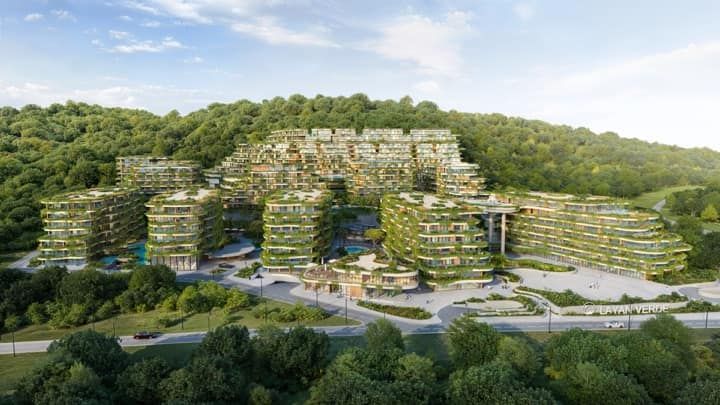
A hypothetical example, a composite; figures are illustrative except for price-list numbers. An investor from London read the headline “arrivals −4%” and writes to their agent: “Everything is falling right now, maybe wait a year?” They are looking at a phase 2 studio at Layan Green Park and at options in Layan Verde.
The agent broke the question into four steps. Step one — what exactly is falling. It is the overall flow of foreigners to Thailand, not prices in Layan; tourism revenue is falling less than the number of visits. Step two — prices. They checked the price list in the catalogue: a phase 2 studio costs 7,424,784 THB ($224,043), a Layan Verde studio 7,833,125 THB ($235,995), and a resale studio in the operating phase 1 of Layan Green Park starts from $142,602. Layan Verde handover is December 2028. The agent explained that the project price lists did not change during the week of news, and that “waiting” without a reason is a bet on an event that is not in the sources. Step three — yield. The project benchmark is about 8–10% net per year via the rental pool (60% of net profit to the owner, 40% to the management company) and a payback of around 12 years; the whole phase 1 price list at Layan Green Park consists of resales. That is a target, not a guarantee, and it is recalculated on occupancy data, not on headlines. Step four — documents and exchange rate. Request the draft contract, the payment schedule and the procedure for notifying schedule changes, and check the rate on transfer day.
Result: the investor did not change the decision because of the news but changed the order of actions — contract, exchange rate, a calculation for their own budget, and only then the decision. The lesson: national statistics are a reason to ask questions, not an answer. More on buyer mistakes is in common investor mistakes.
The week in summary. Arrivals to 10 October are about 23.94 million (−4.04%), revenue about 1.165 trillion baht (−2.47%). The Chinese surge has faded; the 33 million target needs an average of about 110,000 visitors a day over the remaining 82 days — a calculation, not a forecast. Flooding is receding (2.45 million affected on 13 October versus 3.14 million on the 11th), and Phuket does not appear in the reports. The IMF–World Bank meetings have taken place. To watch: the Bank of Thailand meeting on 28 October, new weekly ministry reports and the end of the flooding.
I will send the current price list, fresh rental pool occupancy figures and a yield calculation for your budget — leave a request or see the terms on the Layan Real Estate page. The commission is at market rate, with terms discussed at a meeting.
This material is for information only and is not legal, tax or investment advice. Figures are given from the sources as of the publication date; calculations marked as ours are estimates based on rounded data; forecasts remain forecasts. Verify current rules and figures at the time of the transaction.