Moving to Phuket with children is not the same as moving alone or as a couple. An adult needs a beach, internet and a lease; a child needs a school or nursery, a doctor who speaks a language they understand, a safe courtyard and a routine that holds up outside the high season too. The good news: the island has had a visible family community for years, and the infrastructure is there, from international schools to private hospitals with pediatrics. The bad news: it is scattered across the island, and Phuket’s roads do not forgive a wrong choice of area. This guide gives you the practical picture: what to look for by the child’s age, how to tie school, doctor and housing into one plan, how long the journeys really take, and which mistakes families make most often. Figures for Layan Verde and Layan Green Park come from our catalogue; everything else is a guideline you should verify on the ground.
Contents
- Where to start: school first, housing second
- Nurseries and early years
- Schools: what exists and where
- Pediatrics, hospitals and insurance
- Area and logistics: how long it really takes
- Family housing: condo, villa or condo-hotel
- Family budget: what it consists of
- Visas and documents for the family
- Traps
- Case: a family of three chooses an area
- Conclusion and next step
1. Where to start: school first, housing second
The typical family mistake is to buy or rent the home they like and look for a school afterwards. In Phuket the order is reversed. The reason is simple: the island stretches along the west coast, and tying your day to a school timetable turns every extra trip into a daily loss. If your child is of school age, the school shortlist is the first document in your folder. If the child is pre-school, the nursery and the pediatrician come first. If you only plan seasonal stays, the question shifts from school to how easily a child can be entertained in and around the condo.
A convenient sequence of decisions:
- The child’s age and length of stay (a season, half a year, permanent).
- School or nursery and a confirmed place (apply early; popular schools can have waiting lists).
- Pediatrician and insurance.
- Area and housing within a reasonable drive of the school.
- The family’s visa status for the chosen length of stay.
We covered schools in detail separately: international schools in Phuket. This guide takes a wider view of the family’s whole daily life.
2. Nurseries and early years
For children below school age the choice in Phuket is wider than it seems: nurseries attached to international schools, private English-language nurseries and local Thai kindergartens. The difference is not only the price but the language of the day, the schedule, and how the nursery fits your own work or holiday routine.
What to compare when choosing a nursery:
| Criterion | What to look at |
|---|---|
| Language | English, Thai or a bilingual programme, depending on your school plans |
| Schedule | Full day or half day; whether extended care is offered |
| Groups | Age and size of the group, ratio of staff to children |
| Safety | Yard, fencing, pick-up rules, CCTV |
| Distance | Minutes to your home on a weekday morning, not by a navigator on a Sunday |
| Flexibility | Whether you can take a place for a season rather than a school year |
A practical point: for a family arriving for the winter season, such nurseries are usually the only realistic option, because international schools are built around the academic year. We covered the seasonal format in wintering in Phuket.
For the very youngest, up to a year or two, what matters is not a nursery but access to a pediatrician and a safe environment near home. Here the complex’s infrastructure matters more: a pool with a shallow zone, shade, a playground, a lift and stroller access. According to the catalogue, Layan Green Park has a 171 m² kids’ club and a 347 m² playground, four freshwater pools and a free shuttle to the beach and Boat Avenue. For a family with a toddler these are small conveniences that add up to hours saved every week.
3. Schools: what exists and where
International education on the island is offered through British and international-type programmes (including IB). UWC Thailand and HeadStart operate in the Bang Tao–Cherng Talay zone; according to our catalogue it is 20–25 minutes by car from Layan Green Park. Kajonkiet International is in Kamala. The list and the availability of places change, so record them at the moment you apply, not from articles and forums.
Comparing approaches when choosing a programme:
| Programme | Best for | Keep in mind |
|---|---|---|
| British (IGCSE, A-Level) | Families aiming at UK and Commonwealth universities | A clear ladder of stages; transfers between schools are easier if you are already in this system |
| IB (PYP, MYP, Diploma) | Families with an international path who may move to another country | A broad profile, recognised by universities worldwide |
| Thai state school | Families staying in Thailand long term | Thai is the language of instruction, adaptation is needed; details are set by the Ministry of Education (obec.go.th) |
| Homeschooling or distance learning | Families with flexible schedules, seasonal stays | You must meet the requirements of the country where the child is formally enrolled |
What to do in practice: apply to 2–3 schools, take the level assessment, make a scouting trip, and only then confirm housing. A detailed relocation timeline with a child is in the article on international schools and in the 90-day relocation checklist.
One factor almost nobody mentions in advance is the bus. Many schools run bus routes, and that changes the picture sharply: if your area is on a route, the journey stops being your problem. Ask the school for a route map and pick-up times before you fix on an area.
4. Pediatrics, hospitals and insurance
Phuket has private international hospitals with pediatric departments. According to the catalogue, Bangkok Hospital Phuket is about 25 minutes by car from Layan Green Park. More on the healthcare system and choosing clinics is in healthcare in Phuket. Here is what matters specifically for a family with children.
1. Insurance. Private medicine in Thailand is built around paid services. For a family with a child it is sensible to have medical insurance and to check separately whether it covers outpatient pediatrician visits, hospitalisation, vaccination and emergency care; whether there is an annual limit and a deductible; and whether your chosen clinics accept the policy without prepayment.
2. Vaccination and prevention. The vaccination schedule and prevention guidance are published by the Department of Disease Control of Thailand’s Ministry of Public Health (ddc.moph.go.th). For a child moving from another country it helps to show the pediatrician the vaccination record and agree a schedule before departure. This is not medical advice, only a reminder: a doctor should lead the vaccination plan.
3. Typical childhood issues on the island. Heat and sunburn, stomach infections after street food and swimming, ear infections after the pool and sea, insect bites and skin irritations. A good pediatrician near your home matters more than ten extra minutes to the beach.
4. The road to the doctor. For a family with a baby it is critical that a hospital is reachable in reasonable time at any hour. 25 minutes on the highway at night is fine; in rainy rush hour or in a Bang Tao–Cherng Talay jam it is less so. Plan with a margin.
5. Pharmacies and medicines. In Thailand many drugs are sold without a prescription, but children’s dosages and interactions should be confirmed with a doctor, not a shop assistant. Do not buy what has not been prescribed.
In short, a family checklist should contain three numbers: the pediatrician, the emergency clinic and the insurer. They sit in both parents’ phones and with the nanny, if you have one.
5. Area and logistics: how long it really takes
Phuket’s west coast is a long ribbon with traffic jams on certain stretches, and in high season journey times easily double. So the “20 minutes” in the catalogue is a guideline, not a promise. Always test the route on a weekday morning, when you will actually be driving the child. For transport on the island see getting around Phuket.
Comparing areas for a family with children (a general picture, no price promises):
| Area | Pros for a family | Cons |
|---|---|---|
| Layan and Bang Tao | International school cluster nearby, quiet beaches, new complexes, a flow of residents rather than only tourists | Less “city” life; cafés and services often need a car |
| Kamala | Kajonkiet International in the area, calm atmosphere, beach and infrastructure | Different school logistics if the school is in Bang Tao |
| Rawai and Nai Harn | Local expat community, calm beaches | Farther from the northern school cluster |
| Patong | Developed infrastructure | Noisy tourist environment, little family calm |
| Centre, Phuket Town | State services, hospitals, schools | No beach nearby, more urban bustle |
More on areas: Bang Tao, Layan, Layan beach guide, Bang Tao vs Layan.
A simple logistics rule: the total journey time school–home–doctor–shop on a weekday should not exceed 45–60 minutes one way on your busiest day. If it comes out higher, you have chosen the wrong area.
The rainy season is a separate question. From May to October the sea can be rough, red flags fly on some beaches, and the family switches to the pool and indoor activities. More: the rainy season in Phuket. This is where pools, a gym and a kids’ club inside the complex help: the daily routine stays stable regardless of weather.
6. Family housing: condo, villa or condo-hotel
The type of housing for a family is decided not by a dream but by three prosaic things: floor area, safety for the child and how daily life is organised.
| Criterion | Condo / condo-hotel | Villa |
|---|---|---|
| Safety | Guarded grounds, concierge, key cards | Depends on the estate; a pool needs fencing |
| Space | Usually compact, with a lift | House and plot, but costlier to maintain |
| Service | Management company, cleaning, reception | You organise it yourself |
| Children’s facilities | Pools, kids’ club, playground in the complex | Your own playground and pool, personal responsibility |
| Pets | Depends on complex rules (not allowed in Layan Green Park) | Freedom, but also responsibility |
| Management | Easier to leave for the season: the complex is serviced | Slower and costlier to close up when you leave |
On choosing between formats: condo vs villa in Phuket and is a private pool villa worth it.
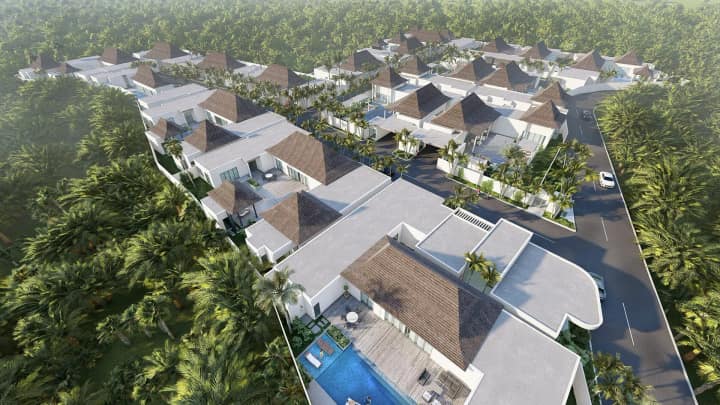
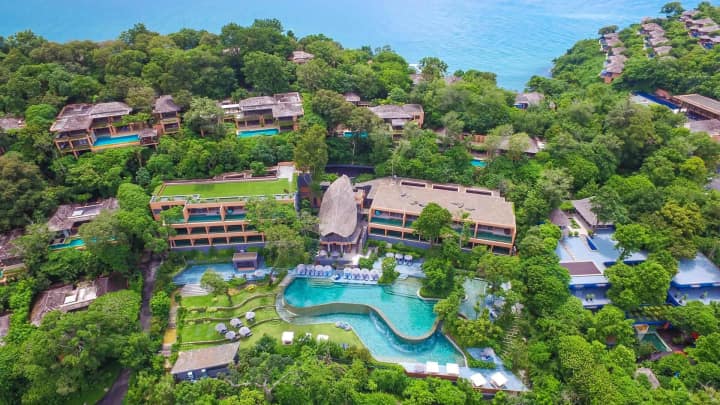
Layan Green Park. A complex 2 minutes by shuttle from Layan beach (about 700 m). Per the catalogue: four freshwater pools and a waterfall, a 253 m² gym, a 171 m² kids’ club and 347 m² playground, 24/7 concierge, security, CCTV and key cards, 108 parking spaces. Phase 2 studios start from $224,043 (7,424,784 THB); in the phase 1 resale market single lots are available from $142,602. This is a condo-hotel with a working rental model, with an important caveat: it does not replace a full home for permanent life with two children and a nanny. But as a base for a winter season and at the same time an investment earning through the rental pool, it works well. Detailed review: Layan Green Park review 2026. Project page: /projects/layan-green-park.
Layan Verde. An eco-quarter on 7.5 ha, 700 m from Layan beach, 774 residences, operated with Dusit International, completion December 2028. Prices start from $235,995 (7,833,125 THB); family units with several bedrooms are in the catalogue: premium 2- and 3-bedroom and luxury with private pools. For a family planning to move in a few years, the horizon is logical: by 2028 the child will already be at school and the home will be ready. Details: /projects/layan-verde and the Layan Verde review.
Income via the rental pool is a guideline of ~8–10% net per year to the owner (60% of the pool’s net profit, 40% to the management company), with payback of about 12 years. This is a target, not a guarantee. For a family living in the unit part of the year, remember that your own stay reduces rental time. The calculation is on the home page in the /#roi block.
7. Family budget: what it consists of
We do not publish exact prices for schools, nurseries and clinics here: tariffs change, and any figure in an article will be outdated before you apply. So below is the structure of the budget, and you plug in the numbers from school price lists and insurers.
| Item | What it includes | How to estimate |
|---|---|---|
| Housing | Rent or mortgage/instalment payments, utilities | The property price list; for our projects, CAM fee and sinking fund |
| Education | Registration fee, annual tuition, uniform, bus, clubs | The school’s current-year price list |
| Healthcare | Insurance, deductibles, vaccines, urgent visits | Policy terms and clinic tariffs |
| Transport | Car or scooter (a scooter with a child is a separate risk), taxi, driver | By actual logistics |
| Food and daily life | Groceries, ready meals, nanny | See cost of living and food costs in Phuket |
| Leisure | Clubs, camps, trips | By the child’s interests |
For owners of units in our projects, running costs are counted separately: in Layan Green Park the CAM fee is 75 THB/m² per month plus a one-off sinking fund of 650 THB/m²; in Layan Verde the CAM fee is 85 THB/m² per month and 850 THB/m² one-off. Details in CAM fee and sinking fund.
The principle: education and healthcare are costs you do not optimise through the price of housing. If the home is slightly farther but the school is 15 minutes closer, that is usually a win. Recalculate not “the cost per square metre” but “the cost of the family’s hour”.
8. Visas and documents for the family
A child’s visa status depends on the adult’s status and the chosen basis of stay. Visa types and requirements are published on the official e-Visa portal (thaievisa.go.th/visa-types); we do not replace it and do not promise the terms will not change. A practical order for a family:
- Determine the basis of stay for the adults (tourist, DTV, retirement, LTR and others).
- Find out how the child is included in that scheme and which documents are needed (birth certificate, notarised translations, proof of relationship).
- Check whether the school requires a separate visa basis for the child.
- Leave a time margin: document requests take time.
An overview of options: DTV visa, LTR visa and tax benefits, retirement visa. Important: a foreigner buying a condo does not by itself gain a right of residence; this is a separate question covered in the article on visas for property owners.
Other documents to collect before the move: a translated and certified birth certificate, the vaccination record, a reference from the previous school with grades and curricula, medical insurance, copies of passports. It is convenient to keep them in the cloud and in a paper folder at once.
This material is informational and is not legal advice. Check visa and school admission terms with official bodies and the schools themselves.
9. Traps
- Housing before school. You bought or rented a year ahead, and the right school has no places in the class. Fix: confirm the place before paying for housing.
- “Twenty minutes” by the navigator. The real morning journey in high season can be 1.5–2 times longer. Test the route at the right hour.
- A scooter with a child. The most common source of injuries for families on the island. For daily trips with children, a car or a driver is better.
- No insurance. One visit to a private hospital without a policy can cost more than the annual premium. Do not postpone.
- An unattended pool. There is security in the complex, but it does not replace a parent or nanny; small children need shallow zones and supervision.
- A pet in a project where pets are banned. Pets are not allowed in Layan Green Park; learn the rules before booking. On pets: pets in Phuket.
- Expecting “like home”. The school calendar, holidays and festivals differ; check the calendar of your chosen school.
- Buying for the “school cluster” without checking returns. If you buy as an investment, remember that a phase 1 resale in Layan Green Park is a ready unit with full payment, while Layan Verde completes in 2028. Check terms and timing against the current price list.
- Underestimating the rainy season. From May to October the sea can be rough; plan indoor activities.
- Myths about residency through property. Buying a unit is not the same as a residence permit; verify with official sources.
10. Case: a family of three chooses an area
An illustrative scenario, not a real client. A family of two adults and a 7-year-old plans to spend the winter (November–March) in Phuket and, later, to move for a longer period. One parent works remotely (remote work in Phuket).
Step 1. School. The family applies to two schools in the Bang Tao–Cherng Talay cluster, takes the level assessment and receives a confirmed place for the next academic year. For the winter they take a seasonal programme or a nursery/camp.
Step 2. Doctor and insurance. They arrange medical insurance for all three, choose a pediatrician and save the emergency clinic’s contact. Time to the hospital is up to 25 minutes.
Step 3. Area. They test the route “home — school — shop — clinic” on a weekday morning. They choose Layan–Bang Tao, with 20–25 minutes to school and the beach close.
Step 4. Housing. They rent a condo for the winter in a complex with a kids’ club and pools. In parallel they study purchase options: a ready unit through a phase 1 resale in Layan Green Park earning via the rental pool, or Layan Verde completing in 2028, a horizon by which the child is already settled in school.
Step 5. Outcome. After the winter the family decides whether the island suits permanent life. The purchase decision comes after the winter, not before: a condo-hotel does not have to be a home, and a rental pool investment is not an obligation to live there. Own-stay time and rental income are scheduled around the calendar.
The key takeaway: the order “school → doctor → area → housing” spared the family from redoing things. Housing became the last link, not the first.
11. Conclusion and next step
Phuket is a workable option for a family with children if you approach it systematically. Choose the school or nursery, secure a pediatrician and insurance, check the real journey, and only then fix an area and housing. For some it will be a seasonal rental, for others a purchase in Layan. If you look at property both as a home and as an asset, we can help match school logistics to the project format, explain the rental pool mechanics and show the current price list.
Layan Real Estate is the agency the group started from: we select property for the client’s brief, not for our own construction sites, and our building experience lets us vet other developers’ projects more strictly. Partner terms: market commission, conditions discussed at a meeting. More about the agency: /agency.
Next step: leave a request and we will prepare a shortlist of homes within 20–25 minutes of the school you need, calculate the budget and show current prices for Layan Verde and Layan Green Park. Return calculator: /#roi.
Related reading: Phuket relocation: 90-day checklist · living in Phuket: relocation · international schools · healthcare in Phuket.