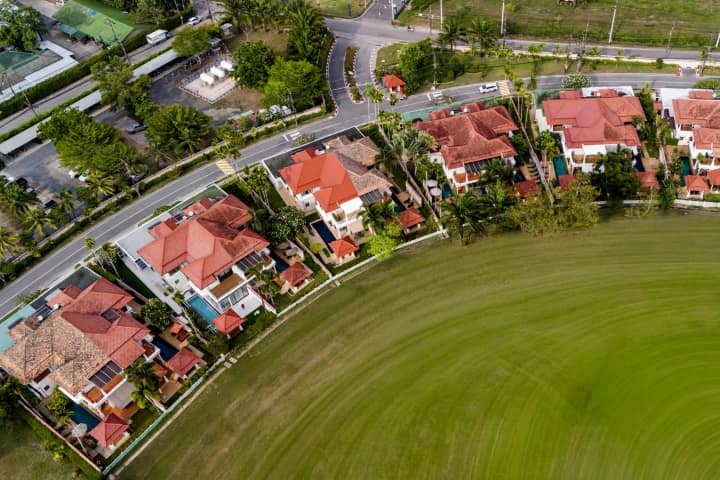
Moving to Phuket almost always looks the same in the daydream and completely different in practice. In the daydream there is a flight, a beach, a sunset and a new life. In practice there is a first week without a Thai SIM card, a second week in a hotel that cost more than planned, and a third week hunting for an apartment that every agent shows you using the same script. The good news is that newcomers’ mistakes repeat, which means they can be predicted and closed off in advance. Below is a step-by-step 90-day plan: what to do before you fly, how to spend the first two weeks, when to choose a district and sign a long lease, when to deal with banking, a driving licence, healthcare and tax, and — most importantly — how to reach the end of month three with a calm decision: keep renting, leave, or buy.
This is a practical plan, not a marketing brochure. Where numbers are needed we rely on our own materials and official sources, and where there is no data we say plainly: check it on the ground. If you want a general overview without a timeline, start with the Phuket relocation guide; if you are only coming for the season, start with the wintering guide.
Contents
- The 90-day logic: three stages instead of chaos
- Before you fly: visa, insurance, documents, money
- Days 1–14: landing and temporary housing
- Days 15–45: district and long-term lease
- Days 30–60: bank, transport, healthcare, schools
- Days 60–90: reporting, tax and budget
- Relocation budget: what to count
- Traps: where newcomers lose money and time
- Mini-case: a family of three, 90 days
- Rent or buy: the day-90 decision
1. The 90-day logic: three stages instead of chaos
The main source of relocation stress is trying to solve everything at once. Visa, housing, school, bank, driving licence, insurance, tax — this is not one list of thirty items but three different modes, each with its own priority.
- Stage “before departure” (4–8 weeks out). The goal is a lawful basis to stay in the country, insurance, and prepared documents and money. Anything that can be done from home gets done from home.
- Stage “landing” (days 1–45). The goal is to avoid expensive decisions. Temporary housing, a SIM, transport, first trips around the districts. No annual contracts and no purchases.
- Stage “settling” (days 45–90). The goal is to turn a trial stay into a stable routine: a long lease, bank, licence, doctor, school, immigration reporting — and only then a conversation about buying.
This sequence protects you from the costliest relocation mistake: choosing a district and a home from photographs rather than from real life in it. The island’s zoning is covered in detail in the Phuket districts map and the comparison of the west and east coasts.
| Stage | Timing | Main goal | What not to do |
|---|---|---|---|
| Preparation | −8…0 weeks | Visa, insurance, documents, money | Don’t book a year-long lease blind |
| Landing | days 1–45 | Temporary housing, SIM, district scouting | Don’t pay a large deposit or buy |
| Settling | days 45–90 | Lease, bank, licence, healthcare, reporting | Don’t postpone visa obligations |
| Decision | day 90 | Stay, change district or buy | Don’t decide on first-season emotion |
2. Before you fly: visa, insurance, documents, money
The visa is the foundation; everything else is built on it. The category you choose determines how long you can stay, whether you can work remotely and which documents are needed. For people who work for a foreign employer or run their own business, the DTV (Destination Thailand Visa) is the most commonly considered: a 10,000 THB fee, proof of 500,000 THB in funds, a 5-year validity with stays of up to 180 days per entry. Details and conditions are in our DTV guide and the article on Phuket for remote workers. High earners have the LTR programme (see the LTR guide), older applicants have retirement categories, and those who prefer a service-style option have Thailand Elite. Also factor in visa exemption: from 15 September 2026 it was cut from 60 to 30 days for citizens of most countries (more in our news piece on the visa-free cut), so “arrive and sort it out on the spot” without a visa no longer works. Always check the current list of categories on the official portal, thaievisa.go.th: Thailand changes the rules often, and any article, this one included, goes stale quickly.
This material is informational and is not legal advice. Make visa and tax decisions only after checking with official bodies or a licensed adviser.
Insurance. Private healthcare in Phuket is high quality but paid, and one serious bill can match the cost of your entire move. Some visas explicitly require a policy. The choice between a local Thai policy, an international expat policy and travel insurance is covered in the article on healthcare in Phuket: travel insurance works only for a transition period, not for permanent residence.
Documents. The minimum set: a passport with comfortable validity left, photographs, bank statements, proof of income or employment, an insurance policy, and proof of an address in Thailand for visa procedures (the first time this is usually a hotel booking). If you are coming with children, prepare birth certificates and school records — you will need them when choosing an international school. For documents issued abroad, check in advance whether translation or legalisation is required.
Money. A Thai bank account is not opened on day one and not at every bank: there is no single rule, and the decision is often made by the individual branch (see banks and connectivity in Phuket). So for the first weeks you live on money you brought or on foreign cards. Check your card’s withdrawal limits and fees in advance, keep a backup source of cash, and remember that the baht–dollar rate moves — our USD/THB overview helps you see how that affects your budget. Large transfers for a property purchase follow a separate procedure that documents the foreign currency — see FET in Thailand.
Before-departure checklist:
- Pick a visa category and apply through the official portal.
- Arrange insurance that fits the visa and the length of stay.
- Prepare documents and copies (paper and digital).
- Check bank cards, limits and a backup source of funds.
- Book temporary housing for 2–4 weeks with free cancellation.
- Settle the question of pets in advance: import and housing rules are in the article on pets in Phuket.
3. Days 1–14: landing and temporary housing
The first two weeks are for simple, reversible decisions. Your task is not to “settle in” but to check that your ideas about island life match reality.
SIM card and internet — on day one. Without a Thai number you cannot receive one-time codes from banks and many services. SIM registration rules for foreigners have tightened: no more than three SIMs per operator against an original passport, a tourist SIM works for a limited time (around 60 days without extension), and new cards go through verification. If you are staying longer, take a regular plan straight away. Details are in the article on banks and connectivity in Phuket.
Temporary housing. The best format is a hotel, aparthotel or short-term rental for 2–4 weeks in the district you want to test. It costs more than a long lease, but lets you switch district with no penalties. You will also see how the area lives on weekdays rather than in glossy photos. In parallel, read up on where to stay in Phuket.
Transport. The island is big, public transport is thin, and without understanding the logistics you will spend time and money on taxis. Options are compared in how to get around Phuket. A scooter looks like the simplest answer, but it is also the riskiest of everyday decisions; there is no such thing as riding without a licence and insurance and no questions asked (details in our driving licence guide).
District scouting. In the first two weeks visit at least three districts you are considering: the north (Layan, Bang Tao), the centre and west (Kamala, Surin), the south (Rawai, Nai Harn). Use Layan vs Bang Tao, Kamala vs Bang Tao and Surin vs Layan as comparisons. Drive the “home — school — clinic — supermarket” route at the hour you will actually drive it, not at 11 a.m. on a Sunday.
What to check in the first 14 days:
- how mobile coverage and internet work in your chosen district;
- how long the drive really takes to the airport, clinic and school;
- the noise level at night and in season;
- how alive the district is outside high season (restaurants, shops, services);
- the cost of a basic basket: food, utilities, transport — compare with the cost of living in Phuket.
4. Days 15–45: district and long-term lease
By the middle of the first month you should have two or three districts on the shortlist. The next step is to move from hotel living to a long lease, which is cheaper and closer to real life.
When to start. If you arrived in high season, good options go quickly, so start searching in the first days but sign only after you have seen the district in daily life. In low season (May–October) the tenant has more negotiating power, especially for terms of a year or more. Demand by month is covered in the article on rental seasonality.
What the term does. The longer the term, the lower the rate; the shorter, the more you pay for flexibility. Rentals shorter than 30 days fall under separate regulation, so for a relocator the norm becomes a 6–12-month contract. Details are in the long-term rental guide.
What to put in the contract. This is the most underrated document of your move. Check:
- the term and renewal procedure, and the rules for raising the rent;
- the deposit amount and conditions for its return;
- who pays utilities and at what tariff (see the utility bills article);
- early-exit terms and notice period;
- an inventory of furniture and appliances and a handover report with photos;
- who is responsible for repairs and air-conditioner servicing.
The full checklist for tenant and landlord is in the guide to rental contracts in Thailand. If you choose a condo in a complex, ask the management company about tenant rules, parking and the upkeep of common areas.
Price guide. According to our data (the wintering article), a studio or one-bedroom on the west coast averages $600–1,500 per month; the exact level depends on district, season and term. This is a guide, not a price list: check current offers on the ground and negotiate, especially in low season.
| Criterion | Short rental (1–3 months) | Long rental (6–12 months) |
|---|---|---|
| Monthly price | Higher | Lower, but with a deposit |
| Flexibility | Maximum | Limited by exit terms |
| Suited for | Scouting and wintering | Stable routine and school |
| Main risk | Overpaying | Getting the district wrong for a year |
5. Days 30–60: bank, transport, healthcare, schools
From the middle of the first month it is time to close the “long” everyday tasks that need time and queues.
Bank account. There is no single national rule: the Bank of Thailand sets the general framework for customer identification, and the bank itself makes the decision. They usually ask for a passport, visa, proof of address and sometimes proof of income or employment. If one branch refuses, another may agree — it does not mean you did anything wrong. For payments, keep working through foreign cards and apps for now; details are in the banking and internet article.
Transport and licence. If you stay for a season or longer, “driving on an international permit” stops being convenient. In 2025 the procedure for issuing licences to foreigners was tightened: an international permit is no longer accepted as a basis for a temporary Thai licence. Plan an in-person process: medical certificate, documents, test. It is all covered in the article on the driving licence in Thailand. Include the cost of ownership — fuel, insurance, tax, inspection, parking — in your budget; a monthly scooter rental runs roughly $60–100 including fuel.
Healthcare. Pick a clinic near home for everyday matters and a hospital for serious cases that you can reach in 20–30 minutes. Save the numbers in your phone and keep a copy of your policy in an app. An overview of clinics and how to choose is in the article on healthcare in Phuket.
School. If you are coming with children, this is the key point for choosing a district. Admission to international schools in Phuket takes time (documents, assessment, waiting for a place), so start early. Schools are concentrated in the centre and west; the Bang Tao–Cherng Talay cluster is convenient because there are several schools and all are close to Layan. Details are in the international schools guide, and we will cover everyday life with children in a separate article.
Home and routine. By the end of this stage you need a working kit: a Thai SIM, home internet, transport, a clinic, a grocery store and a few trusted contacts (a property manager, a handyman, a doctor). All of it can be assembled in 30 days if you do not try to solve everything in a single day.
6. Days 60–90: reporting, tax and budget
By the end of month two you are already living there rather than “having arrived”. It is time to close the formalities that pile up unnoticed.
Immigration notifications. A foreigner who stays in the country for more than 90 consecutive days must periodically notify the immigration service of their whereabouts (the so-called 90-day report). In parallel, the landlord or hotel must notify immigration of your residence at the address (form TM.30). If you live in rented housing, ask the owner to confirm they did it: confirmation is sometimes requested when a visa is extended. Check current forms and deadlines on the immigration service’s website or with an adviser — the rules change.
Tax residency. If you spend 180 days or more in Thailand in a calendar year, you become a tax resident. That affects how income is taxed, including income you receive from abroad. Plan your stay in advance and cross-check with our articles on tax residency, tax on foreign income and income tax rates. The official overview is on the Revenue Department website. None of this is tax advice: your situation needs a licensed professional.
Monthly budget. By month three you have real numbers: rent, utilities, food, transport, connectivity, insurance, school or children’s activities. Compare them with the original plan. If spending is higher, decide what to optimise (district, housing, transport) rather than simply endure it. For comparison with other cities see cost of living Phuket vs Bangkok.
Visa dates. Put into your calendar: the end date of your current stay, the date of the next notification, the insurance renewal date and the lease end date. Review them once a month.
7. Relocation budget: what to count
A relocator’s budget has three groups: one-off start-up costs, regular monthly expenses and a cushion for the unexpected. Specific numbers for your family depend on district, housing and lifestyle, so below is the structure rather than fixed figures.
| Item | Type | Comment |
|---|---|---|
| Visa and fees | One-off | For the DTV the fee is 10,000 THB; check current rates on the official portal |
| Proof of funds | Reserve | For the DTV — 500,000 THB in the account; it is your money, but it must be available |
| Insurance | Annual/monthly | Depends on age and coverage |
| Temporary housing | One-off | 2–4 weeks before signing a lease |
| Rental deposit | Refundable | Return terms are set in the contract |
| Rent | Monthly | Guide for the island’s west — $600–1,500 for a studio/1-bedroom |
| Utilities and connectivity | Monthly | Electricity and water at tariff, internet per plan |
| Food | Monthly | See food costs |
| Transport | Monthly | Scooter/car/taxi; see the getting-around guide |
| School/activities | Monthly/annual | International schools are paid |
| Reserve | Cushion | At least several months of expenses is recommended |
There are ready-made models for different profiles: a budget for one person, a family budget and living on $1,000 a month. Compare them with your plan and see where your scenario departs from the typical one.
Also account for exchange-rate risk: if your income is in dollars or euros and your spending is in baht, rate movements change your real budget in both directions. This is not a rate forecast, only a reminder to calculate your budget with a margin.
8. Traps: where newcomers lose money and time
- A year-long lease signed blind. Signed for 12 months from photos, realised after a month the district does not fit. Fix: 2–4 weeks of landing first, contract second.
- A large deposit with no inventory. No handover report means no way to prove the scratches predate you. Fix: a report, photos, move-in video.
- Relying on old visa information. Rules change; yesterday’s forum is not today’s law. Fix: the official portal and an adviser.
- Skipping notifications. Immigration reporting feels like a formality until it blocks an extension. Fix: a calendar and reminders.
- Riding without a licence and insurance. A scooter is the most common source of injuries and fines among newcomers. Fix: a lawful licence and insurance; see the licence article.
- Overestimating “cheap living”. Thailand is cheap at the street-food level, not at the level of Western comfort: an international school, air conditioning and insurance cost real money.
- Underestimating distances. The island is elongated, and the drive from a “cheap” district to a school or clinic can become an hour a day. Fix: time the route at the relevant hour.
- Buying in the first weeks. Buying property on first-season emotion is an expensive mistake. Fix: the 90-day rule and developer due diligence.
- Betting on “property = visa”. A purchase by itself does not give residence rights. More in the article on visas for property owners.
- Choosing from an advertising picture. Check against reality: Thailand property scams shows what aggressive selling looks like.
9. Mini-case: a family of three, 90 days
A hypothetical scenario (an illustration of the logic, not a real client story): a family of two adults and a school-age child arrives in November. One parent works remotely for a foreign employer and obtains a DTV; family insurance was arranged before departure.
- Days 1–14. An aparthotel in the north of the island, SIM and internet, trips to three districts (Layan, Bang Tao, Kamala). Routes to the school cluster checked at rush hour. Conclusion: the central west is convenient for school, the north for quiet.
- Days 15–45. Five long-lease options viewed, negotiation on a 9-month term, a handover report with photos. In parallel, documents submitted to an international school.
- Days 30–60. A bank account opened on the second attempt (a different branch), a Thai licence obtained after the medical certificate and test, a clinic near home chosen.
- Days 60–90. First immigration report, TM.30 notification checked, budget reconciled: actual spending was above plan on transport and below on food. A calendar with visa and insurance dates set up.
- Day 90. Decision: stay in the rental for another season and consider a purchase after a full “high — low season” cycle.
What matters here: the family made no irreversible decision before day 45 and by day 90 had enough data to choose between renting and buying consciously.
10. Rent or buy: the day-90 decision
By day ninety you have three options: keep renting, go home, or buy. Buying makes sense if you are sure of the district, plan to spend part of the year on the island for at least several years, and accept that property is not only a home but an asset with costs and taxes. If that is not you, renting remains the more flexible choice.
If you lean towards buying. Start with the buying process, the costs of buying and developer checks. For a foreigner the key topics are forms of ownership, the condo quota and taxes. No purchase gives residence rights by itself.
What our agency offers now. Layan Real Estate is a real estate agency covering all of Phuket; we select properties for the client’s brief rather than for a particular developer, which is exactly why we advise living in the district first. If the north-west suits you (see Layan and Bang Tao), two projects are worth a look:
| Project | Status | Price from | Key facts |
|---|---|---|---|
| Layan Verde | Under construction, completion December 2028 | $235,995 | ~700 m to Layan beach, construction-period instalments, rental pool |
| Layan Green Park | Phase 1 operating since 2024 (resale), phase 2 — completion 2026 | $142,602 (resale), $224,043 (phase 2) | EDGE certificate, ~2 minutes to Layan beach, resale — full payment |
Both projects offer a rental pool for rental income: the owner receives 60% of net profit, with a guide of ~8–10% net per year and payback of roughly 12 years — this is the programme’s target, not a guarantee. Before you run the numbers, check the ROI calculation method and the payback section. The differences between the projects are covered in Layan Verde vs Layan Green Park. Terms of working with an agent: market commission, terms discussed at a meeting.
Bottom line. Moving to Phuket is not one decision but a sequence of small, reversible steps. Ninety days is enough to travel from “I want” to “I know”: what suits you, what it costs, and whether it makes sense to tie capital to the island.
Want to talk through your scenario? Write to us on the agency page: we will suggest what to look at in a district, which questions to put to a developer and how to compare renting and buying in numbers — no obligation and no pressure.