Cyprus is a rare rival to Thailand in investor conversations, because it offers something Phuket simply cannot: EU membership, the euro instead of a developing-market currency, and freehold land ownership with no quota at all. Almost everything else runs the opposite way. Thailand is a resort island with a ready-made income model: flagship projects sell not just square metres but a rental pool with a fixed profit-split formula. Cyprus is an EU member with an English-law heritage (a former British colony) where a foreigner can own land and a house on it almost like a citizen, but buying an ordinary apartment does not turn itself into an income asset — the investor organises the yield alone, with no industry standard like Thailand’s 60/40. Add to that Cyprus’s residency-by-investment route, Category 6.2 — a deposit into property from €300,000, but no bank deposit — and the comparison plays out differently from previous pairs. We compare both markets using the same method — from entry price to currency risk — so the decision rests on the structure of 2026 rules rather than general impressions of “Cyprus means Europe” or “Thailand means cheap.”
Contents
- Two markets, two different points of entry
- Entry price and typical product
- Ownership structure for a foreigner
- Yield and rental management models
- Taxes and fees
- Category 6.2 vs Thai visas: two ways to get residency
- Currency, macro and political risk
- Infrastructure, logistics and quality of life
- Pitfalls
- Case: choosing between Category 6.2 and Phuket
1. Two markets, two different points of entry
Before comparing numbers, it is worth pinning down the difference in what a purchase actually accomplishes in each market.
- Cyprus. An independent republic and EU/eurozone member since 2004/2008, with a legal system rooted in English common law — a legacy of British colonial rule until 1960. This comparison covers only the recognised southern part of the island, the Republic of Cyprus; the north has been under Turkish administration since 1974, is unrecognised internationally (bar Turkey), and plays no part in the EU property market foreign investors actually buy into. The market centres on four cities: Limassol — the business and financial hub with the priciest property; Paphos — a resort and retirement-focused city in the southwest; Larnaca — a port city next to the main international airport; Nicosia — the inland capital. For many foreigners, Cyprus is first and foremost a residency route: Category 6.2 grants indefinite PR for a new-build property purchase from €300,000.
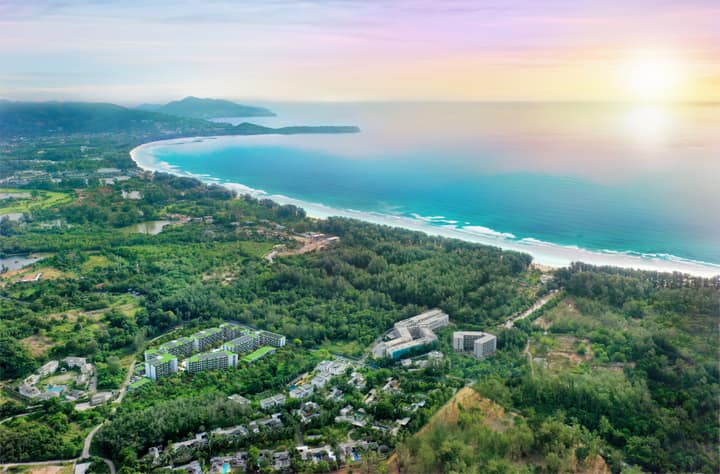
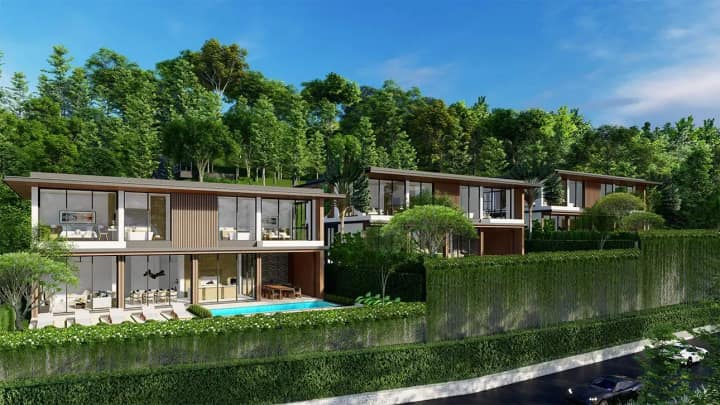
- Phuket (Thailand). An island where real estate is an established part of the tourism industry, and flagship projects sell a ready-made income model: a rental pool with a fixed payout formula. Basic ownership rules — a 49% freehold quota for condos, a 30-year leasehold for a villa on land — have not changed in decades.
The difference in what is actually on offer is the key point: Cyprus sells membership in the European legal and currency system plus near-unrestricted ownership rights, Thailand sells a narrower but deeply built-out resort income model. If you want to see how Phuket stacks up against other international markets, the same method is applied to other pairs in Thailand vs Dubai, Thailand vs Portugal and Thailand vs Malaysia. For where to start as an investor, see investing in Phuket.
2. Entry price and typical product
Cyprus is not, on paper, a cheap market — it is a developed EU economy, not an emerging resort — and the entry price reflects that difference in status rather than in the quality of any specific unit.
| Location | Price benchmark | Typical format |
|---|---|---|
| Paphos, Kato Paphos and town centre | €2,200–3,000 per m² | resale/new-build apartment |
| Larnaca, Limassol — typical coastal new-builds | €2,800–4,500 per m² | new apartment complex |
| Limassol, city average | ~€3,500 per m² | apartment |
| Limassol Marina (top location) | €7,500–12,000 per m² | premium residence |
| Cyprus national median (August 2026) | €3,857/m² (apartments), €3,584/m² (houses) | mixed market |
| Phuket — Layan Green Park, resale studio | $142,602 | ready unit, enters the rental pool immediately |
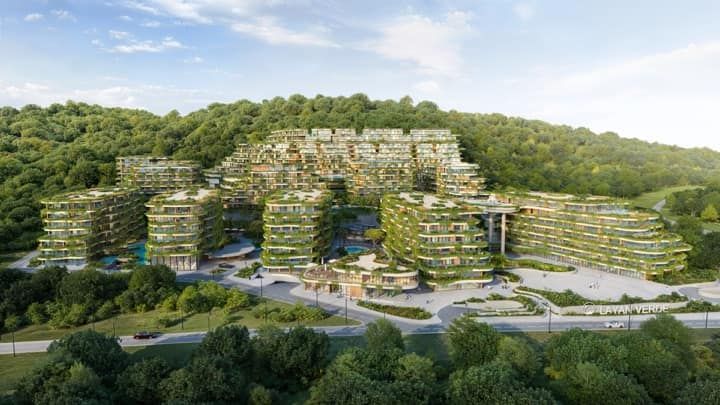
| Phuket — Layan Verde, launch pricing | $235,995 | off-plan, instalments through construction |
The Category 6.2 threshold (€300,000 + VAT) lands roughly in the lower-middle third of the Cyprus new-build market — a studio or small one-bedroom in Larnaca or Paphos, a modest apartment by Limassol standards. But it buys an ordinary EU primary-market apartment with no built-in rental model — any income you generate, you organise yourself: finding a tenant, negotiating price, tracking occupancy. The Thai price at $235,995 or $142,602 is a finished product with an income formula fixed in the management contract and, in Layan Green Park’s case, a working phase 1 that has been operating since 2024. The trade-off between “home for yourself” and “income asset” in Phuket is covered in off-plan vs ready property, and the yield-calculation method is in how to calculate ROI in Phuket.
One further detail: Category 6.2 only accepts new property bought directly from a developer that has never been previously owned or used. A Cyprus resale unit, even priced above €300,000, does not qualify for this residency route — a structural limit that is easy to overlook at the start of a search.
3. Ownership structure for a foreigner
This is the one area where Cyprus is structurally ahead of Thailand — and, unlike the Malaysia comparison, the gap here is even wider, because EU citizens face no restriction whatsoever.
Cyprus. EU citizens buy property in Cyprus with no restrictions at all — on the same terms as locals, including land, a house and any amount of area. Non-EU citizens (which includes holders of Russian, Ukrainian and most other non-EU passports, and post-Brexit UK citizens) need approval from the Council of Ministers — in practice a formality prepared by the District Administration where the property sits, under form COMM 145, with no fee. But there is a substantive limit here: one property (house, apartment or land plot) and no more than 4,000 m² of land underneath it. Title registration runs through a single Department of Lands and Surveys, with an independent market valuation used to calculate fees. In February 2026 the Ministry of Interior confirmed it is drafting revised ownership rules for non-EU buyers amid several parliamentary bills calling for tighter controls — the 2026 status quo is not guaranteed to hold into 2027.
Thailand. A foreigner can hold freehold title to a condominium within a quota — up to 49% of a building’s floor area may be owned directly by foreign buyers, registered through a single national Department of Lands. For a villa on land, only leasehold is available — a registered 30-year land lease with an established renewal practice, not freehold. Details are in leasehold vs freehold in Thailand; on why owning a villa through a Thai company is not a substitute for a proper leasehold and creates legal risk, see Thai company villa ownership.
| Criterion | Cyprus | Thailand |
|---|---|---|
| Freehold for an EU citizen | Unrestricted, including land | Not available at all — freehold only for condos |
| Freehold for a non-EU citizen | Yes, including land and a house — with Council of Ministers approval | Condos only, within a 49% building quota |
| Access restriction | One property, land capped at 4,000 m² (non-EU citizens) | Percentage of building floor area (condo) or leasehold (villa) |
| House on land for a foreigner | Available as freehold, with approval for non-EU buyers | Not available as freehold; only a 30-year land leasehold |
| Term of ownership | Perpetual (freehold) | Perpetual for freehold condos; 30 years + renewal for leasehold |
| Registrar | A single Department of Lands and Surveys | A single national Department of Lands |
Bottom line: on breadth of ownership rights, Cyprus goes further than even Malaysia — freehold is available with no percentage quota at all, and EU citizens need no special permission whatsoever. But that breadth, just as with Malaysia, does not settle the question of income from the asset — and that is exactly where the picture swings back toward Phuket.
4. Yield and rental management models
Here the gap favours Thailand, and it is structural: Cyprus simply has no industry equivalent of a rental pool.
Thailand. The main tool on Phuket’s flagship projects is a rental pool: same-type units are pooled together, a management company lets them out and distributes net profit by formula, typically 60% to the owner / 40% to the manager. At Layan Verde and Layan Green Park that targets roughly 8–10% net annually — a target figure backed by the working operation of Layan Green Park’s delivered phase 1 since 2024. More on the mechanics in Phuket rental management programmes.
Cyprus. There is no industry-wide standard comparable to Thailand’s 60/40 formula — management is overwhelmingly self-run or handled through a local real-estate agency, with no unified public payout formula and no occupancy guarantee. Per the RICS Cyprus Property Price Index with KPMG for Q1 2026, the national average gross apartment yield is around 5.44% a year. Limassol, the country’s most liquid rental market, averages around 6%, with pockets like the Tech Corridor and City of Dreams Mediterranean reaching 8.5%. Paphos long-term rentals are more modest at around 4%, but short-term holiday lets in coastal zones like Kato Paphos and the Universal area — helped by a 15% rise in winter airport capacity in 2026 — reach 9–17% gross. The key word is “gross”: that figure sits before income tax on rental income and any management-agency fee.
| Parameter | Cyprus (typical apartment) | Thailand (Phuket flagship pool) |
|---|---|---|
| Management model | Self-managed or local agency, no unified formula | Developer’s rental pool, 60/40 formula in the contract |
| Advertised yield | Gross ~4–6% on average, up to 8.5–17% in specific tourist pockets | Target ~8–10% net |
| Gross vs net | Gross — before tax and agency fees | Net — already after the manager’s share |
| Verifiable payout history | Case by case, per property and agent | Layan Green Park phase 1 pool has run since 2024 — verifiable history |
| Occupancy guarantee | Not typical; strong seasonality in tourist zones | Fixed by contract; occupancy risk sits with the manager within the pool |
Practical takeaway: the advertised 9–17% in Cyprus’s hot tourist pockets is a gross short-term-rental figure that requires active management, municipal short-term-letting licensing, and tolerance for seasonality — after tax and management costs, the net figure typically lands well below what’s advertised. The Thai figure is already net and requires no operational involvement from the owner. How seasons and occupancy work in Phuket is covered in rental seasons and occupancy.
5. Taxes and fees
Cyprus. New-build purchases carry VAT: a reduced 5% rate on the first 130 m² of area and the first €350,000 of value, provided total area stays under 190 m² and the full price under €475,000 (otherwise the whole amount is taxed at the standard 19% rate). For resale properties, transfer fees apply instead at the Department of Lands: 3% on the first €85,000 of market value, 5% on €85,001–170,000, and 8% above that — but a 50% discount applies on non-VAT transactions, making the effective rates 1.5% / 2.5% / 4%; VAT and full transfer fees are never both due on the same deal. As of January 1, 2026, stamp duty on the sale contract has been abolished entirely. There has been no annual property-ownership tax in Cyprus since 2017. On sale, Capital Gains Tax (CGT) applies at a flat 20% on the gain — the difference between the sale price and the indexed purchase cost — regardless of the seller’s tax residence; a once-in-a-lifetime exemption of up to €85,430 applies on a main-residence sale. An additional 0.4% Equal Distribution of Burdens levy applies to the transfer value. Rental income is taxed under Cyprus’s ordinary progressive income tax — a €22,000 annual tax-free allowance, then rates rising to 35% above €72,001; the Special Defence Contribution on rent, which previously added roughly 2.25% in effective tax, was abolished as of January 1, 2026, under the tax reform.
Thailand. The transfer fee at the Department of Lands runs around 2% of the assessed value, typically split with the seller by agreement. A sale within five years of ownership triggers a 3.3% specific business tax (SBT); after five years, a 0.5% stamp duty applies instead. Delivered projects carry a monthly CAM fee (85 THB/m² at Layan Verde, 75 THB/m² at Layan Green Park) and a one-off sinking fund (850 and 650 THB/m² respectively). The annual Land and Building Tax for residential property runs 0.02–0.3% of assessed (not market) value. Details are in property taxes in Thailand, capital gains tax in Thailand and sinking fund and CAM.
| Cost item | Cyprus | Thailand (Phuket) |
|---|---|---|
| Tax/fee on a new-build purchase | 5% VAT (within 130 m²/€350k, capped at 190 m²/€475k) or 19% | No VAT; off-plan pricing is already final |
| Fee on a resale purchase | 1.5–4% transfer fee on assessed value (50% discount) | ~2% transfer fee, split by agreement |
| Stamp duty on contract | Abolished from 01.01.2026 | Not a separate charge |
| Tax on sale | 20% CGT on gain, once-in-a-lifetime €85,430 main-residence relief + 0.4% levy | SBT 3.3% (<5 years) or 0.5% stamp duty (≥5 years) |
| Annual property tax | Abolished since 2017 | Land and Building Tax 0.02–0.3% of assessed value |
| Tax on rental income | Progressive income tax 0–35%; rental SDC abolished 01.01.2026 | Withholding at source, method depends on status |
| Management fees on common areas | Set individually per building, no Thai-style standard | CAM fee 75–85 THB/m²/month + sinking fund 650–850 THB/m² one-off |
Overall, Cyprus’s 2026 tax reform has meaningfully eased ownership — scrapping stamp duty and the rental SDC lowers the recurring burden, and the €85,430 relief softens CGT on a main-residence sale. But the base 20% CGT rate still exceeds Thailand’s SBT/stamp-duty combination, and income tax on rent up to 35% is noticeably heavier than Thailand’s source withholding. This material is not a substitute for advice from a tax professional in each jurisdiction.
6. Category 6.2 vs Thai visas: two ways to get residency
Cyprus. Category 6.2 (under Regulation 6(2) of the Aliens and Immigration Regulations) is a fast track to indefinite permanent residence:
| Parameter | Condition |
|---|---|
| Investment | From €300,000 + VAT in a NEW property bought directly from a developer (resale does not qualify) |
| Proven income | From €50,000/year from abroad + €15,000 for a spouse + €10,000 per child |
| Processing time | Around 6 months on the fast track (2026) |
| Validity | Indefinite, conditional on maintaining the investment |
| Presence requirement | Must take up residence within 1 year of approval; an absence over 2 years voids the status |
| Work/business | Not permitted — the status is for residence only, not employment in Cyprus |
The investment must be held for life: selling the property without a qualifying replacement revokes the PR. Holders must annually confirm the investment is maintained, hold valid health insurance and provide a clean criminal record certificate. It is important not to confuse PR with citizenship: Cyprus’s citizenship-by-investment programme (from €2 million) was shut down on November 1, 2020, following a corruption scandal — today the only route to a passport is standard naturalisation, requiring at least 7 years of cumulative legal residence within the preceding 10 years (plus the 12 months immediately before applying) and Greek at B1 level.
Thailand. Buying property has never granted a visa on its own — Thailand runs a separate line of instruments with no property-purchase requirement: LTR — a visa for wealthy residents, pensioners and remote professionals with tax breaks on foreign income (details in the LTR visa guide); the classic Non-O/O-A retirement visa; and DTV for remote work.
The key structural difference: Cyprus PR requires holding capital specifically in property — not a bank deposit like Malaysia’s MM2H, but a live asset that can be rented out. Yet the status is tightly bound to keeping that specific investment, and any attempt to cash out through a sale without buying a replacement costs the investor their residency. Thai visas create no such link: LTR grants its tax benefits regardless of whether the investor holds Phuket property for one year or five.
7. Currency, macro and political risk
Cyprus. The euro is a fully trusted currency issued by the European Central Bank; for a eurozone-based investor there is no currency risk at all, and for an investor with a different base currency (dollar, rouble, hryvnia), the euro remains one of the most liquid and predictable currencies in the world. EU and eurozone membership provides institutional stability: bank-deposit insurance up to €100,000 applies under a single EU-wide standard. Two specific risks stand out for 2026: first, the ownership-rules review announced by the Ministry of Interior in February 2026, which could tighten the current non-EU framework (one property, Council of Ministers approval) in the near future; second, materially stricter source-of-funds compliance for clients from the CIS when opening accounts and obtaining purchase approval, compared to a decade ago. Geography is worth clarifying separately: the political settlement of the island’s division (Turkish administration in the north since 1974) has no bearing on the recognised Republic of Cyprus property market in the south, where foreign buyers’ legal transactions actually take place.
Thailand. The Thai baht has historically been stable against the dollar, and Phuket’s flagship projects price and denominate yield directly in USD, removing part of the currency risk from the investor at the contract level. The island’s basic rules on ownership, rental and taxation have not changed in years; the one area regulators have focused on in 2025–2026 is nominee Thai companies used to circumvent land law (more in Thai company villa ownership).
| Risk factor | Cyprus | Thailand (Phuket) |
|---|---|---|
| Currency stability | Euro — issued by the ECB, fully convertible | Historically stable; flagship prices in USD |
| Pricing/rent currency | Euro | US dollar (for flagship projects) |
| Institutional protection | EU-standard deposit insurance up to €100,000 | National banking system with no EU-style guarantee |
| Main structural risk | Ownership-rule review for non-EU buyers from 2026 | Nominee Thai companies used to bypass land law |
Practical takeaway: currency and institutional risk in Cyprus sits below almost any market in Asia — a direct result of EU and eurozone membership. But 2026 specifically is the moment the regulatory framework for non-EU buyers may shift, and that deserves separate weight from currency stability in the decision.
8. Infrastructure, logistics and quality of life
- Airports and flights. Cyprus has two international airports — Larnaca (main) and Paphos — with direct flights across Europe and the Middle East, but no direct air links to most of Asia. Phuket has an international airport (HKT) with direct flights to Europe, Asia and the Middle East, 15–25 minutes from the west coast, including Layan and Bang Tao.
- Legal environment. Cypriot law is rooted in English common law — a legacy of British colonial rule — which noticeably simplifies due diligence for buyers from English-speaking and European jurisdictions: contracts, titles and court practice sit structurally closer to familiar Western standards than Thailand’s system.
- Language environment. English is effectively a second language in Cyprus’s business, banking and public services, thanks to the island’s British past — this lowers the adaptation barrier more sharply than in Thailand, though less than in Malaysia.
- Healthcare and schools. Cyprus runs the GESY universal insurance scheme alongside a developed network of private clinics and international schools at EU standard. Phuket has a network of private clinics (Bangkok Hospital Phuket) and international schools 20–25 minutes from most resort districts; on nominal healthcare standard, Cyprus’s EU-level system is formally higher, but on accessibility for foreigners Phuket does not fall behind.
- Climate and holiday format. Cyprus has a Mediterranean climate with mild winters and hot dry summers, with tourism seasonality more pronounced. Phuket has a year-round tropical climate with a distinct rainy season (May–October), which shapes rental demand differently than in the Mediterranean.
- Cost of daily life. As an EU country, Cyprus is noticeably pricier than Thailand on basic costs — from groceries to fuel and services — worth factoring into a living budget, not just a purchase budget.
9. Pitfalls
- Buying resale for Category 6.2. The programme only accepts new property bought directly from a developer that has never been previously owned or used — even a unit priced above €300,000 will not qualify if it is a resale.
- Assuming Cyprus PR grants Schengen access. Cyprus is in the EU but, as of 2026, not in the Schengen area — accession remains pending.
- Comparing Cyprus’s advertised 9–17% in tourist pockets directly with Thailand’s net yield. These are gross short-term-rental figures with strong seasonality and active management required — subtract tax and costs before comparing them with Phuket’s net ~8–10% rental pool.
- Not budgeting the “one property” cap for a non-EU buyer’s strategy. If the plan is to build a portfolio of several Cyprus units, the second and later properties need a separate structure (a company, for instance), not a repeat Council of Ministers approval for an individual.
- Ignoring the 2026 review of ownership rules. A revised framework for non-EU buyers is already being drafted by the Ministry of Interior — check the current version of the rules right before a deal, not last year’s materials.
- Confusing the reduced 5% VAT with an automatic discount. The rate only applies within 130 m² / €350,000, with an overall cap of 190 m² / €475,000 — exceeding either threshold pushes the entire amount to the standard 19%.
- Treating the 2026 abolition of rental SDC as the end of all tax on rental income. Ordinary progressive income tax on rental income (up to 35%) continues to apply in full.
10. Case: choosing between Category 6.2 and Phuket
An investor with a budget of around $350,000 was weighing Category 6.2: a new studio or small one-bedroom in Larnaca at €300,000 plus 5% VAT within the cap (roughly €315,000 in total cost) — nearly the entire budget went into the programme’s entry threshold, on top of the mandatory proven foreign income of at least €50,000/year, which has nothing to do with the purchase itself but is required for approval. Modelling expected returns through a local agency showed: the average gross rate across Larnaca’s new-build segment is around 5% a year, roughly €15,000 a year on a €300,000 property, of which — after progressive income tax (up to 35% on the excess bracket) and agency commission — noticeably less than half remained, an effective net yield of roughly 2.5–3% a year. In exchange, the investor gained indefinite family PR and the right to live in an EU country without an obligation to visit more than once a year.
The same $350,000 budget played out differently in Phuket: a $235,995 studio at Layan Verde (off-plan, instalments through construction, delivery in 2028) with capital left in reserve, or a ready $142,602 resale unit at Layan Green Park, which enters a working rental pool immediately, targeting roughly 8–10% net a year — freehold within the quota, no requirement for proven external income, and no risk of losing status by selling the asset. The investor ultimately split the task: part of the capital went into a ready income unit in Phuket for cash flow, while the question of European residency was set aside until it could be funded separately from the investment portion of the portfolio, without conflating an income asset with a visa instrument.
Conclusion. Cyprus and Thailand solve different problems, and in this pair the gap in Europe’s favour is wider than in the Malaysia comparison: freehold with no quota, the euro, EU membership and indefinite PR at a relatively accessible entry threshold by European standards. But that breadth of rights comes at the cost of yield — with no industry standard like a rental pool, a Cyprus apartment rarely becomes a genuinely passive asset, and a 20% capital gains tax plus income tax on rent up to 35% are noticeably heavier than Thailand’s fee structure. Phuket is the choice for investors who want a verifiable, USD-denominated net yield through a structured rental pool, even at the cost of narrower ownership rights. Many investors combine both tools: Phuket property for income, Cyprus PR for European residency, if that is needed separately from the investment goal. For a broader view, the same method is applied to other market pairs in Thailand vs Dubai, Thailand vs Portugal and Thailand vs Malaysia.
I can compare specific Phuket properties against your budget and goal, with a yield calculation in the ROI calculator — or we can talk strategy through Layan Real Estate. Our group’s own projects are Layan Verde and Layan Green Park.
Get a plan matched to your strategy
By submitting this form you agree to the privacy policy.
This material is for information purposes only and is not investment or legal advice. Category 6.2 terms, tax rates and property-ownership rules in Cyprus can change — confirm with accredited lawyers and tax advisors in each country at the time of your transaction. Figures on Cyprus are drawn from official sources (Cyprus’s Migration Department, Ministry of Interior and Tax Department — see “Sources”) and the RICS/KPMG index, and should be verified at the date of your deal.