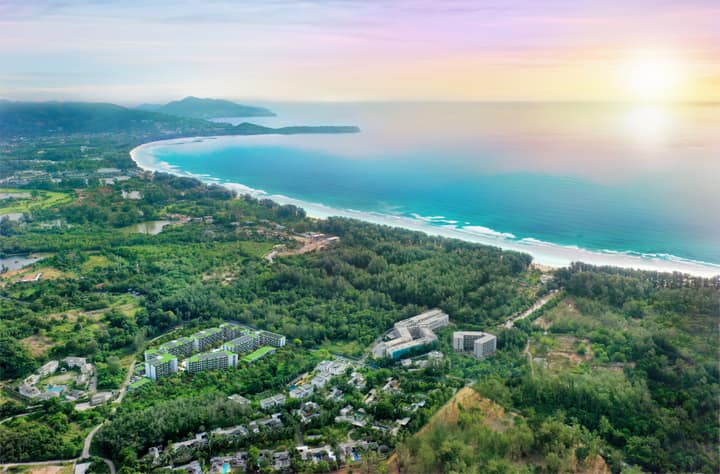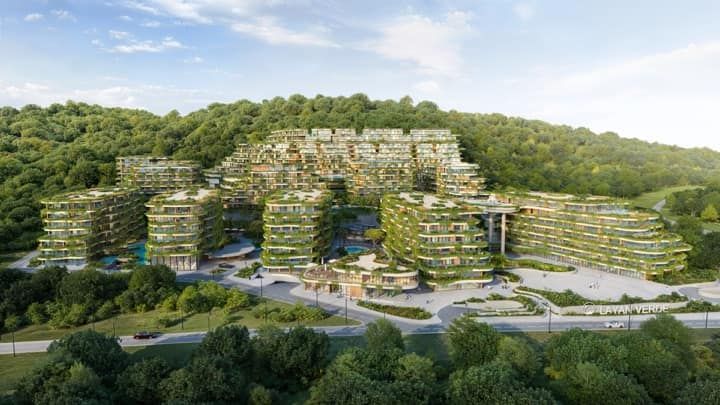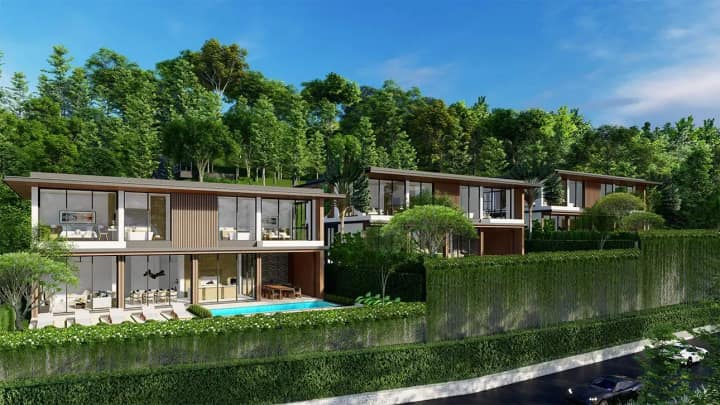
Da Nang is Vietnam’s third-largest city after Hanoi and Ho Chi Minh City, a resort showcase on the East (South China) Sea coast with My Khe Beach — once named by CNN as one of the most beautiful beaches on the planet. In recent years it has become a recurring alternative to Phuket in investor conversations, pitched with a low entry price, one of the region’s fastest-growing economies and a tourism boom. The differences show up as soon as you get into the details: in Vietnam a foreigner cannot own land in any form whatsoever, units are registered as a 50-year leasehold with non-automatic renewal, there is no industry-wide rental yield standard comparable to Thailand’s rental pool, and the dong has been weakening against the dollar for a fourth year running. We compare both markets on one methodology — from entry price to currency risk — so the decision rests on the actual rule structure of 2026, not on postcard photos of Da Nang’s waterfront or Patong.
Contents
- Two markets, two very different risk profiles
- Entry price and the typical product
- Ownership structure for a foreigner
- Yield and rental management models
- Taxes and fees
- Visas and residency
- Currency, macro and political risk
- Infrastructure, logistics and quality of life
- Traps
- Case: choosing between Da Nang and Phuket
1. Two markets, two very different risk profiles
Phuket and Da Nang are both resort cities riding growing tourist flows and foreign demand for real estate, but they grew out of fundamentally different legal systems and different economic cycles.
- Da Nang (Vietnam). A city of roughly 1.2 million people in central Vietnam, between Hanoi and Ho Chi Minh City, with its own international airport and a reputation — by local rankings — as Vietnam’s “most liveable” city. Its property market has been through a rough cycle: a condotel boom in 2016–2018, stagnation from 2019 driven by legal uncertainty over condotel and land status, and — with Housing Law No. 27/2023/QH15 and the 2024 Land Law now in force — a gradual clarification of the rules that is still unfolding in 2026.
- Phuket (Thailand). An island where real estate is an established part of the tourism industry, and the basic ownership rules have not changed in decades. A single national title registrar — the Department of Lands — has run the same scheme throughout: freehold within a 49% quota for condos, leasehold for a villa on land.
The gap in regulatory maturity here is the key point: Thailand’s foreign ownership system is settled and stable, while Vietnam’s is still being fine-tuned through implementing decrees and regulations, some of which, as of 2026, exist only as drafts rather than final documents. For how Phuket stacks up against other international markets, see our comparisons Thailand vs Dubai, Thailand vs Bali, Thailand vs Turkey, Thailand vs Portugal and Thailand vs Georgia, which apply the same method to other pairs.
2. Entry price and the typical product
On paper, Da Nang looks cheaper than Phuket per square metre in the mass segment, but the spread within the city itself is huge, and the product is often less transparent about build stage and legal status.
| Parameter | Da Nang (Vietnam) | Phuket (Thailand) |
|---|---|---|
| Typical format | Apartment in a condo tower or condotel, often with no unified rental model | Condo-hotel / residence in a rental pool |
| Price, $/sqm (mass segment) | ~$1,400–2,200 city average | Studio from $235,995 (construction-period instalments) |
| Top locations | My Khe waterfront — $2,800–4,000/sqm; central Hai Chau district — from $6,000/sqm | Finished resale unit at Layan Green Park — $142,602, enters the rental pool immediately |
| Budget segment | Outskirts (Lien Chieu, Cam Le) — $900–1,200/sqm | — |
| Price spread across the city | Over 5x between the outskirts and the centre | Moderate, tied to beach proximity and developer |
| Trend | Average primary price ~VND 83 million/sqm in Q1 2026 | Rises with construction progress of a specific project (Layan Verde studios climbed from $224,776 to $235,995) |
Da Nang sells a wide price spread per square metre — from $900 on the outskirts to $6,000+ downtown — which makes comparing a “city average” almost meaningless without naming the district. Phuket sells a narrower range of a finished resort product: a unit in a complex with its own infrastructure, where one developer controls construction and handover and a management company runs income through a transparent formula.
A particular feature of Da Nang is its condotel market, which went through a boom in 2016–2018 followed by stagnation: the legal status of a condotel (residential or commercial designation, entitlement to the “pink book” — the certificate of land-use rights) remained contested for years, and some projects from that wave never received clear title documents on their units. According to CBRE, the Da Nang condotel market is “cautiously” recovering in 2025–2026 amid a clearer legal framework, but most supply still comes from the secondary market rather than new developer launches. Phuket has never had a comparable episode of mass legal uncertainty over condotels — freehold/leasehold status has been fixed by the Department of Lands from the start of every deal. The method for calculating your own yield is covered in how to calculate ROI in Phuket; overall island price trends are in the 2026 price trends review.
3. Ownership structure for a foreigner
This is the section with the widest structural gap in the whole comparison — and it does not favour Da Nang.
Vietnam. A foreigner cannot own land in any form: all land in the country belongs to the state and the collective, with only usage rights granted over it. Under Housing Law No. 27/2023/QH15 (effective August 1, 2024), a foreign individual can buy an apartment only in a project officially approved for sale to foreigners, and only within a 30% quota of units per building (30% per block for a multi-block complex on a shared podium), or no more than 250 standalone houses per administrative unit comparable to a district. This is registered as a 50-year leasehold with the right to one renewal of another 50 years — up to 100 years of tenure in total — but the renewal is not automatic: the application must be filed in advance, the decision rests with the local administration, and without that step (or a sale before expiry) the unit reverts to the state. A standalone house or villa on land is simply not available to a foreigner — apartments in approved projects only.
Thailand. A foreigner can own a condominium unit as freehold within a quota — up to 49% of a building’s floor area can be held directly by foreign owners, registered through the Department of Lands nationwide, with no time limit at all. For a villa on land, leasehold is available — a registrable 30-year land lease with an established renewal practice. Details in leasehold vs freehold in Thailand; on why owning a villa through a Thai company is not a substitute for a proper leasehold and creates legal risk, see villa ownership through a Thai company.
| Criterion | Vietnam | Thailand |
|---|---|---|
| Land rights for a foreigner | None whatsoever | Not required for a condo; leasehold for a villa |
| Apartment rights | 50-year leasehold + one renewal of up to 50 years (not automatic) | Freehold — title with no expiry, within a 49% quota |
| Building quota | 30% of units per building/block | 49% of building floor area |
| House on land for a foreigner | Not available | 30-year land leasehold with renewal |
| List of approved projects | Mandatory — not every new development qualifies | Not required; regulated at the quota level nationwide |
| Registrar | Local provincial/city administration | Department of Lands (single national registry) |
Bottom line: Thai condo freehold is title with no expiry risk at all, while a Vietnamese leasehold is an asset with a built-in deadline and a renewal procedure that depends on a decision by local officials. This is not a minor footnote — it is a difference in the very nature of the asset: one is real property in the ordinary sense, the other is a long-term usage right with an end date.
4. Yield and rental management models
This is where the gap is most tangible in practice, and it is directly downstream of the legal maturity gap in section 3.
Thailand. The core instrument at flagship projects is the rental pool: identical units are pooled together, a management company rents them out and distributes net profit under a formula, typically 60% to the owner / 40% to the operator. At Layan Verde and Layan Green Park this targets ~8–10% net annual yield — a target figure backed by the working operation of Layan Green Park’s completed phase 1 since 2024. The mechanics are covered in the Phuket rental programmes review.
Vietnam. There is no industry-wide standard comparable to Thailand’s fixed, publicly stated 60/40 formula. According to Savills and CBRE, Da Nang apartments target roughly 6–8% annual yield under self-management or a local management company, without a single industry-wide distribution formula. Separately, part of the 2016–2018 condotel wave offered developer-backed “guaranteed yield” schemes — a mechanism much like the one described for Batumi in Thailand vs Georgia: the obligation is backed by the specific developer’s financial strength, not by law. When the condotel market stalled in 2019, some of these guarantees stopped being paid, which was one driver of the segment’s multi-year stagnation.
| Parameter | Thailand (flagship pool) | Vietnam (typical Da Nang unit) |
|---|---|---|
| Management model | Developer-run rental pool | Self-managed or local management company, no unified formula |
| Distribution formula | 60% owner / 40% operator, fixed in the contract | Individual terms, often without a clear calculation |
| Advertised yield | Target of ~8–10% net | ~6–8% annual per Savills/CBRE estimate (apartments) |
| Guaranteed yield at some condotels | Not typical at flagship projects | Common in 2016–2018; some programmes stopped paying in 2019 |
| Legal backing of the obligation | A contract with a working pool’s payment history | Equal to the specific developer’s financial strength |
Practical takeaway: at Phuket, yield is usually a formula in a contract with the developer’s management company, backed by a verifiable payment history across several seasons. In Da Nang, an attractive percentage in a developer’s pitch deck deserves the same scrutiny as any other “guarantee” in a developing market — and it’s worth remembering that the city’s condotel market has already been through a trust crisis caused by exactly this kind of promise.
5. Taxes and fees
Vietnam. An individual’s rental income is not taxed at all if the annual amount is below VND 100 million (roughly $3,800–4,000 at 2026 exchange rates). Above that threshold, a flat 5% VAT plus 5% personal income tax — 10% of gross revenue combined — applies with no deductions, and the rule is the same for residents and non-residents. As of January 1, 2026, the separate business licence fee (previously a fixed amount tiered by income bracket) was abolished, simplifying the scheme to just these two rates. On sale, an individual owner pays a separate 2% tax on the transaction amount (the higher of the contract price or the state-assessed valuation) — not on profit, but on the full sale amount, regardless of holding period, even on a loss-making sale. There is no separate annual property ownership tax in Vietnam as of 2026, though a nationwide property tax has been under discussion by the authorities for years.
Thailand. A transfer fee at the Department of Lands on each sale (split with the seller by agreement), rental income tax typically withheld at source for a non-resident, capital gains tax and a specific business tax on sales within five years of ownership. At finished projects there is a monthly CAM fee (85 THB/sqm at Layan Verde, 75 THB/sqm at Layan Green Park) and a one-off sinking fund (850 and 650 THB/sqm respectively). Details in property taxes in Thailand and sinking fund and CAM explained.
| Cost item | Vietnam | Thailand (Phuket) |
|---|---|---|
| Rental income tax | 0% below VND 100m/year; above it, 10% of gross revenue (5% VAT + 5% PIT) | Withheld at source for a non-resident |
| Tax on sale | 2% of the transaction amount, regardless of profit or holding period | Capital gains tax + specific business tax on sales within 5 years |
| Annual property tax | Does not exist as of 2026 (a draft is under discussion) | No separate ownership tax (aside from CAM/sinking fund) |
| Common areas / repair fund | Not standardised — depends on the specific complex | CAM fee + sinking fund, known upfront from the price list |
| Rental business licence fee | Abolished as of 01.01.2026 | Not applicable under this model |
Vietnam’s scheme looks simpler on paper for a small income — the VND 100 million threshold exempts a large share of private landlords from tax entirely. But the 2% tax on the full sale amount rather than on profit is a risk that shows up precisely on an unfavourable deal: the seller pays a fixed percentage even on a loss-making sale, whereas Thailand’s system is tied to an actual increase in value.
6. Visas and residency
Vietnam. Since August 2023, an e-visa has been available to citizens of every country and territory: stays of up to 90 days, with single entry ($25) or multiple entry ($50), processed in 3–5 business days through the official portal evisa.xuatnhapcanh.gov.vn, with entry through any of 83 checkpoints. An e-visa cannot be extended from inside the country — once it expires, you must physically leave Vietnam. There is no “residency through a property purchase” visa route in Vietnam at all: buying an apartment by itself grants no right to long-term stay, and long-term visas for investors and retirees are structured differently and are less standardised than in many other Southeast Asian countries.
Thailand. Buying a condo or villa has never granted a visa by itself — a separate line-up of instruments is used instead: LTR, for wealthy residents, pensioners and remote professionals with tax benefits on foreign income (details in our LTR visa review); DTV, a 5-year visa for “digital nomads” (more in our Destination Thailand Visa review); and the classic Non-O/O-A retirement visa. Thai citizenship through investment is not provided for by law.
| Parameter | Vietnam | Thailand |
|---|---|---|
| Visa-free / e-visa entry | E-visa up to 90 days, single or multiple entry, for every country | Depends on nationality, usually shorter without a visa |
| Extension from inside the country | Not possible for an e-visa | Possible for several visa types (LTR, Non-O) |
| Residency through buying a home | Not provided for | No such route exists directly |
| Dedicated visas for residents/investors | Less standardised than Thailand’s | LTR, DTV, Non-O/O-A — a separate, mature product line |
| Citizenship through investment | Not provided for | Not provided for |
Practical takeaway: neither country offers a visa “through a property purchase,” but Thailand’s set of long-term visas for residents and investors is noticeably more mature and predictable — LTR and DTV have run on clearly defined criteria for several years, while in Vietnam comparable products for foreigners remain less formalised, and the base instrument stays a 90-day e-visa with no in-country extension.
7. Currency, macro and political risk
Vietnam. The dong (VND) trades under a managed float that the State Bank of Vietnam (SBV) regularly adjusts through interventions. In practice that means not a one-off shock but ongoing, creeping depreciation: 2025 marked the fourth consecutive year of the dong weakening against the dollar, losing roughly 3.4–4% year-to-date and hitting a record low of around VND 26,436 per dollar in August 2025. Forecasts for 2026 (including from UOB) pencil in further gradual weakening with a possible correction in the first quarter. For an owner of a dong-denominated asset, this is a built-in and predictably recurring risk rather than a one-time event. Vietnam’s economy, meanwhile, is growing at historically fast rates, which partly offsets the currency risk through rising local-currency asset values — but not automatically in dollar terms.
Thailand. The Thai baht has historically been stable against the dollar, and Phuket’s flagship projects price and yield in dollars, removing part of the currency risk from the investor at the contract level. The basic rules of ownership, rental and taxation on the island have not changed in years; the one area of active regulatory attention in 2025–2026 is nominee Thai companies used to circumvent land law (more in villa ownership through a Thai company).
| Risk factor | Vietnam | Thailand (Phuket) |
|---|---|---|
| Currency stability | Dong weakening against the dollar for a 4th straight year, record low in 2025 | Baht relatively stable against the dollar; flagship prices in USD |
| Nature of the risk | Managed but continuous creeping depreciation | Markedly smaller swings with no pronounced trend |
| Regulatory maturity | Still being fine-tuned: the 2023 Housing Law and 2024 Land Law are still being implemented | Basic rules unchanged for years |
| Main structural risk | Incomplete enforcement practice for new laws | Nominee Thai companies circumventing land law |
Practical takeaway: an investor choosing Da Nang should build into the model not a one-off devaluation but a systemic, multi-year depreciation trend — and should evaluate the asset’s yield in dollars over the long horizon rather than in nominal dong.
8. Infrastructure, logistics and quality of life
- Airports and flights. Phuket has an international airport (HKT) with direct flights to Europe, Asia and the Middle East, 15–25 minutes from the west coast, including Layan and Bang Tao. Da Nang also has its own international airport with a growing number of direct East Asian routes, but the choice of long-haul flights to Europe and the Middle East is noticeably narrower than Phuket’s — many routes connect through Hanoi or Ho Chi Minh City.
- Resort season. Phuket runs on a year-round tourist flow with a clear high/low season split driven by rainfall. Da Nang sits in a zone exposed to tropical typhoons from September to November, which periodically disrupts both tourist flow and construction schedules.
- Beach and sea. My Khe Beach in Da Nang is one of Vietnam’s best-known beaches — sandy and long. Phuket’s beaches sit on the Andaman Sea with turquoise water in the dry season and greater variety in character, from bustling Patong to quiet Layan.
- Healthcare and schools. Phuket has a network of international-standard private clinics (Bangkok Hospital Phuket) and international schools within 20–25 minutes of most resort areas. In Da Nang, international infrastructure for families with children is developing but still lags Phuket — and Bangkok even more so — in density and brand recognition.
- Cost of everyday life. Vietnam is generally cheaper than Thailand on basic day-to-day expenses, but that gap is gradually narrowing as the country’s economy grows and local inflation persists.
9. Traps
- Forgetting that land is not for sale at all. In Vietnam, a foreigner gains no land rights in any form — this is not “a shorter leasehold” but a fundamentally different type of asset than even a villa on leasehold land in Thailand.
- Not checking whether a project is on the approved list for foreigners. The 30% quota and the right to buy apply only in specially approved projects, not in any new development — the status needs documented confirmation before a reservation.
- Putting off leasehold renewal “for later.” The additional 50-year renewal is not automatic and requires an advance application; missing the deadline means losing the asset to the state.
- Believing a condotel’s “guaranteed yield” without checking the developer’s track record. Exactly these kinds of promises stopped being honoured en masse after 2019 — a specific management company’s track record matters more than the pitch deck.
- Treating the 2% sale tax as “small” because it isn’t a profit tax. It is a tax on the full transaction amount — it is still due even on a loss-making or break-even sale.
- Planning yield in dong and never converting to dollars. The dong’s ongoing depreciation eats into nominal yield once converted to hard currency — model it in dollars over the long horizon.
- Underestimating typhoon season when planning construction and stays. September–November in Da Nang is a period of elevated storm risk worth factoring into both a construction schedule and your own travel calendar.
10. Case: choosing between Da Nang and Phuket
An investor with a budget of around $200,000 was looking at a condotel on the Da Nang waterfront in 2023: the appeal was a price of roughly $1,500 per square metre and a developer-promised “guaranteed yield” of 8–10% a year. Returning to the numbers in 2026, the picture looked different: a chunk of the market’s guaranteed-yield programmes had already stopped paying out back in 2019, the “pink book” status on his particular project’s units was never finalised due to the incomplete legal framework of that period, and the dong had lost roughly 10–12% against the dollar cumulatively over that stretch — so the nominal local-currency yield turned out to be noticeably more modest once converted to dollars.
A studio at Layan Green Park near Layan Beach, by contrast, entered a working rental pool immediately with a 60/40 formula and a target of ~8–10% net in dollars, freehold was registered within the quota with no expiry risk, and the deal terms and ownership rules had not changed since the purchase date. The investor chose Phuket — not because Da Nang had become a bad place for a holiday, but because they were looking for an asset with no built-in deadline and a verifiable income formula in hard currency, not the lowest price per square metre today.
Bottom line. Vietnam and Thailand suit different risk profiles. Da Nang offers entry at a low price per square metre into one of the region’s fastest-growing economies, but in exchange comes an asset with no land rights, a leasehold with non-automatic renewal, a market with no unified yield standard, and a currency on a multi-year weakening trend. Phuket is the choice for those who value predictable dollar yield, freehold with no expiry date, and rules that have stayed stable for years. For a broader look at how Phuket compares internationally, see Thailand vs Dubai, Thailand vs Bali, Thailand vs Turkey, Thailand vs Portugal and Thailand vs Georgia, which apply the same method to other market pairs.
I can help compare specific properties on Phuket for your budget and goals, with a yield estimate from the ROI calculator — or we can discuss strategy through Layan Real Estate. Our group’s own projects are Layan Verde and Layan Green Park.
Get a match for your strategy
By submitting this form, you agree to our privacy policy.